
Car ABS Module Diagnostics & Repair in Daytona Beach, FL
The ABS module is the electronic control center for your vehicle's Anti-lock Braking System. It monitors wheel-speed information and other inputs, detects conditions that could cause wheel lockup, and commands the ABS hydraulic system when intervention is needed.
When an ABS warning light comes on, however, the ABS module should not automatically be replaced. Wheel speed sensors, wiring, power and ground circuits, wheel bearings, hydraulic components, communication problems, and other faults can all set ABS trouble codes.
Jimmy’s Mobile Care provides car ABS module diagnostics and repair in Daytona Beach, FL. We scan the ABS system, retrieve fault information, evaluate the relevant circuits and components, and determine whether the ABS control module itself is actually responsible.
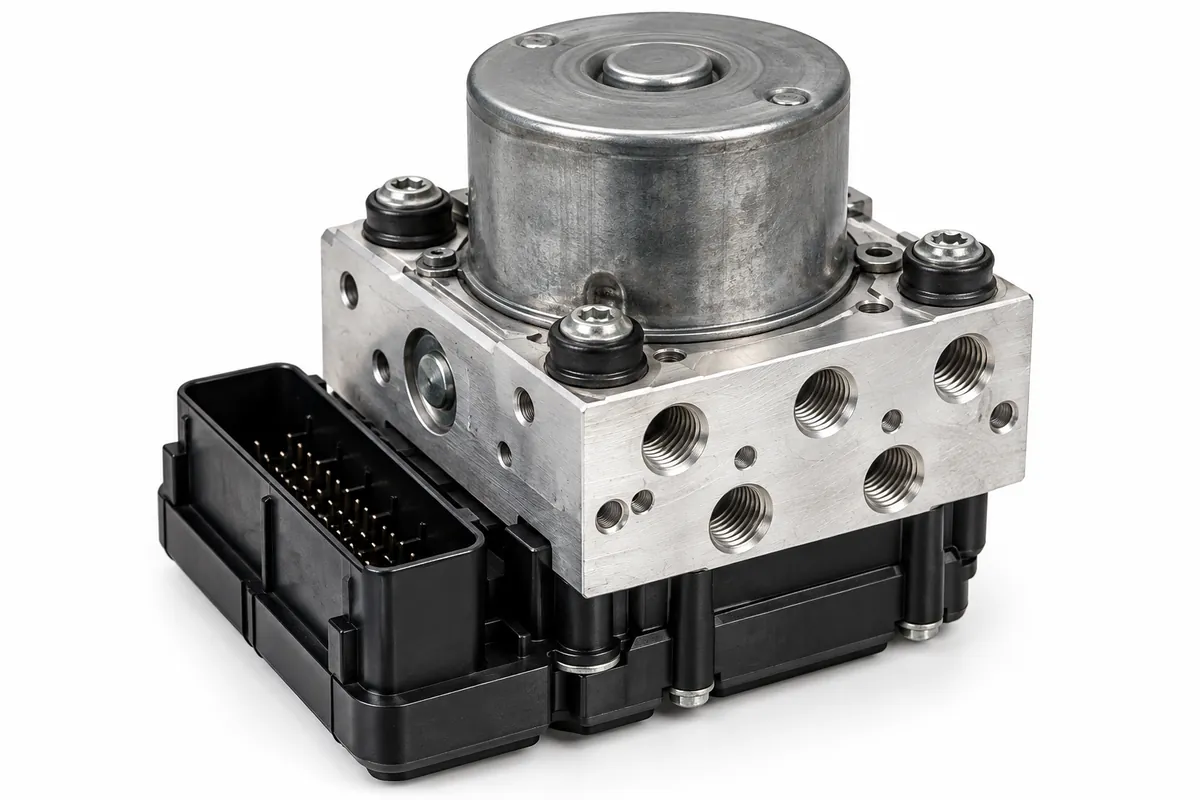
Mobile ABS Module Diagnostics in Daytona Beach
ABS diagnosis is different from simply reading a generic engine code.
The ABS system has its own control electronics and diagnostic trouble codes. Proper diagnosis begins by communicating with the ABS controller and determining what the module is reporting.
Depending on the vehicle and fault, diagnosis can include:
- ABS warning-light diagnosis
- ABS trouble-code retrieval
- ABS module communication testing
- Module power and ground checks
- Wheel speed sensor data
- Individual wheel-speed comparison
- Wiring and connector inspection
- ABS pump and hydraulic-unit evaluation
- Network communication diagnosis
- Related fuse and relay checks
- Module output and functional testing where supported
- Determining whether programming or initialization is required
The objective is to identify the fault before replacing an expensive ABS component.
What Is an ABS Control Module?
The ABS module, also called an ABS control module, is an electronic controller.
It receives information from wheel speed sensors and other vehicle systems and uses that information to determine when ABS intervention is required.
During normal braking, the conventional hydraulic braking system performs most of the work.
During a wheel-lock condition, the ABS controller can command the hydraulic system to rapidly adjust brake pressure at individual wheels.
That allows the tire to regain rotation rather than remaining locked while the vehicle is moving.
What the ABS Module Controls
Although system design varies by vehicle, the ABS controller can interact with:
- Wheel speed sensors
- ABS hydraulic valves
- ABS pump motor
- Brake pedal or brake switch information
- Steering and stability-control systems
- Traction-control functions
- Engine and transmission controllers
- Instrument cluster
- Vehicle communication networks
On vehicles where ABS, traction control, and electronic stability control share components, one fault can illuminate several warning lights.
That does not necessarily mean several systems failed independently.
They may all be responding to the same underlying ABS-related fault.
ABS Module vs. ABS Pump
The ABS control module and ABS pump have different jobs.
The control module is primarily electronic. It processes information and commands the system.
The pump is part of the hydraulic side of ABS operation. It helps manage brake-fluid pressure during ABS intervention.
On some vehicles, the electronic module, hydraulic valve body, and pump are assembled closely together and may be serviced as a combined unit.
On others, portions can be diagnosed or serviced separately.
That's why an “ABS module problem” should not automatically be treated as an “ABS pump problem,” or vice versa.
ABS Module vs. Hydraulic Control Unit
The hydraulic control unit contains the valves and hydraulic passages used to regulate brake pressure during ABS operation.
The electronic ABS controller commands those functions.
Depending on the vehicle, you may encounter terminology such as:
- ABS module
- ABS control module
- ABS control unit
- ABS hydraulic control unit
- Hydraulic control unit
- ABS actuator
- ABS pump assembly
These names sometimes describe separate components and sometimes describe portions of an integrated assembly.
We identify the actual system configuration before determining what needs repair.
Why Is My ABS Light On?
An illuminated ABS warning light means the system has detected a fault.
It does not specifically mean that the ABS module has failed.
Possible causes include:
- Failed wheel speed sensor
- Damaged wheel speed sensor wiring
- Connector problems
- Wheel bearing or encoder problems
- Low system voltage
- Blown fuse
- Power or ground circuit failure
- ABS pump problem
- Hydraulic-unit fault
- Internal ABS module fault
- Vehicle-network communication problem
Reading the stored ABS trouble codes gives us a starting point, but the code still needs to be interpreted correctly.
ABS Trouble Code Diagnostics
ABS diagnostic trouble codes identify the circuit, signal, communication path, or function where the controller detected a problem.
A trouble code is diagnostic information, not necessarily the name of the part that should be replaced.
For example, a wheel-speed-related code can be caused by the sensor itself, but it can also involve:
- Sensor wiring
- Connector damage
- Excessive sensor gap
- Damaged tone ring or encoder
- Wheel bearing problems
- Power or ground problems
- Signal circuit faults
Likewise, an ABS module communication code doesn't automatically prove that the module is defective.
The electrical circuits allowing the module to operate and communicate need to be considered first.
ABS Module Communication Testing
One important diagnostic distinction is whether a scan tool can communicate with the ABS controller.
If other vehicle modules communicate normally but the ABS module does not, the next step is not necessarily immediate module replacement.
The ABS controller requires proper:
- Battery voltage
- Ignition power
- Ground
- Communication circuits
If one of those is missing, a perfectly good module may appear dead to the diagnostic equipment.
We evaluate the supporting circuits before determining that an internally failed module is responsible for the no-communication condition.
ABS Module Power and Ground Testing
Electronic control modules cannot operate without stable electrical power and ground.
If the ABS module is offline or behaving abnormally, its electrical supply becomes part of the diagnosis.
Depending on the vehicle, this may involve checking:
- ABS fuses
- Relevant relays
- Battery voltage
- Ignition feeds
- Constant power circuits
- Ground circuits
- Voltage at the module
- Connector condition
A blown fuse or damaged power circuit can disable the ABS controller without any internal module failure.
ABS Fuses and Relays
ABS systems can use multiple high-current and low-current electrical circuits.
The hydraulic pump motor, control electronics, and other portions of the system may not all receive power through the same circuit.
A fuse inspection therefore needs to consider the actual wiring configuration for the vehicle.
If a fuse has failed, simply replacing it isn't always the end of the diagnosis.
A fuse that blows again can indicate a short circuit, excessive current draw, pump motor problem, wiring fault, or another electrical condition that needs to be found.
Wheel Speed Sensors and ABS Module Diagnosis
Wheel speed sensors are among the ABS module's most important inputs.
The controller compares wheel-speed information to determine what each wheel is doing.
A sensor problem can illuminate the ABS light and disable some ABS, traction-control, or stability-control functions.
Before blaming the module for abnormal wheel-speed information, we can evaluate the sensor data and compare wheel behavior.
If one wheel reports an implausible speed while the others agree, the problem may be at that wheel rather than inside the ABS controller.
Viewing Live Wheel Speed Data
ABS-capable diagnostic equipment can provide live data from the wheel speed sensors on many vehicles.
This is especially useful when a fault occurs while the vehicle is moving.
We can look for conditions such as:
- One wheel reading zero
- One wheel dropping out intermittently
- One speed significantly disagreeing with the others
- Erratic sensor information
- Signal loss at certain speeds
Live data helps distinguish an input problem from a controller problem.
It also helps avoid replacing an ABS module because the controller correctly detected a bad signal somewhere else.
ABS Wiring and Connector Problems
The ABS system operates in a harsh environment.
Wheel-end wiring is exposed to movement, heat, water, road debris, and previous repair work. The ABS module itself can also be located in an engine-compartment area exposed to heat and moisture.
Electrical problems can include:
- Broken wires
- Corroded terminals
- Loose connectors
- Water intrusion
- Damaged insulation
- Poor terminal tension
- Wiring rubbed through against another component
- Previous wiring repairs
When a trouble code points toward an electrical circuit, the wiring needs to be considered before the connected component is condemned.
Low Battery Voltage and ABS Problems
Modern control modules depend on proper system voltage.
A weak battery, charging-system problem, voltage drop during starting, or other electrical issue can sometimes create warning lights or stored communication and voltage-related faults.
This is especially relevant when multiple vehicle modules report voltage or communication problems at approximately the same time.
The ABS system shouldn't be diagnosed in isolation when the evidence points toward a broader vehicle electrical problem.
ABS Module Network Communication Problems
Modern ABS controllers communicate with other modules over vehicle data networks.
The ABS module may exchange information with the:
- Engine control module
- Transmission control module
- Instrument cluster
- Steering system
- Body controller
- Stability-control system
- Other vehicle controllers
A network fault can therefore produce ABS-related trouble codes even when the hydraulic brakes are mechanically intact.
If communication problems involve several modules, diagnosis may need to focus on the vehicle network rather than replacing the ABS controller.
ABS Pump Motor Diagnostics
The ABS pump motor is responsible for hydraulic functions during ABS operation.
A pump-related trouble code can involve:
- Pump motor failure
- Electrical supply
- Fuse
- Relay
- Wiring
- Ground
- Connector
- Internal hydraulic-unit problem
- ABS controller output
We determine whether the pump is receiving the electrical command and power required to operate before deciding that the pump itself has failed.
ABS Pump Motor Electrical Testing
An ABS pump can require substantially more current than the electronic control portion of the module.
That means its electrical circuit deserves separate attention.
Depending on the vehicle and diagnostic access, testing may involve determining whether the pump has:
- Proper power supply
- Suitable ground
- Command from the ABS controller
- Appropriate electrical continuity
- Evidence of an open or shorted motor circuit
Where supported, bidirectional diagnostic controls may also allow the pump to be commanded for functional testing.
ABS Hydraulic Control Unit Problems
The hydraulic control unit contains valves and passages that regulate brake-fluid pressure during ABS events.
Hydraulic faults can be different from electronic module faults.
Possible problems can involve:
- Internal valves
- Pump operation
- Hydraulic passages
- Electrical solenoids
- Fluid contamination
- Internal leakage
- Air trapped in the unit
The specific vehicle design determines whether the hydraulic unit is serviced separately or together with the ABS control module.
ABS Module Internal Failure
After external causes have been ruled out, the ABS module itself can be found defective.
Internal electronic failures can affect:
- Communication
- Sensor input processing
- Pump or valve control
- Internal circuitry
- Module outputs
- Network communication
- Stored fault behavior
A confirmed internal module failure may require repair of the original module, replacement with another unit, or replacement of a larger integrated ABS assembly depending on the vehicle.
The correct solution depends on how that particular ABS system is designed and serviced.
ABS Module Repair vs. Replacement
An ABS module doesn't always have to be replaced with a brand-new assembly.
Some electronic ABS modules can be professionally rebuilt or repaired by specialized module-repair services.
That can be useful when:
- The original module has a known repairable electronic fault
- A new module is very expensive
- A replacement is difficult to obtain
- Retaining the original vehicle-specific module reduces programming complications
Other failures aren't suitable for module rebuilding, particularly when the hydraulic unit or pump assembly is also damaged.
We determine what part of the ABS system has failed before deciding which repair path makes sense.
Removing an ABS Module for Repair
On applications where the electronic controller can be separated from the hydraulic unit, it may be possible to remove the electronic portion without replacing the entire hydraulic assembly.
Vehicle design determines whether this can be done safely and whether the hydraulic brake circuit has to be opened.
If the hydraulic lines remain connected and only the electronic module is removed, brake bleeding may not be necessary.
If the hydraulic unit itself must be removed, the brake system will be opened and additional hydraulic procedures will be required.
ABS Module Replacement
When replacement is necessary, the exact procedure depends heavily on the vehicle.
An ABS module replacement may involve:
Scanning the ABS system. We retrieve trouble codes and available system information before removing anything.
Confirming the fault. Power, grounds, communication circuits, sensors, wiring, pump operation, or other relevant causes are checked as appropriate.
Identifying the failed portion of the ABS assembly. We determine whether the problem is the electronic controller, hydraulic unit, pump, or an integrated assembly.
Disconnecting the electrical system as required. ABS module connectors and related circuits are handled according to the vehicle's service requirements.
Removing the failed module or assembly. The procedure depends on whether the electronic controller can be separated from the hydraulic components.
Installing the repaired or replacement component. The correct unit is fitted to the vehicle.
Restoring electrical and hydraulic connections. Any circuits opened during service are correctly reconnected.
Programming or initializing the module when required. Some vehicles require configuration before the replacement controller can operate correctly.
Bleeding the hydraulic system when it has been opened. Air introduced during hydraulic-unit replacement must be removed.
Clearing and rechecking trouble codes. The system is scanned again after repair.
Verifying ABS operation. Available data and system functions are checked before the repair is considered complete.
Does an ABS Module Need Programming?
Sometimes.
ABS module programming requirements vary significantly between manufacturers and vehicles.
A replacement module may require:
- Vehicle configuration
- Coding
- Programming
- Initialization
- Variant setup
- Calibration
- Communication with other vehicle modules
Some replacement modules may already contain appropriate software but still require vehicle-specific configuration.
Others may not operate correctly until programming is completed.
This is why an ABS module shouldn't be purchased solely because the connector and housing look identical to the original.
The electronic compatibility matters.
Used ABS Modules
A used ABS module can appear attractive because of the potential parts savings, but compatibility needs to be verified.
Depending on the vehicle, issues can include:
- Different part numbers
- Different software versions
- Vehicle-specific configuration
- Programming requirements
- VIN-related information
- Different options or brake-system configurations
- Existing faults in the used component
A used module isn't automatically a plug-and-play repair.
The application and programming requirements need to be checked before installation.
ABS Module Part Numbers Matter
ABS assemblies that look physically identical can contain different electronics, hydraulic configurations, or software.
Part-number matching is therefore important when selecting a replacement.
The vehicle's year, model, engine, drivetrain, braking configuration, and installed options can all affect compatibility.
We identify the actual unit installed on the vehicle before determining the appropriate replacement or repair option.
ABS Module and Traction Control Lights
ABS and traction-control systems commonly share wheel-speed information and hydraulic components.
As a result, an ABS fault can also cause the traction-control system to be disabled.
You may see:
- ABS warning light
- Traction-control warning light
- Stability-control warning light
- Multiple brake-system messages
This doesn't necessarily mean three separate systems have failed.
One wheel-speed sensor, communication problem, or ABS fault may affect all of them.
Scanning the applicable modules helps identify the common cause.
ABS Module and Stability Control
Electronic stability control builds on many of the same components used by ABS.
The system may use wheel speeds along with steering-angle, yaw, acceleration, and other information to determine whether the vehicle is following the driver's intended path.
Because ABS hydraulic control is used to apply or release individual wheel brakes, an ABS fault can disable stability-control functions as well.
Again, the warning lights need to be diagnosed rather than interpreted as automatic proof of module failure.
Can You Drive With the ABS Light On?
An illuminated ABS light commonly means the Anti-lock Braking System has detected a fault and may be disabled.
The vehicle may still have conventional braking, depending on the nature of the failure, but you may no longer have normal anti-lock operation during hard braking or low-traction conditions.
If the red brake warning light is also illuminated, the pedal feels abnormal, brake fluid is low, or braking performance has changed, the situation may involve the base hydraulic brake system and should be treated more urgently.
Warning lights should be diagnosed so you know which portion of the braking system is affected.
Why Clearing the ABS Light Isn't a Repair
Clearing ABS trouble codes doesn't repair the condition that caused them.
If the underlying fault remains, the controller will usually detect it again and reset the code.
We use code clearing as part of the diagnostic and verification process—not as a substitute for fixing the problem.
After repair, codes can be cleared and the system rechecked to determine whether the fault returns.
Why Diagnose Before Replacing an ABS Module?
ABS modules can be expensive, and many other faults can make the system appear to have a module problem.
Diagnosis helps answer the questions that actually determine the repair.
Can We Communicate With the ABS Module?
If not, we need to determine whether the controller has proper power, ground, and network connections.
What ABS Codes Are Stored?
The trouble codes tell us which circuits or functions the system has identified as abnormal.
Are the Wheel Speed Sensors Reporting Correctly?
Live data can reveal a sensor or wheel-end problem that has nothing to do with internal module failure.
Does the ABS Pump Operate?
A pump problem and an electronic control-module problem are not automatically the same failure.
Is the Hydraulic Unit Involved?
An internal hydraulic or valve problem can require a different repair from an electronic module fault.
Does the Replacement Module Require Programming?
Electronic compatibility and vehicle configuration need to be considered before installing another module.
Answering these questions can prevent an expensive ABS assembly from being replaced unnecessarily.
How Much Does ABS Module Repair Cost?
ABS module repair cost varies widely because “ABS module” can describe very different repairs.
Factors affecting cost can include:
- Vehicle year, make, and model
- Type of ABS system
- Electronic module vs. integrated assembly
- Original-module repair or rebuilding
- New or replacement component cost
- ABS pump involvement
- Hydraulic-unit involvement
- Accessibility
- Programming requirements
- Coding or initialization
- Brake-fluid bleeding
- ABS service-bleed procedures
- Additional wiring or sensor problems discovered during diagnosis
A repairable electronic control-module fault can be substantially different from replacing a complete ABS hydraulic pump and controller assembly.
Call Jimmy’s Mobile Care at (386) 308-2509 with your vehicle information, warning lights, and symptoms so we can discuss the appropriate diagnostic service.
Mobile ABS Module Diagnostics & Repair in Daytona Beach
Jimmy’s Mobile Care brings ABS diagnostics directly to your Daytona Beach location.
If your ABS warning light is on, traction-control or stability-control lights have appeared, the ABS module isn't communicating, or another shop or scan suggests an ABS module problem, we can diagnose the system before expensive parts are replaced.
Depending on the vehicle and confirmed fault, the solution may involve an electrical repair, wheel-speed input problem, ABS module repair, module replacement, pump or hydraulic-unit service, or programming-related work.
The important first step is determining which part of the ABS system actually failed.
Schedule ABS Module Diagnostics & Repair in Daytona Beach
An ABS warning light doesn't automatically mean your car needs an ABS module.
Jimmy’s Mobile Care scans the ABS system, evaluates the trouble codes and relevant live data, checks supporting electrical circuits and related ABS components as needed, and determines whether the controller itself is responsible.
Call Jimmy’s Mobile Care at (386) 308-2509 to schedule car ABS module diagnostics and repair in Daytona Beach, FL. Call today and we'll come to your location.