
Car Starter Diagnostics & Replacement in Daytona Beach, FL
When you turn the key or press the start button, the starter motor has one job: crank the engine fast enough for it to start. If the starter, solenoid, electrical supply, control circuit, or mechanical engagement fails, the engine may click, crank slowly, or not crank at all.
Jimmy’s Mobile Care provides car starter diagnostics and replacement in Daytona Beach, FL. We test the starting system before replacing parts so we can determine whether the problem is actually the starter or something else in the battery, cables, control circuit, or engine-starting system.
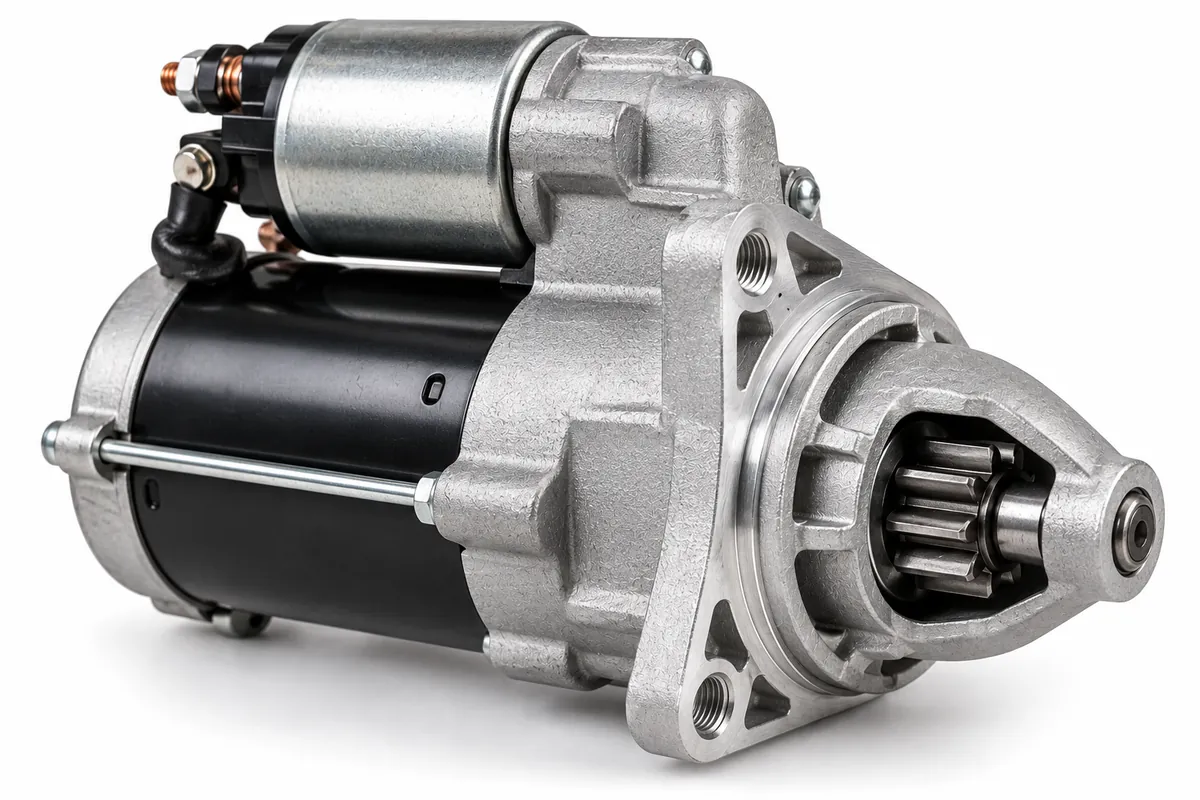
Mobile Starter Diagnostics in Daytona Beach
A no-crank condition does not automatically mean the starter is bad.
Depending on the symptoms, diagnosis can include:
- Battery voltage testing
- Battery load condition
- Starter power supply
- Starter ground circuit
- Voltage-drop testing
- Starter control signal
- Starter relay operation
- Starter-solenoid operation
- Starter current draw
- Cable and terminal condition
- Neutral-safety or park/neutral input
- Ignition-switch command
- Push-button start command
- Engine ground condition
- Starter pinion engagement
- Flywheel or flexplate condition
The goal is to determine whether the starter itself has failed or whether another component is preventing it from operating correctly.
What Does a Car Starter Do?
The starter is a high-torque electric motor used to rotate the engine during starting.
When the driver requests a start, the starter system typically:
- Receives a start command.
- Energizes the starter solenoid.
- Moves the starter pinion into engagement with the flywheel or flexplate.
- Connects battery power to the starter motor.
- Spins the engine.
- Disengages after the engine starts.
The starter must receive enough voltage and current to produce substantial torque.
A starter that is mechanically good cannot operate correctly if the electrical supply is weak.
Starter Motor vs. Starter Solenoid
The starter motor and starter solenoid are closely related, but they perform different jobs.
Starter Motor
The starter motor creates the torque needed to crank the engine.
Starter Solenoid
The solenoid helps engage the starter drive with the flywheel and switches high battery current to the starter motor.
On many modern vehicles, the solenoid is mounted directly on the starter assembly.
A solenoid problem can therefore look like a starter-motor failure.
Jimmy’s Mobile Care also treats starter-solenoid issues separately where the system design and repair allow that distinction.
Signs of a Bad Starter
Possible starter-related symptoms include:
- Single click with no crank
- Repeated clicking
- No sound when attempting to start
- Slow cranking
- Intermittent no-crank
- Starter works after several attempts
- Grinding during starting
- Starter spinning without cranking the engine
- Starter remaining engaged after the engine starts
- Burning smell near the starter
- Excessive current draw
These symptoms overlap with battery, cable, relay, switch, and mechanical problems.
Diagnosis should establish which part of the starting system is actually failing.
Car Clicks but Won’t Start
A click when attempting to start can mean several different things.
Possible causes include:
- Weak battery
- Poor battery connection
- High resistance in a battery cable
- Poor engine ground
- Starter solenoid problem
- Internal starter failure
- Starter relay problem
A strong single click from the starter area may suggest that the solenoid is moving but the motor is not cranking.
Rapid repeated clicking more commonly points toward insufficient voltage reaching the starter circuit.
The sound alone is useful, but electrical testing is needed to identify the cause.
Single Click With No Crank
A single solid click can occur when the starter solenoid engages but the starter motor does not turn.
Possible causes include:
- Worn starter contacts
- Failed starter motor
- Seized starter
- Weak battery
- Excessive voltage drop
- Poor ground connection
- Engine mechanically unable to turn
Before replacing the starter, we verify that sufficient voltage and current are actually reaching it.
Rapid Clicking When Starting
Rapid clicking commonly happens when voltage collapses as the starter circuit is energized.
Possible causes include:
- Discharged battery
- Weak battery
- Loose battery terminal
- Corroded connection
- Poor ground
- Excessive resistance in the starting circuit
In this situation, the starter may be perfectly functional.
The battery and cable system should be checked first.
No Click and No Crank
If nothing happens when the driver attempts to start the engine, the problem may be upstream of the starter motor.
Possible causes include:
- Dead battery
- Open battery cable
- Starter relay problem
- Ignition switch problem
- Park/neutral switch issue
- Clutch safety switch
- Start-button input problem
- Immobilizer or security issue
- Control-module problem
- Broken starter-control wire
Testing the start command helps determine whether the starter is actually being asked to operate.
Slow Cranking
Slow cranking can result from either electrical or mechanical resistance.
Possible causes include:
- Weak battery
- High-resistance battery cable
- Poor ground
- Worn starter motor
- Excessive starter current draw
- Internal engine resistance
- Oil viscosity or mechanical problems
A slow starter should not automatically be replaced without checking voltage and cable condition.
Starter Voltage Testing
The starter requires battery voltage at its main power terminal.
However, measuring voltage with no load does not tell the whole story.
A cable can show close to battery voltage when nothing is operating but lose substantial voltage when the starter draws current.
That is why starting-system diagnosis often includes voltage-drop testing under load.
Starter Voltage Drop Testing
Voltage-drop testing measures how much voltage is lost across a cable or connection while current is flowing.
We can test both sides of the starting circuit.
Positive Side
This can reveal resistance in:
- Positive battery cable
- Cable connections
- Fuse or junction points
- Starter terminal connection
Ground Side
This can reveal resistance in:
- Negative battery cable
- Engine ground strap
- Ground connections
- Battery ground connection
A bad cable can make a good starter behave like a failed starter.
Why Battery Voltage Can Look Good but the Starter Still Won’t Crank
A battery may show acceptable open-circuit voltage while still being unable to deliver sufficient current under starter load.
Likewise, corroded or damaged cables may allow enough voltage for lights and electronics but not enough current for the starter.
The starter is one of the highest-current electrical loads on the vehicle.
Starting-system testing therefore needs to consider both voltage and current delivery.
Starter Current Draw
Starter-current testing can help evaluate starter condition.
An abnormally high current draw can be associated with:
- Internal starter binding
- Worn starter bearings
- Mechanical starter failure
- Engine mechanical resistance
An abnormally low current draw with no cranking can point toward:
- Open internal starter circuit
- Poor electrical connection
- Solenoid contact problem
Current readings must be interpreted together with voltage and engine condition.
Starter Solenoid Testing
The starter solenoid must receive the proper control signal and complete the high-current circuit to the starter motor.
Testing may include checking:
- Solenoid control voltage
- Main battery feed
- Solenoid output
- Voltage drop across solenoid contacts
A click from the solenoid does not necessarily mean its electrical contacts are carrying current correctly.
Starter Control Wire
The smaller starter terminal typically carries the control signal that tells the solenoid to operate.
If that signal is missing when the driver requests a start, the fault may be elsewhere in the control circuit.
Possible causes include:
- Starter relay
- Ignition switch
- Neutral-safety switch
- Clutch switch
- Wiring
- Security system
- Engine or body control module
Replacing the starter will not fix a missing start command.
Starter Relay and Starter Diagnosis
The starter relay allows a lower-current control circuit to command the high-current starting circuit.
A relay can fail electrically or mechanically.
Symptoms may include:
- Intermittent no-crank
- No starter response
- Starter operates after repeated attempts
Relay testing can help determine whether the command is reaching the starter.
Starter and Neutral Safety Switch
Automatic-transmission vehicles typically require the transmission to be in Park or Neutral before the starter can operate.
If the park/neutral signal is missing, the starter may not receive a command.
A vehicle that sometimes starts in Neutral but not Park can point toward a range-sensor or neutral-safety issue.
That should be distinguished from an actual starter failure.
Starter and Clutch Safety Switch
Manual-transmission vehicles commonly use a clutch-interlock switch.
The starter may not operate unless the clutch pedal is depressed.
A failed or misadjusted clutch switch can create a no-crank condition while the starter itself remains functional.
Push-Button Start and Starter Diagnosis
Modern push-button systems add electronic control to the starting request.
The vehicle may need to recognize:
- Correct key or fob
- Brake-pedal input
- Park or Neutral
- Security authorization
- Start-button request
The engine computer or body-control system may then command the starter relay or starter circuit.
A push-button vehicle that does not crank therefore still requires conventional starter testing, but the command side may be more complex.
Starter and Immobilizer Problems
Security or immobilizer systems can prevent engine starting.
Depending on the vehicle, an immobilizer problem may:
- Prevent cranking
- Allow cranking but disable fuel or ignition
- Produce a security warning
Because security strategy varies by vehicle, a no-start should be classified first as either:
- No-crank
- Cranks but does not start
That distinction prevents a starter from being blamed for a fuel, ignition, or security problem.
No Crank vs. Crank-No-Start
This is one of the most important distinctions in starter diagnosis.
No Crank
The engine does not rotate when starting is requested.
Possible causes include the starter, battery, cables, relay, switches, or control circuit.
Crank-No-Start
The starter rotates the engine normally, but the engine does not run.
Possible causes are generally elsewhere, such as:
- Fuel delivery
- Ignition
- Engine timing
- Sensor input
- Security authorization
If the engine is cranking at normal speed, replacing the starter will not fix a crank-no-start problem.
Intermittent Starter Problems
A starter can fail intermittently before it fails completely.
Possible patterns include:
- Works when cold but not hot
- Works after several attempts
- Clicks sometimes and cranks other times
- Fails after a long drive
- Starts again after cooling down
Possible causes can include:
- Worn solenoid contacts
- Worn brushes
- Internal electrical resistance
- Heat-related expansion
- Poor external connections
Testing while the failure is occurring provides the best evidence.
Starter Works When Cold but Not Hot
Heat-related starter problems can appear after the engine compartment becomes hot.
Possible causes include:
- Internal starter wear
- Solenoid contact resistance
- Heat-sensitive winding problems
- High resistance in cables or connections
A hot-start problem should still be separated from:
- Weak battery
- Charging-system issue
- Fuel or ignition problem
The key question is whether the engine actually cranks when the failure occurs.
Tapping the Starter
A worn starter sometimes operates temporarily after being tapped.
This can happen because vibration moves worn brushes or internal contacts enough to restore electrical contact.
If tapping the starter changes the symptom, that can be a useful clue.
But it is not a repair.
A starter that only works after being struck is showing evidence of internal wear and should be properly tested.
Starter Spins but Engine Does Not Crank
If the starter motor can be heard spinning but the engine does not turn, the problem may involve starter-drive engagement.
Possible causes include:
- Failed starter drive
- Pinion not extending
- Damaged starter gear
- Damaged flywheel or flexplate teeth
The starter motor itself may be spinning normally while failing to mechanically engage the engine.
Starter Grinding Noise
Grinding during starting can indicate improper engagement between the starter pinion and flywheel or flexplate.
Possible causes include:
- Damaged starter pinion
- Worn flywheel teeth
- Incorrect starter
- Loose starter mounting
- Misalignment
- Starter drive not disengaging correctly
A grinding starter should be inspected promptly because continued operation can damage the ring gear.
Flywheel and Flexplate Teeth
The starter pinion engages teeth on the:
- Flywheel on many manual-transmission vehicles
- Flexplate on many automatic-transmission vehicles
If those teeth are damaged, the starter may fail to engage at certain engine positions.
Symptoms can include:
- Grinding
- Starter spins without turning engine
- Intermittent failure to engage
A new starter cannot correct severely damaged ring-gear teeth.
Loose Starter Mounting Bolts
The starter needs to be securely and correctly positioned against the engine or transmission housing.
Loose or missing mounting bolts can cause:
- Misalignment
- Grinding
- Poor pinion engagement
- Starter movement
- Broken mounting ears
Starter mounting should be inspected when abnormal engagement noise is present.
Starter Ground Path
Many starters ground through their metal housing into the engine block.
That means the complete ground path may include:
- Starter housing
- Engine block
- Engine ground strap
- Negative battery cable
Corrosion or a damaged engine ground can reduce starter current even when the starter itself is good.
Ground-side voltage drop helps identify this problem.
Battery Cables and Starter Problems
The starter depends on heavy-gauge battery cables.
Possible cable problems include:
- Corrosion
- Loose terminals
- Internal cable deterioration
- Heat damage
- Broken strands
- Damaged terminal ends
A cable can look acceptable externally while containing internal corrosion.
Testing under load is often more useful than appearance alone.
Starter Terminal Corrosion
Starter terminals can be exposed to:
- Heat
- Water
- Oil
- Road contamination
Corrosion can increase electrical resistance.
Possible symptoms include:
- Slow crank
- Click-no-crank
- Intermittent starting
- Heat at the connection
Connections should be inspected and tested before condemning the starter.
Oil Leaks and Starter Damage
On some engines, oil leaks can drip directly onto the starter.
Repeated oil exposure can contaminate:
- Electrical terminals
- Starter housing
- Solenoid
- Wiring
If a starter fails in an area affected by an oil leak, the oil source should also be considered.
Replacing the starter without correcting heavy contamination can shorten the life of the replacement.
Heat Damage Around the Starter
Starters are often mounted near:
- Exhaust manifolds
- Exhaust pipes
- Catalytic converters
- Engine blocks
Excessive heat can affect starter performance and wiring.
Factory heat shields should be retained where equipped.
Missing or damaged heat protection can contribute to repeated starter problems.
Starter Replacement
Once testing confirms that the starter itself has failed, replacement can typically include:
- Confirm the starter fault. Battery, cable, control-signal, and voltage-drop problems are ruled out as appropriate.
- Disconnect battery power. The starter has a direct high-current battery connection.
- Gain access to the starter. Covers, intake components, shields, or other parts may need to be removed.
- Disconnect starter wiring. Main battery and control connections are removed carefully.
- Remove starter mounting bolts. The starter is separated from the engine or transmission housing.
- Inspect the mounting area. Wiring, terminals, heat shields, and visible ring-gear condition are checked.
- Compare the replacement starter. Mounting, electrical connections, gear design, and application are verified.
- Install the replacement starter. It is positioned and secured correctly.
- Reconnect electrical terminals. Power and control connections are installed securely.
- Restore removed components. Shields, brackets, covers, and related parts are reinstalled.
- Reconnect the battery.
- Test starter operation. Cranking speed, engagement, and sound are checked.
- Verify charging and battery condition where appropriate. A weak battery or charging problem can damage or mimic starter problems.
The repair should address not only the failed starter but any condition that contributed to the failure.
Starter Replacement and Battery Condition
A weak battery can place additional stress on the starting system.
Before or after starter replacement, battery condition should be considered.
A severely weak battery can cause:
- Slow starter speed
- Solenoid chatter
- Excessive heat
- Repeated unsuccessful starting attempts
Installing a new starter does not correct a failing battery.
Starter Replacement and Alternator Condition
The alternator does not normally crank the engine, but it recharges the battery after starting.
A charging problem can gradually leave the battery too weak to operate the starter.
This can create a repeated no-start complaint.
If the battery keeps becoming discharged, the charging system should be considered rather than repeatedly blaming the starter.
Does a New Starter Need Programming?
Most conventional replacement starters do not require programming.
They are electromechanical components.
However, the vehicle's broader starting system may involve modules, security authorization, stop/start systems, or other electronic controls.
The starter itself generally does not require software programming simply because it has been replaced.
Start-Stop System Starters
Vehicles with automatic start-stop systems may use starters designed for substantially more frequent operation.
These starters may differ from conventional designs in:
- Internal construction
- Durability requirements
- Control strategy
- Electrical system integration
The correct replacement starter must match the application.
A standard starter should not be substituted simply because it physically fits.
Starter Replacement Access
Starter location varies greatly between vehicles.
It may be:
- Easy to reach from underneath
- Mounted at the front of the engine
- Mounted near the transmission
- Hidden beneath an intake manifold
- Surrounded by exhaust or drivetrain components
Access can significantly affect replacement labor.
Some starter jobs are straightforward mobile repairs, while others require substantial disassembly.
Can a Starter Be Rebuilt?
Some starter motors can be rebuilt.
A rebuild can involve replacing parts such as:
- Brushes
- Bushings or bearings
- Solenoid contacts
- Drive assembly
- Internal electrical components
Whether rebuilding is practical depends on the starter design, parts availability, and replacement cost.
For many modern passenger vehicles, installing a quality replacement starter is often more practical than rebuilding the original unit on-site.
Remanufactured vs. New Starter
Replacement starters may be sold as:
- New
- Remanufactured
A remanufactured starter has been disassembled and restored with worn or failed components replaced according to the rebuilder's process.
A new starter is manufactured as a new assembly.
The appropriate choice depends on:
- Application
- Availability
- Quality
- Warranty
- Cost
Correct fit and dependable construction matter more than simply choosing the lowest-priced unit.
Why Starter Part Numbers Matter
Starters that look similar may have important differences in:
- Mounting pattern
- Gear tooth count
- Electrical terminal location
- Rotation
- Power rating
- Nose housing
- Solenoid position
- Transmission application
The correct starter should be selected by vehicle application rather than appearance alone.
Why a New Starter May Still Not Crank
If a starter is replaced without identifying the actual fault, the no-crank condition may remain.
Possible causes include:
- Weak battery
- Bad battery cable
- Poor engine ground
- Starter relay problem
- Missing control signal
- Neutral-safety switch
- Ignition switch
- Security-system issue
- Mechanical engine problem
That is why starter diagnosis should come before replacement whenever possible.
How Much Does Car Starter Replacement Cost?
Starter replacement cost varies based on the vehicle and access.
Factors can include:
- Vehicle year, make, and model
- Starter price
- Starter location
- Amount of disassembly required
- New vs. remanufactured starter
- Damaged wiring or terminals
- Heat shields
- Battery-cable problems
- Additional starting-system faults
A starter mounted openly near the bottom of the engine can be a very different repair from one located beneath an intake manifold.
Call Jimmy’s Mobile Care at (386) 308-2509 with your vehicle information and starting symptoms so we can discuss the appropriate diagnostic service.
Why Diagnose the Starter Before Replacing It?
No-crank symptoms can come from several different areas.
Diagnosis helps answer the questions that actually determine the repair.
Is the Battery Strong Enough?
A weak battery can imitate a failed starter.
Is Full Battery Power Reaching the Starter?
Cable resistance can prevent a good starter from operating.
Is the Ground Circuit Good?
A poor engine ground can cause slow or no cranking.
Is the Starter Receiving a Start Command?
If the control signal is missing, the fault is upstream.
Is the Solenoid Switching Current Properly?
A solenoid can click without successfully powering the starter motor.
Is the Starter Drawing Abnormal Current?
Current and voltage behavior can reveal internal starter problems.
Is the Starter Mechanically Engaging the Engine?
A spinning starter with no engine movement can indicate drive or ring-gear problems.
Is This Really a Starter Problem?
If the engine cranks normally but does not start, the starter has already performed its primary job.
Testing these areas helps avoid replacing an expensive starter when the actual failure is elsewhere.
Mobile Car Starter Diagnostics in Daytona Beach
Jimmy’s Mobile Care provides mobile car starter diagnostics in Daytona Beach for vehicles experiencing no-crank, clicking, intermittent starting, slow cranking, grinding, or other starter-related symptoms.
We can evaluate the battery supply, starter circuit, control signal, voltage drop, and starter operation to determine what is preventing the engine from cranking normally.
Mobile Car Starter Replacement in Daytona Beach
When testing confirms starter failure and the repair is suitable for mobile service, we can replace the starter at your Daytona Beach location.
After installation, we verify:
- Starter engagement
- Cranking speed
- Electrical connections
- Starting operation
- Abnormal noise
We also consider battery and cable condition so a separate electrical problem does not undermine the replacement starter.
Schedule Car Starter Diagnostics & Replacement in Daytona Beach
A click, slow crank, or no-crank condition does not automatically mean the starter is bad.
Jimmy’s Mobile Care tests the starting system first so we can determine whether the problem is the starter motor, solenoid, battery supply, cable resistance, control circuit, or another related fault.
Call Jimmy’s Mobile Care at (386) 308-2509 to schedule car starter diagnostics and replacement in Daytona Beach, FL. Call today and we'll come to your location.