
Car Throttle Body Diagnostics & Replacement in Daytona Beach, FL
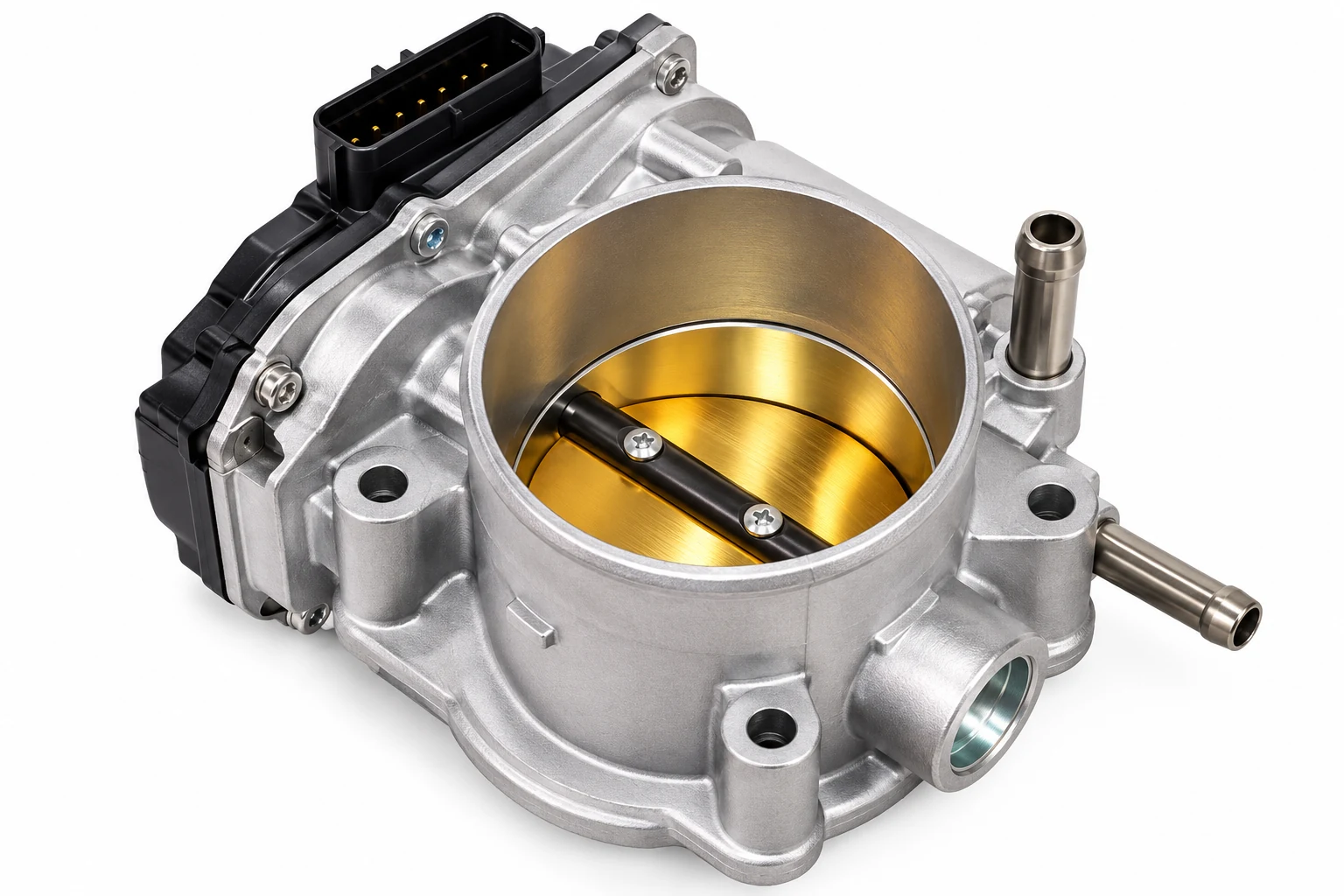
The throttle body controls how much air enters the engine. On most modern vehicles, it is part of an electronic throttle-control system in which the engine computer commands an electric motor to open and close the throttle plate while built-in position sensors report the actual throttle angle.
When the throttle body becomes heavily contaminated, the throttle plate sticks, the internal electric motor fails, position-sensor signals disagree, wiring is damaged, or the throttle can no longer follow the commanded position accurately, the vehicle may idle poorly, hesitate, stall, lose power, enter reduced-power mode, respond poorly to the accelerator pedal, or turn on the check-engine or electronic-throttle-control warning light.
Jimmy’s Mobile Care provides car throttle body diagnostics and replacement in Daytona Beach, FL. We test throttle position, commanded versus actual throttle angle, electrical circuits, throttle actuator operation, accelerator-pedal inputs, airflow data, intake leaks, and relearn requirements before recommending replacement so a wiring problem, accelerator-pedal sensor, vacuum leak, MAF or MAP sensor, fuel-delivery fault, or engine-control problem is not mistaken for a bad throttle body.
Mobile Throttle Body Diagnostics in Daytona Beach
A throttle-body code or electronic-throttle-control warning light does not automatically mean the entire throttle body should be replaced.
Depending on the vehicle and symptoms, diagnosis can include checking:
- Commanded throttle position
- Actual throttle position
- Throttle Position Sensor 1
- Throttle Position Sensor 2
- Electronic throttle actuator operation
- Accelerator Pedal Position Sensor 1
- Accelerator Pedal Position Sensor 2
- Throttle motor circuits
- Power and ground
- Connector condition
- Wiring harness
- Throttle plate movement
- Carbon and deposit buildup
- Intake-manifold vacuum leaks
- MAF data
- MAP data
- Engine RPM
- Fuel trims
- Battery voltage
- Related trouble codes
- Freeze-frame information
- Throttle relearn or adaptation status
The objective is to determine whether the throttle body itself has failed or whether the computer is reacting to another problem in the electronic throttle-control system.
What Is a Throttle Body?
The throttle body is located in the engine’s air-intake path, generally between the:
- Air filter and intake ducting
- Intake manifold
Its primary job is to regulate the amount of air entering the engine.
The main components can include:
- Throttle housing
- Throttle plate
- Throttle shaft
- Electric actuator motor
- Throttle-position sensors
- Electrical connector
Older throttle bodies may instead use:
- Mechanical accelerator cable
- Separate throttle position sensor
- Separate idle-air-control valve
The correct diagnostic approach depends on the design.
What Does a Throttle Body Do?
The throttle body changes airflow according to engine demand.
When the throttle opens farther:
- More air can enter the engine
- Engine load can increase
- RPM can rise when other conditions allow
When the throttle closes:
- Airflow decreases
- Engine power falls
- The PCM controls idle airflow on modern electronic systems
The throttle body is therefore a major part of:
- Acceleration
- Idle control
- Engine load control
- Traction control
- Cruise control
- Stability-control intervention
Mechanical Throttle Body vs. Electronic Throttle Body
Throttle systems have changed significantly over time.
Mechanical Throttle Body
A cable physically connects the accelerator pedal to the throttle plate.
Pressing the pedal directly moves the throttle.
Electronic Throttle Body
There is no direct mechanical cable controlling normal operation.
Instead:
- The accelerator pedal sensors report driver demand.
- The PCM evaluates the request.
- The PCM commands the throttle actuator motor.
- The throttle plate moves.
- Throttle-position sensors verify actual movement.
Electronic throttle control is commonly called:
- ETC
- Drive-by-wire
- DBW
What Is Electronic Throttle Control?
Electronic throttle control replaces the traditional direct throttle cable with electronic sensing and motorized control.
The system can include:
- Accelerator pedal position sensors
- Engine-control module
- Throttle actuator motor
- Dual throttle-position sensors
- Wiring and connectors
The computer continuously checks whether all these signals agree.
If they do not, it may reduce engine power for safety.
Throttle Body vs. Accelerator Pedal Position Sensor
These are separate components.
Accelerator Pedal Position Sensor
Tells the computer how far the driver is pressing the pedal.
Throttle Body
Physically controls the intake-air opening.
A vehicle may have a perfectly good throttle body but still have poor throttle response because the accelerator-pedal signal is incorrect.
The pedal and throttle data should be compared before either component is replaced.
Throttle Body vs. Throttle Position Sensor
On many older vehicles, the throttle position sensor is a separate replaceable component attached to the throttle shaft.
On many modern electronic throttle bodies, the position sensors are built into the throttle-body assembly.
If an integrated position sensor fails, the complete throttle body may need replacement.
Whether the sensor is serviced separately depends on the vehicle.
Throttle Body vs. MAF Sensor
The two components serve different purposes.
Throttle Body
Controls airflow into the engine.
Mass Air Flow Sensor
Measures the mass of incoming air.
A throttle problem can affect airflow data, but an incorrect MAF signal can also cause poor drivability while the throttle body remains mechanically sound.
Throttle Body vs. MAP Sensor
The MAP sensor measures intake-manifold pressure.
The throttle body regulates the opening that influences that pressure.
A throttle body problem can therefore affect MAP readings, but an abnormal MAP value does not automatically prove the throttle body is defective.
Throttle Body vs. Idle Air Control Valve
Older cable-operated throttle systems may use an idle-air-control valve to bypass air around a mostly closed throttle plate.
Modern electronic throttle bodies often control idle by moving the throttle plate itself.
If a vehicle has a separate IAC valve, idle problems should not automatically be blamed on the throttle body.
Electronic Throttle Actuator Motor
Inside an electronic throttle body is an electric actuator motor.
The PCM drives this motor to move the throttle plate.
The actuator must be able to:
- Open the plate
- Close the plate
- Hold commanded positions
- Respond quickly and accurately
A weak or failed actuator motor can cause:
- Reduced-power mode
- Throttle-response problems
- Correlation codes
- No throttle response
Throttle Position Sensors
Modern electronic throttle bodies typically use redundant position sensors.
The computer may monitor:
- TPS 1
- TPS 2
These often produce different but mathematically related signals.
The PCM continuously checks them against one another.
If the signals disagree beyond the allowable range, the computer may set a fault and enter a protective operating mode.
Why Two Throttle Position Sensors Are Used
Electronic throttle control is safety-critical.
Redundant sensors allow the PCM to recognize a signal that becomes:
- Implausible
- Open
- Shorted
- Stuck
The computer does not simply trust one signal.
It compares multiple inputs before allowing normal throttle operation.
Commanded vs. Actual Throttle Position
One of the most useful electronic-throttle diagnostic comparisons is:
- Commanded throttle position
- Actual throttle position
If the computer commands the throttle to move but actual position does not follow correctly, possible causes include:
- Sticking throttle plate
- Failed actuator motor
- Internal gear problem
- Throttle-body electronics
- Wiring or power-supply fault
However, the PCM may intentionally limit throttle opening during certain faults, so scan data must be interpreted in context.
Throttle Angle at Idle
A modern electronic throttle plate does not necessarily sit fully closed at idle.
The PCM may hold it slightly open to provide the air needed for:
- Idle speed
- Accessory loads
- Cold-start operation
Therefore, seeing a nonzero throttle position at idle is not automatically a problem.
Throttle Body Carbon Buildup
Deposits commonly form around:
- Throttle plate
- Throttle bore
- Plate edges
These deposits can come from:
- PCV vapors
- Oil mist
- Intake contamination
Heavy buildup can reduce or alter airflow around the nearly closed throttle plate.
Possible symptoms can include:
- Rough idle
- Low idle
- Stalling
- Sticky throttle movement
- Poor idle adaptation
Dirty Throttle Body Symptoms
Possible symptoms of significant throttle-body contamination include:
- Rough idle
- Unstable idle
- Stalling
- Hesitation
- Poor low-speed response
- Difficult idle relearn
- Throttle plate sticking
However, these same symptoms can result from:
- Vacuum leaks
- Ignition misfire
- Fuel-injector problems
- MAF fault
- MAP fault
The throttle body should be inspected rather than assumed to be dirty.
Does a Dirty Throttle Body Need Replacement?
Usually not simply because it has deposits.
If the throttle body is mechanically sound and electronically functional, cleaning may restore normal airflow.
Replacement becomes more appropriate when there is:
- Failed actuator motor
- Failed internal electronics
- Integrated position-sensor failure
- Excessive shaft wear
- Physical damage
- Repeated sticking that cannot be corrected
Cleaning cannot repair electronic or mechanical failure.
Throttle Body Cleaning
Throttle-body cleaning may involve removing deposits from:
- Throttle plate
- Bore
- Plate edges
The correct cleaner and procedure matter.
Modern electronic throttle bodies can contain sensitive:
- Motors
- Position sensors
- Electronics
- Coatings
Aggressive solvents or improper handling can damage the assembly.
Can You Push an Electronic Throttle Plate Open by Hand?
This depends on the throttle-body design and manufacturer procedure.
Forcing the plate against the actuator gears can potentially damage:
- Motor drive
- Gear mechanism
- Internal stops
Some service procedures permit careful manual movement.
Others recommend controlling the plate electronically or removing the assembly for cleaning.
The correct procedure should be followed rather than forcing the plate.
Cleaning Throttle Body Without Removing It
Some throttle bodies can be cleaned while installed.
However, access and contamination level matter.
Cleaning in place can make it harder to:
- Reach both sides of plate
- Inspect bore thoroughly
- Prevent cleaner or debris from entering intake
Removal may provide better access on some vehicles.
Cleaning a Removed Throttle Body
Removal can allow more complete inspection of:
- Plate
- Bore
- Sealing edge
- Gasket surface
Electronic components should still be protected from excessive chemical exposure.
Throttle Body Cleaner vs. Carburetor Cleaner
Modern throttle bodies may have coatings or electronics that are not compatible with aggressive carburetor cleaner.
A product specifically intended for:
- Throttle bodies
- Electronic fuel-injection intake systems
is generally more appropriate when cleaning is permitted.
Throttle Body Gasket
The throttle body usually seals to the intake manifold with a:
- Gasket
- O-ring
- Molded seal
A damaged seal can create an intake-air leak.
If the throttle body is removed, the gasket should be inspected and replaced where appropriate.
Throttle Body Vacuum Leak
A leak around the throttle body can cause:
- Rough idle
- High idle
- Lean fuel trims
- Whistling
Possible leak locations include:
- Throttle-body gasket
- Intake duct
- Vacuum hose connection
- Intake manifold
A vacuum leak should not be mistaken for an electronic throttle-body failure.
Cracked Intake Hose Near Throttle Body
The intake duct between the MAF sensor and throttle body can develop:
- Cracks
- Loose clamps
- Split boots
If the vehicle uses a MAF sensor upstream, air entering through a downstream crack may be unmetered.
This can cause:
- Lean fuel trims
- Rough idle
- Hesitation
The throttle body may be functioning normally.
Signs of a Bad Throttle Body
Possible symptoms include:
- Electronic throttle-control warning
- Check-engine light
- Reduced-power mode
- Poor throttle response
- No throttle response
- Hesitation
- Stalling
- Rough idle
- High idle
- Surging
- Poor acceleration
- Engine RPM limited
- Throttle-related trouble codes
These symptoms should be supported by testing before replacement.
Throttle Body and Reduced Engine Power
Modern electronic-throttle systems use safety strategies.
If the PCM detects an implausible throttle condition, it may intentionally limit:
- Throttle opening
- RPM
- Engine torque
The driver may see a message such as:
- Reduced Engine Power
- Electronic Throttle Control
- Service Electronic Throttle
The exact warning depends on manufacturer.
Reduced-power mode means the PCM detected a significant problem; it does not identify the failed component by itself.
Electronic Throttle Control Warning Light
Some vehicles use a dedicated electronic-throttle-control indicator.
Depending on manufacturer, it may look like:
- Lightning bolt between curved brackets
- ETC message
- Throttle warning
Possible causes include:
- Throttle body
- Accelerator pedal sensor
- Wiring
- Low voltage
- PCM issue
The stored codes should be read before replacing parts.
Lightning Bolt Warning Light
Certain Chrysler, Dodge, Jeep, and Ram vehicles use a lightning-bolt-style electronic throttle-control warning.
The light can indicate a fault somewhere in the electronic throttle-control system.
Possible causes include:
- Throttle-body actuator
- Throttle-position sensors
- Accelerator pedal sensors
- Wiring
- Electrical power problem
The warning is not proof that the throttle body itself has failed.
Throttle Body and Limp Mode
When the PCM cannot safely control the throttle, it may use a limited operating mode.
Possible behavior includes:
- Very limited throttle opening
- Fixed throttle position
- Reduced RPM
- Poor acceleration
This allows the vehicle to maintain limited operation while reducing the risk of unintended throttle behavior.
Throttle Body and No Accelerator Response
If the accelerator pedal is pressed but the engine does not respond normally, possible causes include:
- Throttle actuator fault
- Accelerator pedal sensor fault
- ETC wiring fault
- PCM failsafe mode
Comparing pedal input with commanded and actual throttle position can help separate these possibilities.
Throttle Body and Hesitation
A sticking plate or slow electronic response can cause hesitation.
However, hesitation can also come from:
- MAF sensor
- MAP sensor
- Fuel-pressure problem
- Ignition misfire
- Injector fault
The throttle position should be monitored while the hesitation occurs.
Throttle Body and Stalling
Heavy deposits or improper throttle adaptation may affect idle airflow.
However, stalling can also be caused by:
- Vacuum leak
- Crankshaft sensor
- Fuel-delivery problem
- Charging-system issue
The actual cause should be established before replacing the throttle body.
Throttle Body and Rough Idle
A dirty throttle bore can alter airflow at small throttle openings.
Electronic throttle control may compensate over time by learning a different plate position.
After heavy buildup or battery disconnection, the learned position can become important.
But rough idle can also result from:
- Spark plugs
- Coils
- Injectors
- Intake leaks
- Compression problems
Throttle-body cleaning should not replace proper diagnosis.
Throttle Body and High Idle
High idle can be caused by:
- Intake leak
- Throttle plate held open
- Incorrect throttle adaptation
- Electronic throttle fault
The commanded and actual throttle angle should be compared.
If the PCM is commanding a nearly closed position but airflow remains excessive, a mechanical or intake-leak problem may exist.
Throttle Body and Surging
Surging can occur if:
- Throttle plate sticks
- Throttle control becomes unstable
- Airflow calculation is incorrect
However, surging can also result from:
- Fuel delivery
- Vacuum leak
- MAF or MAP signal
- Ignition problem
The symptom alone does not identify the throttle body.
Throttle Body and Hard Starting
A severely stuck throttle plate can influence starting airflow.
But hard-start complaints more commonly involve:
- Fuel pressure
- Coolant temperature
- Crankshaft sensor
- Battery
- Injector leakage
Throttle data should support a throttle-related diagnosis.
Throttle Body and No-Start
A throttle body is generally not the first component to suspect for a typical crank-no-start.
Even with an ETC fault, many vehicles can still start using a failsafe throttle strategy.
A no-start should also lead toward:
- Crankshaft signal
- Fuel pressure
- Spark
- Compression
unless throttle data clearly indicates a severe airflow-control problem.
Throttle Body and Poor Fuel Economy
An incorrect throttle position signal or airflow-control problem can affect load calculation.
But poor fuel economy is influenced by many other conditions.
A throttle body should not be replaced based on fuel mileage alone.
Throttle Body and Fuel Trims
Fuel trims can help identify intake-air problems.
For example:
- Large positive fuel trims at idle can suggest a vacuum leak
- Fuel trims that improve at higher RPM can further support an intake leak
A dirty or defective throttle body can affect airflow, but fuel trims alone do not prove throttle failure.
Throttle Body and MAF Correlation
The PCM may compare:
- Throttle position
- MAF airflow
- MAP pressure
- RPM
If the throttle opens but airflow does not increase as expected, possible causes include:
- MAF problem
- Intake restriction
- Throttle-body fault
Correlation among several signals helps determine which data is implausible.
Throttle Body and MAP Correlation
As the throttle opens on a naturally aspirated gasoline engine:
- Manifold pressure generally rises toward atmospheric pressure
If throttle angle changes but MAP data does not respond as expected, the system may have:
- MAP problem
- Intake restriction
- Throttle problem
The signals should be compared together.
Throttle Body and Accelerator Pedal Correlation
When the driver presses the accelerator pedal:
- APP sensor values should change smoothly.
- PCM should calculate a throttle request.
- Commanded throttle should change.
- Actual throttle should follow.
If the pedal data changes normally but actual throttle does not follow command, the throttle body or its circuit becomes more suspicious.
If pedal data itself is erratic, the throttle body may be responding correctly to a bad input.
Accelerator Pedal Sensor Testing
The accelerator pedal often contains redundant sensors.
The PCM checks whether their signals agree.
Possible faults can cause:
- Reduced power
- No throttle response
- ETC warning
A bad accelerator pedal assembly can closely imitate a throttle-body failure.
Throttle Body Trouble Codes
Throttle-related fault families can include:
- P0120
- P0121
- P0122
- P0123
- P0220
- P0221
- P0222
- P0223
- P0638
- P2100
- P2101
- P2102
- P2103
- P2110
- P2111
- P2112
- P2135
- P2138
Exact definitions vary by vehicle and system.
P0120 Throttle Position Sensor Circuit
P0120 generally identifies a fault involving a throttle-position circuit.
Possible causes include:
- Position sensor
- Wiring
- Connector
- Throttle-body electronics
On an integrated electronic throttle body, the position sensor may not be separately serviceable.
P0121 Throttle Position Range/Performance
P0121 commonly indicates that a throttle-position signal is outside the expected range or does not agree with other information.
Possible causes include:
- Throttle position sensor
- Sticking throttle plate
- Wiring
- Incorrect adaptation
- Correlation problem
A range/performance code should be diagnosed rather than treated as an automatic throttle-body replacement order.
P0122 Throttle Position Circuit Low
Possible causes can include:
- Signal short to ground
- Sensor fault
- Missing reference voltage
- Wiring problem
The electrical circuit should be tested.
P0123 Throttle Position Circuit High
Possible causes can include:
- Signal short to voltage
- Open ground
- Position-sensor fault
- Connector problem
Again, the throttle body itself is only one possibility.
P0220 and Related Throttle Sensor Codes
P0220 and related codes can involve another throttle-position circuit.
Electronic throttle bodies often have redundant position signals.
The PCM compares them for safety.
A fault in one may trigger:
- Reduced power
- ETC warning
P0638 Throttle Actuator Control Range/Performance
P0638 commonly identifies a throttle-actuator performance issue.
Possible causes include:
- Sticking plate
- Failed actuator motor
- Wiring problem
- Internal throttle-body fault
The commanded and actual throttle positions should be compared.
P2100 Throttle Actuator Control Motor Circuit
P2100 generally indicates an electrical problem involving the throttle actuator motor circuit.
Possible causes include:
- Open actuator circuit
- Wiring damage
- Connector issue
- Failed throttle motor
- PCM driver problem
Testing should determine whether the motor itself is defective.
P2101 Throttle Actuator Range/Performance
P2101 commonly means the throttle actuator did not behave as expected.
Possible causes include:
- Plate binding
- Heavy deposits
- Actuator motor problem
- Wiring
- Internal gear fault
Actual throttle movement is important in diagnosis.
P2102 Throttle Actuator Circuit Low
A low-actuator circuit fault can be caused by:
- Wiring short
- Motor circuit problem
- Connector fault
The motor circuit should be tested before replacement.
P2103 Throttle Actuator Circuit High
A high-circuit fault can indicate:
- Wiring short to voltage
- Actuator fault
- Electrical driver problem
The circuit needs proper diagnosis.
P2110 Forced Limited RPM
P2110 generally indicates that the PCM is intentionally limiting engine RPM because another electronic-throttle fault has been detected.
P2110 is often a response code, not the root cause.
Other stored codes should be diagnosed first.
P2111 Throttle Actuator Stuck Open
P2111 generally indicates the throttle plate is more open than commanded.
Possible causes include:
- Mechanical sticking
- Carbon buildup
- Actuator problem
- Internal gear fault
- Electrical control problem
The plate and actuator should be inspected.
P2112 Throttle Actuator Stuck Closed
P2112 generally indicates the plate is not opening as commanded.
Possible causes include:
- Deposits
- Mechanical binding
- Failed motor
- Gear problem
- Wiring
Testing is required before replacing the assembly.
P2135 Throttle Position Sensor Correlation
P2135 commonly indicates that redundant throttle-position sensor signals no longer agree within the expected relationship.
Possible causes include:
- Integrated sensor failure
- Wiring
- Connector
- Internal throttle-body problem
This code is especially important on drive-by-wire systems because the PCM relies on signal agreement for safety.
P2138 Accelerator Pedal Position Correlation
P2138 generally involves accelerator-pedal sensor correlation, not necessarily the throttle body.
A vehicle with P2138 may have:
- Pedal assembly problem
- Wiring
- Connector
Replacing the throttle body for a pedal-correlation fault may not solve the problem.
Throttle Body Power Supply
The throttle actuator requires sufficient electrical power.
Low system voltage can interfere with electronic throttle operation.
Before condemning an electronic throttle body, it may be appropriate to verify:
- Battery voltage
- Charging-system voltage
- Power supply
- Grounds
Low voltage can create multiple electronic faults at once.
Throttle Body Grounds
Poor ground connections can affect:
- Motor operation
- Position-sensor signals
Voltage-drop testing may reveal a ground problem that simple continuity testing misses.
Throttle Body Connector
The connector should be inspected for:
- Loose pins
- Spread terminals
- Corrosion
- Moisture
- Heat damage
- Broken lock
- Harness tension
Because the throttle body combines multiple circuits, a connector problem can create several codes simultaneously.
Throttle Body Wiring Harness
Harness faults can include:
- Open circuits
- Shorts
- Broken conductors
- Chafing
- Heat damage
A new throttle body will not repair damaged wiring.
Wiggle Testing Throttle Wiring
When an intermittent fault is suspected, carefully moving the harness while monitoring:
- TPS data
- Commanded throttle
- Actual throttle
can sometimes reproduce the fault.
The harness should not be pulled aggressively.
Throttle Body Motor Testing
Depending on the system, diagnosis may evaluate:
- Actuator circuit resistance
- Current draw
- Command response
- Actual plate movement
The motor should not be powered directly without knowing the proper circuit design.
Incorrectly applying battery voltage can damage:
- Throttle electronics
- Motor
- PCM circuits
Bidirectional Throttle Control Testing
An advanced scan tool may be able to command the throttle actuator while the engine is off or under specified conditions.
This can help compare:
- Requested position
- Actual position
If the throttle consistently fails to follow valid commands despite correct power and wiring, the throttle body becomes more suspect.
Throttle Position Sensor Signals
Redundant position sensors may be designed so that:
- One signal increases as throttle opens
- Another changes according to a different expected relationship
The important test is not that both sensors display the same voltage.
It is that each follows its designed pattern and their relationship remains valid.
Throttle Position Should Change Smoothly
As the throttle moves, position data should generally change smoothly.
Abnormal behavior can include:
- Sudden jumps
- Dropouts
- Dead spots
- Stuck values
These can indicate:
- Sensor failure
- Wiring issue
- Internal throttle-body fault
Throttle Plate Sticking
The throttle plate can stick because of:
- Heavy carbon deposits
- Mechanical damage
- Internal gear problem
- Shaft problem
Sticking may be most noticeable near the closed position where deposits accumulate.
Throttle Body Gear Failure
Electronic throttle bodies can contain reduction gears between the motor and throttle shaft.
If the gears become:
- Worn
- Broken
- Stripped
the motor may run without moving the plate correctly.
Internal gears are often not separately serviceable.
Throttle Shaft Wear
Mechanical wear around the throttle shaft can create:
- Air leakage
- Excessive movement
- Poor control
Severe shaft wear may require throttle-body replacement.
Cleaning cannot repair physical shaft wear.
Throttle Plate Damage
Physical damage can occur from:
- Improper cleaning
- Foreign-object contact
- Forced movement
A bent or damaged throttle plate can prevent accurate airflow control.
Throttle Body and Intake Restriction
A clogged air filter or collapsed intake duct can restrict airflow.
The throttle may open normally while actual airflow remains low.
The intake system should therefore be inspected when poor acceleration is accompanied by apparently normal throttle operation.
Throttle Body and Vacuum Leak
A vacuum leak bypasses the intended airflow path.
The PCM may compensate by:
- Closing throttle farther
- Adjusting fuel trims
An abnormal idle throttle angle can therefore be a reaction to an intake leak rather than proof of a bad throttle body.
Throttle Body and PCV Fault
A stuck-open PCV valve or damaged PCV hose can create an intake leak.
Possible effects include:
- High idle
- Lean fuel trims
- Rough idle
The throttle body may be responding correctly.
Throttle Body and EVAP Purge Valve
A purge valve stuck open can allow excessive vapor or air into the intake manifold.
This can cause:
- Rough idle
- Hard starting
- Fuel-trim changes
It can imitate certain throttle or vacuum-leak symptoms.
Throttle Body and Fuel Pressure
A vehicle with normal throttle movement but insufficient fuel pressure may:
- Hesitate
- Lack power
- Stall
The throttle body cannot compensate for inadequate fuel supply.
Throttle Body and Ignition Misfire
Misfires from:
- Spark plugs
- Ignition coils
- Compression
can cause rough running even though throttle operation is normal.
A rough engine should not lead directly to throttle-body replacement without supporting throttle data.
Throttle Body and Battery Voltage
Electronic throttle control is voltage-sensitive.
A weak battery or charging problem can contribute to:
- ETC warnings
- Multiple low-voltage codes
- Relearn problems
Battery and charging voltage should be considered when several electronic systems fail simultaneously.
Throttle Body After Battery Replacement
Some vehicles may idle differently after:
- Battery disconnection
- Battery replacement
because previously learned throttle or idle values have been cleared.
The throttle body may require:
- Idle relearn
- Throttle adaptation
This does not necessarily mean the throttle body failed.
Throttle Body Relearn
An electronic throttle body may require the PCM to relearn:
- Closed position
- Idle position
- Minimum airflow
after:
- Cleaning
- Replacement
- Battery disconnection
- PCM reset
The exact procedure varies by manufacturer.
What Is a Throttle Relearn?
A throttle relearn allows the engine computer to establish the relationship between:
- Throttle actuator
- Position sensors
- Actual airflow
Some vehicles perform this automatically.
Others require:
- Specific ignition sequence
- Idle period
- Road drive
- Scan-tool procedure
Throttle Body Adaptation
European and other manufacturers may refer to the process as:
- Throttle adaptation
- Throttle alignment
- Basic settings
These terms generally refer to establishing correct learned throttle positions.
Can a Throttle Body Work Without a Relearn?
Sometimes yes.
Some vehicles learn automatically after normal operation.
Others may experience:
- High idle
- Low idle
- Stalling
- Poor response
until the required adaptation is completed.
Vehicle-specific requirements matter.
High Idle After Throttle Body Cleaning
After cleaning, more air may pass around the throttle plate at the same physical opening than before.
If the PCM had learned compensation for heavy deposits, idle may temporarily become too high.
A relearn may be required.
Rough Idle After Throttle Body Cleaning
Possible causes include:
- Adaptation not completed
- Intake hose left loose
- Vacuum leak
- Throttle connector problem
- Excess cleaner
The throttle body should not automatically be replaced.
Stalling After Throttle Body Cleaning
If the throttle plate and bore are now substantially cleaner, previously learned airflow values may no longer match.
A proper relearn may correct the condition.
Any disturbed:
- Gaskets
- Hoses
- Electrical connectors
should also be checked.
New Throttle Body Requires Relearn
Many replacement electronic throttle bodies require some form of:
- Relearn
- Adaptation
- Basic setting
Failure to perform it where required can cause poor idle or throttle-related codes despite a good new part.
Does a Throttle Body Need Programming?
A conventional replacement throttle body generally does not contain vehicle-specific programming in the same sense as a control module.
However, some vehicles require:
- Throttle adaptation
- Relearn
- Initialization
Certain advanced assemblies or manufacturer-specific systems may require scan-tool procedures.
Programming and relearning are not the same thing.
Throttle Body Replacement
Once diagnostics confirm that the throttle body itself is faulty, replacement generally includes:
- Verify the complaint and stored trouble codes.
- Review freeze-frame information.
- Compare accelerator-pedal input with throttle command.
- Compare commanded and actual throttle position.
- Inspect throttle-position signals.
- Check throttle actuator operation.
- Verify power and ground.
- Inspect wiring and connector condition.
- Check for intake and vacuum leaks.
- Inspect the throttle plate and bore for deposits or sticking.
- Determine whether cleaning is appropriate or actual replacement is required.
- Turn the ignition off.
- Disconnect the battery if required by the service procedure.
- Remove the air-intake duct.
- Disconnect the throttle-body electrical connector.
- Disconnect coolant hoses if that vehicle routes coolant through the throttle body.
- Remove vacuum connections where applicable.
- Remove throttle-body mounting bolts.
- Remove the throttle body.
- Inspect the intake-manifold mounting surface.
- Remove the old gasket or seal.
- Compare the replacement throttle body with the original.
- Install the correct new gasket or seal.
- Position the replacement throttle body.
- Tighten mounting bolts evenly to specification.
- Reconnect coolant hoses where applicable.
- Reconnect electrical and vacuum connections.
- Reinstall the intake duct securely.
- Restore coolant if any was lost.
- Reconnect the battery where applicable.
- Perform the required throttle relearn or adaptation.
- Start the engine and verify idle behavior.
- Compare commanded and actual throttle position.
- Verify accelerator-pedal response.
- Check for intake leaks.
- Clear applicable trouble codes.
- Road-test the vehicle.
- Confirm the original fault does not return.
The exact repair procedure varies significantly by vehicle.
Coolant Lines on a Throttle Body
Some throttle bodies have engine coolant routed through them.
This can help control throttle-body temperature.
If coolant hoses must be disconnected:
- Coolant may be lost
- System level must be restored
- Air may need to be bled
Not every throttle body uses coolant passages.
Throttle Body Mounting Bolts
Throttle bodies are commonly mounted to:
- Aluminum intake manifold
- Plastic intake manifold
Overtightening can damage:
- Threads
- Plastic housing
- Throttle-body flange
Vehicle-specific torque should be used.
Throttle Body Gasket Replacement
A damaged or reused seal can create an intake leak after installation.
This can lead to:
- High idle
- Lean codes
- Positive fuel trims
- Rough idle
The gasket or O-ring should be serviced according to the application.
Used Throttle Body
A used throttle body may work, but its:
- Mileage
- Motor wear
- Gear condition
- Position-sensor condition
- Contamination
are unknown.
An electronic throttle body is a combination of mechanical and electronic parts, so a quality new or proven remanufactured unit may be more predictable.
OEM vs. Aftermarket Throttle Body
Electronic throttle bodies must match:
- Motor characteristics
- Position-sensor calibration
- Connector
- Bore diameter
- PCM strategy
A poorly calibrated replacement can physically fit yet still create:
- Correlation codes
- Poor idle
- Reduced-power mode
- Relearn problems
Part quality matters.
Performance Throttle Bodies
Larger aftermarket throttle bodies may increase airflow capacity on modified engines.
However, installing a larger throttle body does not automatically increase power on an otherwise stock engine.
It may also require consideration of:
- PCM calibration
- Intake size
- Throttle mapping
- Engine airflow requirements
A performance modification is different from replacing a failed original throttle body.
Individual Throttle Bodies
Some performance engines use one throttle body per cylinder or intake runner.
These are referred to as:
- Individual throttle bodies
- ITBs
This is fundamentally different from the common single electronic throttle-body assembly used on most passenger vehicles.
New Throttle Body but Reduced Power Returns
If reduced-power mode returns after replacement, possible causes include:
- Accelerator pedal sensor
- Wiring
- Connector
- Low voltage
- Incorrect replacement part
- Relearn not completed
- PCM issue
The underlying codes should be diagnosed again.
New Throttle Body but P2135 Returns
Recurring TPS correlation after replacement may indicate:
- Connector problem
- Harness fault
- Incorrect throttle body
- Electrical reference problem
- PCM issue
Another throttle body should not automatically be installed.
New Throttle Body but P2111 or P2112 Returns
Possible causes include:
- Wiring
- Incorrect adaptation
- Connector problem
- Wrong replacement part
- Intake obstruction or mechanical issue
The commanded and actual throttle position should be reviewed.
New Throttle Body but Car Still Idles Rough
Possible causes include:
- Vacuum leak
- Relearn not completed
- MAF problem
- Ignition misfire
- Fuel injector
- Intake hose leak
- Compression issue
The throttle body is only one possible source of rough idle.
New Throttle Body but Pedal Still Does Not Respond
If accelerator-pedal data is abnormal, the pedal assembly or wiring may be responsible.
A new throttle body cannot correct a missing or implausible driver-demand signal.
Throttle Body Replacement Cost
Throttle body replacement cost depends on factors such as:
- Vehicle year, make, and model
- Mechanical vs. electronic design
- Integrated electronics
- Access
- Coolant-line connections
- Gasket requirements
- Relearn procedure
- Wiring or connector repair
- Diagnostic time
Some throttle bodies are easily accessible at the front of the intake manifold, while others require removal of additional air-intake or engine components.
Call Jimmy’s Mobile Care at (386) 308-2509 with your vehicle information and symptoms so we can determine the appropriate throttle-body diagnostic service.
Why Diagnose a Throttle Body Before Replacing It?
Modern electronic throttle control involves several components that must agree with one another.
Does the Accelerator Pedal Signal Change Correctly?
If not, the driver request may never reach the throttle-control system correctly.
Does Commanded Throttle Change?
The PCM may intentionally limit throttle during another fault.
Does Actual Throttle Follow the Command?
A significant mismatch can point toward the actuator, binding plate, or electrical circuit.
Are Both Throttle Position Signals Plausible?
A correlation fault may indicate integrated position-sensor or wiring trouble.
Does the Throttle Plate Move Freely?
Carbon or physical binding may prevent proper movement.
Is the Throttle Body Simply Dirty?
Cleaning may be appropriate instead of replacement when electronics and mechanics are otherwise healthy.
Is the Connector Secure?
Loose terminals can interrupt several throttle circuits at once.
Is Battery Voltage Correct?
Low voltage can cause electronic throttle-control faults.
Is There a Vacuum Leak?
An intake leak can produce high idle or abnormal fuel trims even with a good throttle body.
Are MAF and MAP Readings Consistent With Throttle Position?
Correlation among multiple sensors helps determine which input is wrong.
Has the Required Relearn Been Performed?
An unlearned throttle can create poor idle after cleaning or replacement.
Testing these areas helps prevent replacement of a good throttle body while the actual fault remains.
Mobile Throttle Body Diagnostics in Daytona Beach
Jimmy’s Mobile Care provides mobile car throttle body diagnostics in Daytona Beach for vehicles experiencing:
- P0120
- P0121
- P0122
- P0123
- P0220
- P0221
- P0638
- P2100
- P2101
- P2102
- P2103
- P2110
- P2111
- P2112
- P2135
- Electronic throttle-control warning
- Reduced Engine Power message
- No accelerator response
- Rough idle
- Stalling
- Hesitation
- Poor acceleration
- Suspected throttle-body wiring faults
We evaluate accelerator-pedal input, commanded and actual throttle position, actuator operation, position-sensor signals, wiring, intake condition, and related engine data before determining whether the throttle body itself requires replacement.
Mobile Throttle Body Replacement in Daytona Beach
When diagnostics confirm a defective throttle body and the repair is appropriate for on-site service, Jimmy’s Mobile Care can replace many electronic and mechanical throttle-body assemblies at your Daytona Beach location.
After replacement, we can verify:
- Correct throttle-body installation
- Proper gasket sealing
- Secure electrical connection
- Proper throttle movement
- Commanded versus actual throttle response
- Accelerator-pedal response
- Required throttle relearn or adaptation
- Stable idle
- No immediate return of the original fault
If the actual problem is an accelerator-pedal sensor, intake leak, damaged wiring, MAF or MAP problem, low electrical voltage, fuel-delivery fault, or another engine-control condition, that issue must be repaired instead of unnecessarily replacing the throttle body.
Schedule Car Throttle Body Diagnostics & Replacement in Daytona Beach
A throttle warning light, reduced-power message, rough idle, hesitation, P2135 code, or poor accelerator response does not automatically mean the throttle body needs replacement.
The same symptoms can result from carbon buildup, damaged wiring, a poor electrical connection, accelerator-pedal faults, vacuum leaks, incorrect MAF or MAP data, low battery voltage, or a throttle adaptation that has not been completed.
Jimmy’s Mobile Care tests the complete throttle-control relationship before replacement so the throttle body is replaced only when the diagnosis supports it.
Call Jimmy’s Mobile Care at (386) 308-2509 to schedule car throttle body diagnostics and replacement in Daytona Beach, FL. Call today and we'll come to your location.