
Car Accelerator Pedal Position Sensor Diagnostics & Replacement in Daytona Beach, FL
The accelerator pedal position sensor tells the engine computer how far the driver is pressing the accelerator pedal. On modern drive-by-wire vehicles, the pedal is no longer mechanically connected to the throttle body by a traditional throttle cable. Instead, the pedal assembly sends electronic driver-demand signals to the powertrain control module, which then decides how far to command the electronic throttle body to open.
When an accelerator pedal position sensor becomes inaccurate, develops an electrical dead spot, loses its 5-volt reference or ground, sends signals that no longer agree with one another, or suffers from connector or wiring problems, the vehicle may hesitate, fail to respond normally to the accelerator, enter reduced-power mode, limit engine RPM, or illuminate the check-engine or electronic-throttle-control warning light.
Jimmy’s Mobile Care provides car accelerator pedal position sensor diagnostics and replacement in Daytona Beach, FL. We test the pedal signals, APP1/APP2 correlation, reference voltage, ground, wiring, connector condition, full pedal sweep, commanded throttle response, and related electronic-throttle data before recommending replacement so a throttle-body fault, throttle position sensor problem, damaged wiring, low system voltage, or PCM issue is not mistaken for a bad accelerator pedal position sensor.
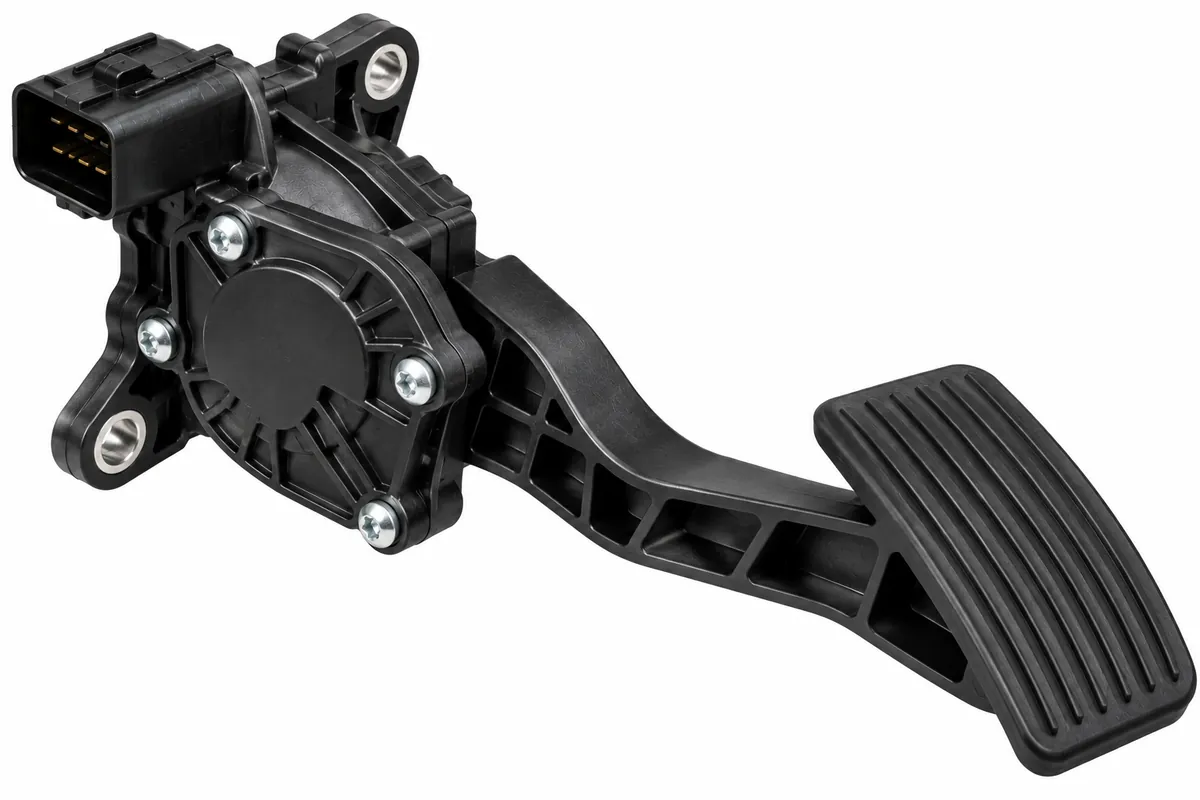
Mobile Accelerator Pedal Position Sensor Diagnostics in Daytona Beach
An accelerator pedal position code does not automatically mean the pedal assembly should be replaced.
Depending on the vehicle and fault, diagnosis can include checking:
- Accelerator Pedal Position Sensor 1
- Accelerator Pedal Position Sensor 2
- APP1/APP2 correlation
- Pedal percentage
- Sensor voltage
- 5-volt reference
- Sensor ground
- Signal circuits
- Connector condition
- Wiring harness
- Full pedal sweep
- Dead spots
- Intermittent signal dropout
- Commanded throttle position
- Actual throttle position
- Throttle Position Sensor 1
- Throttle Position Sensor 2
- Electronic throttle actuator operation
- Battery voltage
- Charging-system voltage
- Related trouble codes
- Freeze-frame information
The goal is to determine whether the driver-demand signal from the pedal is truly incorrect or whether the electronic throttle-control system is responding to another fault.
What Is an Accelerator Pedal Position Sensor?
The accelerator pedal position sensor, commonly abbreviated:
APP sensor
measures how far the accelerator pedal is being pressed.
On most modern vehicles, the sensor is integrated into the complete accelerator pedal assembly.
The pedal assembly may contain:
- Pedal arm
- Pivot
- Pedal pad
- Accelerator position sensors
- Electrical connector
- Internal electronics
In many applications, the sensor is not serviced separately from the pedal assembly.
What Does the Accelerator Pedal Position Sensor Do?
The APP sensor tells the powertrain control module how much acceleration the driver is requesting.
The PCM uses this information when determining:
- Throttle opening
- Engine torque
- Fuel delivery
- Ignition strategy
- Transmission response
- Cruise-control operation
- Traction-control intervention
The pedal does not directly command a fixed throttle opening.
The PCM evaluates driver demand along with other operating conditions before commanding the throttle body.
Accelerator Pedal Position Sensor vs. Gas Pedal
The terms are commonly used interchangeably by drivers.
On a drive-by-wire vehicle, the “gas pedal” is actually an electronic accelerator pedal assembly containing one or more position sensors.
Pressing the pedal changes an electrical signal rather than pulling a mechanical throttle cable.
Accelerator Pedal Position Sensor vs. Throttle Position Sensor
These are different sensors.
Accelerator Pedal Position Sensor
Measures what the driver is requesting.
Throttle Position Sensor
Measures where the throttle plate actually is.
On an electronic throttle system, the PCM compares both sides of the system.
The basic relationship is:
- Driver presses accelerator pedal.
- APP sensors report pedal movement.
- PCM interprets driver demand.
- PCM commands throttle actuator.
- Throttle plate moves.
- TPS sensors report actual throttle position.
A problem can occur at any point in this chain.
Accelerator Pedal Position Sensor vs. Throttle Body
The pedal sensor does not physically control airflow.
The throttle body controls airflow.
A failed APP sensor can prevent the PCM from commanding normal throttle movement even when the throttle body itself is completely functional.
Likewise, the pedal sensor can work correctly while a failed throttle actuator prevents the throttle plate from moving.
Drive-by-Wire Accelerator System
Most modern vehicles use an electronic throttle-control system often called:
- Drive-by-wire
- Electronic throttle control
- ETC
Instead of a cable running from the pedal to the throttle body, the system uses:
- Accelerator pedal sensors
- PCM
- Throttle actuator motor
- Throttle position sensors
Electronic control allows the PCM to manage engine torque precisely.
Why Accelerator Pedals Use Multiple Position Sensors
The accelerator pedal is a safety-critical input.
For this reason, many modern pedal assemblies contain two or more position sensors.
These may be identified as:
- APP Sensor 1
- APP Sensor 2
- APP A
- APP B
The PCM continuously compares their signals.
If they stop agreeing within the expected relationship, the PCM can recognize the fault and limit engine power.
APP Sensor 1 and APP Sensor 2
The two sensor signals do not necessarily display the same voltage or percentage.
Depending on the system:
- Both may rise at different rates
- One may operate over a different voltage range
- The PCM may expect a specific ratio between them
The important factor is that both signals follow their programmed relationship smoothly through the full pedal range.
How an Accelerator Pedal Position Sensor Works
Different pedal assemblies may use:
- Potentiometer-type sensors
- Hall-effect sensors
- Other noncontact position-sensing technology
The pedal’s physical movement is converted into an electrical signal.
The PCM interprets that signal as driver torque demand.
Potentiometer-Type Accelerator Pedal Sensor
A potentiometer-style sensor changes resistance as the pedal moves.
A typical circuit may include:
- 5-volt reference
- Ground
- Signal output
Pedal movement changes the signal voltage.
Many pedal assemblies contain multiple independent circuits for redundancy.
Hall-Effect Accelerator Pedal Sensor
Many newer pedal assemblies use Hall-effect technology.
A Hall-effect sensor can determine position without using a traditional sliding electrical contact.
Possible advantages include reduced mechanical wear of the sensing element.
Diagnosis still involves checking:
- Reference supply
- Ground
- Signal
- Correlation
- Smooth pedal response
The exact electrical characteristics depend on the vehicle.
Accelerator Pedal 5-Volt Reference
Many APP sensors operate from a regulated:
5-volt reference
supplied by the PCM.
If that reference voltage is lost, the pedal sensor cannot report position correctly.
Possible causes include:
- Open reference wire
- Short to ground
- Another sensor pulling down a shared reference
- PCM issue
Replacing the pedal assembly will not repair a missing reference supply.
Dual 5-Volt Reference Circuits
Some accelerator pedal assemblies use redundant electrical circuits with separate:
- Reference supplies
- Grounds
- Signals
This improves fault detection and system safety.
A wiring diagram should be used because terminal functions vary by vehicle.
Shared 5-Volt Reference Fault
The APP sensor may share a 5-volt circuit with other engine-management sensors.
If another sensor shorts the reference to ground, several unrelated-looking codes may appear at once.
Possible shared sensors can include:
- MAP sensor
- AC pressure sensor
- Fuel pressure sensor
A low 5-volt reference therefore does not automatically prove the pedal sensor is responsible.
APP Sensor Ground
The pedal sensors require a stable low-reference or ground circuit.
A poor ground can distort the sensor voltage and create:
- Incorrect pedal percentage
- Correlation faults
- Intermittent reduced power
- Low or high input codes
Ground quality should be tested rather than assumed.
Accelerator Pedal Signal Circuits
The signal circuits carry pedal-position information back to the PCM.
Possible faults include:
- Open circuit
- Short to ground
- Short to voltage
- Excessive resistance
- Intermittent connection
The signals should change smoothly as the pedal moves.
Accelerator Pedal Connector
The pedal connector should be inspected for:
- Loose terminals
- Bent pins
- Corrosion
- Water intrusion
- Damaged locking tab
- Backed-out terminals
- Previous wiring repairs
A pedal assembly installed on a damaged connector may continue setting the same fault.
Accelerator Pedal Wiring
Pedal wiring can be damaged by:
- Driver foot movement
- Carpet or trim interference
- Moisture
- Previous dashboard repairs
- Harness stretching
- Abrasion
Because the assembly is inside the passenger compartment, its wiring experiences a different environment from underhood sensors, but electrical faults can still occur.
Wiring Near the Pedal
The harness near the accelerator pedal should be checked for:
- Pinching
- Chafing
- Poor previous repair
- Loose connector retention
Interior work can sometimes disturb the pedal wiring.
Signs of a Bad Accelerator Pedal Position Sensor
Possible symptoms include:
- Check-engine light
- Electronic throttle-control warning
- Reduced Engine Power message
- Limited acceleration
- No accelerator response
- Intermittent accelerator response
- Hesitation
- RPM limitation
- Limp mode
- Inconsistent pedal response
- Accelerator pedal trouble codes
These symptoms should be supported by signal testing before replacement.
Accelerator Pedal Sensor and No Throttle Response
If the PCM cannot determine driver demand reliably, it may ignore or severely limit the accelerator-pedal input.
The driver may press the pedal while:
- Engine remains near idle
- RPM rises only slightly
- Vehicle accelerates very slowly
This can be an intentional failsafe response.
Intermittent Accelerator Response
An intermittent APP signal may cause the vehicle to respond normally one moment and lose throttle response the next.
Possible causes include:
- Internal sensor dropout
- Loose connector
- Damaged wire
- Correlation problem
Live-data monitoring during the fault is especially useful.
Accelerator Pedal Sensor and Hesitation
A sensor with an electrical dead spot can momentarily misreport pedal position as the driver accelerates.
This may feel like:
- Hesitation
- Flat spot
- Delayed response
However, hesitation can also be caused by:
- Fuel delivery
- Ignition
- MAF sensor
- MAP sensor
- Throttle-body fault
The pedal signal should show an abnormality before the sensor is condemned.
Accelerator Pedal Sensor and Reduced Engine Power
Reduced-power mode is common when the PCM detects an electronic throttle-control fault.
The PCM may intentionally limit:
- Throttle opening
- Engine torque
- RPM
- Acceleration
This is designed to prevent unintended throttle operation.
Reduced power does not automatically prove that the pedal sensor is the faulty component.
Accelerator Pedal Sensor and Limp Mode
A pedal-sensor correlation fault can cause the PCM to enter a failsafe mode.
Depending on vehicle strategy, the system may:
- Hold throttle near idle
- Permit only limited acceleration
- Limit engine speed
The behavior is intentional until reliable pedal information is restored.
Accelerator Pedal Sensor and Check-Engine Light
A problem in one or more pedal circuits can set diagnostic trouble codes.
Common APP-related code families include:
- P2120
- P2121
- P2122
- P2123
- P2124
- P2125
- P2126
- P2127
- P2128
- P2129
- P2138
Definitions can vary by manufacturer.
P2120 Accelerator Pedal Position Sensor Circuit
P2120 generally indicates a problem involving an accelerator pedal or throttle position circuit.
Possible causes include:
- APP sensor
- Wiring
- Connector
- Reference voltage
- Ground
The circuit should be tested before replacement.
P2121 APP Sensor Range/Performance
P2121 commonly indicates that an accelerator pedal sensor signal is outside the expected range or does not respond as expected.
Possible causes can include:
- Internal sensor problem
- Dead spot
- Wiring fault
- Correlation issue
The signal should be monitored through the complete pedal range.
P2122 Accelerator Pedal Position Sensor Low Input
P2122 generally indicates lower-than-expected voltage on an accelerator-pedal circuit.
Possible causes include:
- Signal short to ground
- Missing reference voltage
- Sensor fault
- Wiring issue
Testing the supply, ground, and signal circuits helps identify the actual cause.
P2123 Accelerator Pedal Position Sensor High Input
P2123 generally indicates a signal voltage higher than expected.
Possible causes can include:
- Signal short to voltage
- Open ground
- Sensor problem
- Connector fault
The electrical circuit should be verified.
P2124 Intermittent Accelerator Pedal Signal
An intermittent code can result from:
- Loose terminal
- Broken wire
- Internal sensor dropout
- Harness movement
An intermittent problem may disappear during static testing.
Monitoring live data while operating the pedal can help expose it.
P2125 Accelerator Pedal Position Sensor Circuit
P2125 commonly refers to another accelerator-pedal circuit.
Many systems use redundant sensors, so the correct sensor channel should be identified.
The code does not automatically mean the entire pedal assembly has failed.
P2126 APP Sensor Range/Performance
P2126 commonly indicates an implausible or abnormal signal from another pedal-position circuit.
Possible causes include:
- Sensor internal fault
- Wiring
- Connector
- Correlation problem
The relationship between both APP signals is important.
P2127 Accelerator Pedal Position Sensor Low Input
P2127 generally identifies a low-input condition on one of the accelerator-pedal sensor circuits.
Possible causes include:
- Short to ground
- Open reference
- Failed sensor
- Connector problem
The sensor should not be replaced until the circuit has been checked.
P2128 Accelerator Pedal Position Sensor High Input
P2128 generally indicates a higher-than-expected signal.
Possible causes include:
- Signal short to voltage
- Open ground
- Internal sensor fault
- Wiring problem
Electrical testing should establish which condition exists.
P2129 Intermittent APP Sensor Circuit
An intermittent circuit fault can be caused by:
- Connector movement
- Broken conductor
- Sensor dropout
- Harness damage
A full pedal sweep combined with harness inspection can help locate the problem.
P2138 Accelerator Pedal Position Sensor Correlation
P2138 is an important drive-by-wire fault.
It generally indicates that redundant pedal-position signals no longer agree within the expected relationship.
Possible causes include:
- Accelerator pedal assembly
- Wiring
- Connector
- Reference-voltage problem
- Ground problem
Because signal correlation is a safety feature, the PCM may immediately reduce engine power.
What Does APP Correlation Mean?
The PCM expects the two pedal sensors to maintain a specific relationship.
For example, if the driver presses the pedal:
- APP1 should move smoothly
- APP2 should also move smoothly
- Their relationship should remain within the programmed tolerance
If one signal suddenly drops while the other continues normally, the PCM recognizes that the driver-demand information cannot be trusted.
APP Sensor Correlation Testing
A scan tool can be used to observe:
- APP Sensor 1
- APP Sensor 2
The pedal should be moved slowly from released position to full travel and back.
Both signals should respond:
- Smoothly
- Consistently
- Without dropouts
The exact percentages or voltages do not necessarily have to match one another.
Their programmed relationship matters.
Accelerator Pedal Percentage
Scan data may show accelerator-pedal position as a percentage.
The reading may not necessarily be:
- 0% at rest
- 100% at full pedal
Some vehicle software scales the data differently.
The important factors include:
- Smooth movement
- Full expected range
- Proper correlation
Pedal Released Position
With the accelerator released, both APP signals should be within the expected rest range.
A signal that indicates substantial pedal input with the pedal released can be caused by:
- Sensor fault
- Wiring problem
- Incorrect pedal data interpretation
Vehicle-specific specifications should be used.
Full Pedal Position
When the pedal is pressed fully, APP signals should move toward their expected maximum range without:
- Sudden dropouts
- Flat spots
- Reversals
A sensor may work at the beginning and end of travel while failing in the middle.
APP Sensor Dead Spot
A dead spot is a portion of pedal travel where the electrical signal becomes:
- Erratic
- Flat
- Intermittent
- Discontinuous
This can produce a repeatable hesitation or reduced-power event at a specific pedal position.
A full sweep test is important for detecting this type of fault.
Testing the Accelerator Pedal Sensor With a Scan Tool
A scan tool can provide some of the most useful APP diagnostic information.
Parameters may include:
- APP1 percentage
- APP2 percentage
- APP1 voltage
- APP2 voltage
- Commanded throttle
- Actual throttle
- TPS1
- TPS2
Slow pedal movement can reveal whether the signals remain smooth and correlated.
Comparing Pedal Position to Commanded Throttle
On a drive-by-wire system:
- APP represents driver request
- Commanded throttle represents PCM response
If APP values are smooth and believable but commanded throttle stays limited, the PCM may be responding to another fault.
If APP itself drops out, the pedal sensor or its circuit becomes more suspicious.
Comparing APP to Actual Throttle Position
The driver can press the accelerator while the throttle body remains closed because of:
- Throttle actuator failure
- ETC failsafe mode
- Throttle-body fault
If APP readings show the driver request correctly, replacing the pedal assembly would not solve that problem.
Comparing APP to TPS
The accelerator pedal and throttle position signals should change in a generally logical relationship during normal acceleration.
They are not expected to be numerically identical because the PCM controls throttle movement based on many variables.
The important question is whether each side of the system is functioning correctly.
Testing APP With a Multimeter
Depending on the design, a multimeter can help check:
- Reference voltage
- Ground
- Signal voltage
On an analog circuit, slowly operating the pedal can show whether the signal changes smoothly.
However, a digital meter can miss very brief dropouts.
Oscilloscope Testing an Accelerator Pedal Sensor
An oscilloscope can show the APP signal continuously.
It can reveal:
- Dead spots
- Spikes
- Brief signal interruptions
- Noise
Dual channels can allow both pedal sensor signals to be viewed together.
This can make correlation faults easier to identify.
APP Sensor Voltage Sweep
On an analog system, signal voltage should normally change smoothly as the pedal is pressed.
A normal test should not show:
- Sudden zero-voltage drop
- Unexpected full-voltage spike
- Abrupt discontinuity
Exact voltage ranges depend on vehicle design.
APP Sensor Resistance Testing
Older potentiometer-style sensors may permit resistance testing.
However, many modern Hall-effect pedal sensors should not be diagnosed using a generic resistance test.
The sensor type must be identified first.
Accelerator Pedal Wiring Wiggle Test
If the fault is intermittent, carefully moving the harness while monitoring APP signals may reveal:
- Signal spikes
- Dropouts
- Correlation faults
The wiring should not be pulled aggressively.
Accelerator Pedal Sensor and Throttle Body
A common diagnostic mistake is replacing the pedal assembly because the vehicle has poor throttle response when the actual problem is the throttle body.
The two sides can be separated through scan data.
If APP Changes Normally
The pedal is reporting driver demand.
If Commanded Throttle Changes but Actual Throttle Does Not
The throttle actuator or throttle body becomes more suspicious.
If APP Drops Out
The pedal sensor or its circuit becomes more suspicious.
This distinction can prevent unnecessary parts replacement.
Accelerator Pedal Sensor and Throttle Position Sensor
The throttle position sensor reports actual plate position.
An APP/TPS mismatch can occur because of:
- APP failure
- TPS failure
- Throttle actuator failure
- Wiring
The faulty component should be identified from the individual signal behavior.
Accelerator Pedal Sensor and Throttle Actuator Motor
The accelerator pedal does not directly power the throttle actuator.
The sequence is:
Pedal → PCM → Throttle Motor
A failed motor cannot be repaired by replacing the pedal.
Likewise, the motor may be good but never receive a normal command because the pedal signal is implausible.
Accelerator Pedal Sensor and Dirty Throttle Body
A dirty or sticking throttle body can produce poor response even when the pedal sensor works perfectly.
If APP data changes smoothly but actual throttle does not follow, inspect the throttle side of the system.
Carbon deposits do not normally damage the accelerator pedal sensor because the pedal is inside the passenger compartment.
Accelerator Pedal Sensor and MAF Sensor
A bad MAF sensor can cause:
- Hesitation
- Poor acceleration
- Reduced performance
while APP data remains normal.
The MAF measures airflow; it does not determine driver pedal position.
Accelerator Pedal Sensor and MAP Sensor
A MAP sensor problem can affect:
- Engine load calculation
- Fueling
- Performance
but it does not directly change the pedal-position signal.
APP data should remain smooth if the pedal system is healthy.
Accelerator Pedal Sensor and Fuel Pressure
Low fuel pressure can make the engine fail to accelerate even though:
- APP works
- Throttle opens normally
This is why lack of acceleration alone is not proof of a pedal sensor problem.
Accelerator Pedal Sensor and Ignition Misfire
A misfiring engine may hesitate under acceleration.
Possible causes include:
- Spark plugs
- Ignition coils
- Injectors
- Compression
If pedal and throttle data remain normal, the APP sensor is unlikely to be the primary cause.
Accelerator Pedal Sensor and Transmission Problems
The transmission may respond to driver-demand information when choosing:
- Shift timing
- Gear
- Torque-converter strategy
A severely incorrect pedal signal could influence shift behavior.
However, transmission symptoms alone should not lead directly to pedal replacement.
Accelerator Pedal Sensor and Cruise Control
Cruise-control operation may be disabled when the PCM detects a pedal or electronic-throttle fault.
Loss of cruise control can therefore accompany:
- P2138
- Reduced-power mode
but cruise failure by itself does not prove an APP sensor problem.
Accelerator Pedal Sensor and Traction Control
Electronic throttle systems allow the PCM to reduce engine torque during traction-control or stability-control events.
An unreliable driver-demand signal may cause those systems to:
- Disable
- Set warnings
The stored fault codes should identify the diagnostic direction.
Accelerator Pedal Sensor and Brake Pedal Input
Some electronic throttle systems compare accelerator demand with:
- Brake-switch information
If the vehicle sees unusual simultaneous brake and accelerator input, it may alter throttle response.
A brake-switch fault can sometimes affect perceived throttle behavior.
The exact strategy varies by vehicle.
Accelerator Pedal Sensor and Battery Voltage
Electronic throttle systems rely on stable electrical power.
A weak battery or charging-system problem can produce:
- Multiple sensor codes
- Reduced-power mode
- Erratic electronic throttle behavior
System voltage should be checked when several electronic faults appear together.
Low Voltage and P2138
Low system voltage can disrupt sensor references and module operation.
If P2138 appears alongside:
- Low-voltage codes
- Multiple module warnings
- Starting problems
battery and charging-system condition should be evaluated before replacing the pedal assembly.
Accelerator Pedal Sensor and PCM
PCM failure is possible but generally less common than:
- Sensor
- Connector
- Wiring
Before condemning the PCM, the complete pedal circuits should be verified from the sensor to the module.
Water Intrusion Near Accelerator Pedal
Because the accelerator pedal is mounted low in the passenger compartment, water intrusion can sometimes affect:
- Connector
- Harness
- Terminals
Potential water sources can include:
- Windshield leaks
- Door leaks
- HVAC drainage problems
- Flooding
Moisture damage should be corrected along with the electrical fault.
Floor Mat Interference With Accelerator Pedal
A floor mat can physically interfere with pedal travel if it is:
- Incorrectly installed
- Stacked over another mat
- Not secured
This is a mechanical interference issue, not an APP sensor failure.
The pedal should be able to move freely through its intended range.
Accelerator Pedal Binding
A pedal can feel abnormal because of:
- Mechanical pivot damage
- Foreign object
- Trim interference
- Floor mat obstruction
Physical pedal movement should be checked before electronic diagnosis is completed.
Accelerator Pedal Returns Slowly
If the pedal itself does not return normally, inspect for:
- Mechanical binding
- Damaged pedal assembly
- Obstruction
The problem may be mechanical even if the sensors still produce an electrical signal.
Accelerator Pedal Sensor Intermittent Failure
Intermittent sensor failure may occur because of:
- Internal electronics
- Worn sensing element on applicable designs
- Connector movement
- Heat
- Wiring
The vehicle can operate normally between failures.
This makes stored codes, freeze-frame information, and live-data testing especially valuable.
Heat-Related APP Sensor Failure
Although the accelerator pedal is not exposed to engine heat like underhood sensors, interior temperature and electrical heat can still influence an intermittent electronic fault.
A signal that changes only after extended operation should be monitored under the conditions that reproduce the problem.
Accelerator Pedal Position Sensor Replacement
Once diagnostics confirm that the accelerator pedal position sensor or integrated pedal assembly is defective, replacement generally includes:
- Verify the complaint and stored trouble codes.
- Review freeze-frame data.
- Monitor APP Sensor 1.
- Monitor APP Sensor 2.
- Check APP1/APP2 correlation.
- Perform a slow full-pedal sweep.
- Look for dead spots or signal dropouts.
- Verify reference voltage.
- Verify sensor grounds.
- Check the signal circuits.
- Inspect the connector.
- Inspect wiring near the pedal.
- Compare APP data with commanded throttle.
- Compare commanded throttle with actual throttle position.
- Verify that the throttle-body fault is not causing the complaint.
- Turn the ignition off.
- Disconnect the battery if required by the service procedure.
- Remove trim panels where necessary for access.
- Disconnect the accelerator pedal electrical connector.
- Remove the pedal mounting fasteners.
- Remove the pedal assembly.
- Compare the replacement assembly with the original.
- Inspect the mounting area and connector.
- Install the replacement pedal assembly.
- Tighten mounting hardware correctly.
- Reconnect the electrical connector.
- Reinstall removed trim.
- Reconnect the battery where applicable.
- Turn the ignition on.
- Verify both APP signals.
- Perform another full pedal sweep.
- Confirm correct APP correlation.
- Perform initialization or relearn where required.
- Start the engine.
- Check commanded and actual throttle response.
- Clear applicable trouble codes.
- Road-test the vehicle when appropriate.
- Confirm normal accelerator response and no return of the original fault.
The exact procedure depends on vehicle design.
Complete Accelerator Pedal Assembly Replacement
On many vehicles, the accelerator pedal position sensors are permanently integrated into the pedal assembly.
In those applications, the normal repair is:
replacement of the complete accelerator pedal assembly
rather than opening the pedal and replacing an internal sensor.
Can the Accelerator Pedal Sensor Be Replaced Separately?
It depends on the vehicle.
Some older systems may have a separately serviceable sensor.
Many modern electronic pedal assemblies do not.
If the manufacturer supplies the sensor only as part of the pedal assembly, the complete assembly should be serviced as designed.
Accelerator Pedal Mounting
The pedal assembly is generally bolted to:
- Firewall
- Floor structure
- Pedal bracket
The replacement should sit securely with no:
- Movement
- Binding
- Interference
The pedal must operate smoothly after installation.
Accelerator Pedal Relearn
Some vehicles may require an accelerator-pedal position relearn or initialization after replacement.
Other vehicles learn the pedal position automatically.
The procedure can involve:
- Ignition cycles
- Pedal sequence
- Scan-tool function
Vehicle-specific service information should be followed.
Does an Accelerator Pedal Position Sensor Need Programming?
A conventional APP sensor or pedal assembly generally does not require vehicle-specific programming like an electronic module.
However, some vehicles may require:
- Initialization
- Accelerator-pedal relearn
- Throttle adaptation
These procedures should not be confused with module programming.
Accelerator Pedal Position Relearn vs. Throttle Relearn
These can be separate procedures.
Accelerator Pedal Relearn
Establishes pedal-position values where required.
Throttle Relearn
Establishes throttle-body or idle values.
A vehicle may require:
- One
- Both
- Neither
depending on design.
New Accelerator Pedal but P2138 Returns
If P2138 returns after pedal replacement, possible causes include:
- Connector problem
- Wiring fault
- Reference-voltage problem
- Ground problem
- Incorrect replacement part
- PCM issue
Another pedal assembly should not automatically be installed.
New Accelerator Pedal but P2122 Returns
A recurring low-input code can indicate:
- Short to ground
- Missing reference voltage
- Harness problem
- Connector issue
The circuit should be tested before condemning the new sensor.
New Accelerator Pedal but P2127 Returns
A recurring P2127 can also indicate a circuit problem rather than a defective new pedal.
Check:
- Reference voltage
- Ground
- Signal wiring
- Connector terminals
New Accelerator Pedal but Reduced Power Remains
Possible causes include:
- Throttle body
- Throttle actuator
- TPS correlation fault
- Wiring
- Low system voltage
- Another ETC code
The electronic throttle system should be reevaluated as a whole.
New Accelerator Pedal but Throttle Still Does Not Respond
If new APP signals are correct but the throttle remains limited, inspect:
- Commanded throttle
- Actual throttle
- Throttle-body actuator
- TPS signals
- ETC-related trouble codes
The problem may have been on the throttle side all along.
New Accelerator Pedal but Car Still Hesitates
If the pedal signals now test normally, hesitation may be caused by:
- Fuel pressure
- MAF sensor
- MAP sensor
- Ignition misfire
- Fuel injector
- Vacuum leak
The remaining symptom should be diagnosed separately.
OEM vs. Aftermarket Accelerator Pedal Sensors
The PCM expects the pedal sensors to maintain precise electrical relationships.
A replacement assembly must provide the correct:
- Signal range
- Correlation
- Connector
- Mechanical travel
- Mounting
A poorly calibrated replacement can cause recurring electronic throttle-control faults.
Cheap Accelerator Pedal Sensor Problems
A low-quality pedal assembly can potentially produce:
- Incorrect APP values
- P2138
- P212x codes
- Intermittent throttle response
- Reduced-power mode
Correct calibration and build quality are important because the pedal is a safety-critical driver input.
Used Accelerator Pedal Assembly
A used pedal may appear to work, but its:
- Mileage
- Wear
- Internal electronics
- Previous exposure
are unknown.
A quality new assembly is generally a more predictable repair.
Accelerator Pedal Position Sensor Replacement Cost
Replacement cost depends on:
- Vehicle year, make, and model
- Separate sensor vs. complete pedal assembly
- Access
- Wiring condition
- Diagnostic time
- Relearn requirements
Many pedal assemblies are relatively accessible, but accurate diagnosis remains important because electronic throttle symptoms can originate elsewhere in the system.
Call Jimmy’s Mobile Care at (386) 308-2509 with your vehicle information and symptoms so we can determine the appropriate accelerator-pedal diagnostic service.
Why Diagnose the Accelerator Pedal Position Sensor Before Replacing It?
The APP sensor is only one part of the drive-by-wire system.
Do APP1 and APP2 Move Smoothly?
A dead spot or dropout can support an internal sensor fault.
Do Both APP Signals Maintain Proper Correlation?
If one signal diverges from the other, the PCM may set P2138 and reduce power.
Is the 5-Volt Reference Present?
A replacement pedal cannot repair a missing reference voltage.
Are the Ground Circuits Good?
A poor ground can distort one or both pedal signals.
Is the Connector Secure?
Loose terminals can create intermittent throttle loss.
Does the Wiring Change When the Harness Moves?
An intermittent harness problem can look exactly like a failing pedal sensor.
Does Commanded Throttle Follow Pedal Demand?
If APP data is correct but the PCM does not command normal throttle, another fault may be active.
Does Actual Throttle Follow Commanded Throttle?
If command is present but the throttle plate does not move correctly, the throttle body or actuator becomes more suspicious.
Is System Voltage Stable?
Low voltage can create several ETC faults at once.
Is the Pedal Physically Free to Move?
Floor mats, trim, or mechanical damage can restrict travel without an electronic sensor failure.
Testing these areas helps prevent unnecessary pedal replacement and isolates the actual cause of reduced or erratic throttle response.
Mobile Accelerator Pedal Position Sensor Diagnostics in Daytona Beach
Jimmy’s Mobile Care provides mobile car accelerator pedal position sensor diagnostics in Daytona Beach for vehicles experiencing:
- P2120
- P2121
- P2122
- P2123
- P2124
- P2125
- P2126
- P2127
- P2128
- P2129
- P2138
- Reduced Engine Power warning
- Electronic throttle-control warning
- No accelerator response
- Intermittent accelerator response
- Hesitation
- Limited RPM
- Suspected accelerator-pedal wiring problems
We test APP1 and APP2 signals, correlation, reference voltage, grounds, connector integrity, pedal sweep, commanded throttle, and actual throttle response before determining whether the pedal assembly itself requires replacement.
Mobile Accelerator Pedal Position Sensor Replacement in Daytona Beach
When diagnostics confirm a defective accelerator pedal position sensor or integrated pedal assembly and the repair is appropriate for mobile service, Jimmy’s Mobile Care can replace many accelerator pedal assemblies at your Daytona Beach location.
After replacement, we can verify:
- Secure pedal mounting
- Correct electrical connection
- Smooth APP1 signal
- Smooth APP2 signal
- Proper signal correlation
- Correct full pedal sweep
- Normal commanded-throttle response
- Normal actual-throttle response
- Required initialization or relearn
- No immediate return of the original fault
If the actual problem is damaged wiring, a missing 5-volt reference, poor ground, throttle-body actuator fault, throttle position sensor problem, low voltage, or PCM issue, that condition must be corrected instead of unnecessarily replacing the accelerator pedal assembly.
Schedule Car Accelerator Pedal Position Sensor Diagnostics & Replacement in Daytona Beach
A P2138 code, reduced-power warning, limited acceleration, or intermittent loss of accelerator response does not automatically mean the accelerator pedal assembly has failed.
The same symptoms can result from a damaged connector, faulty wiring, reference-voltage problem, poor ground, throttle-body failure, TPS correlation fault, low electrical voltage, or another electronic throttle-control problem.
Jimmy’s Mobile Care tests the accelerator pedal signals throughout their complete operating range and compares driver demand with commanded and actual throttle response before replacement so the pedal assembly is replaced only when the diagnosis supports it.
Call Jimmy’s Mobile Care at (386) 308-2509 to schedule car accelerator pedal position sensor diagnostics and replacement in Daytona Beach, FL. Call today and we'll come to your location.