
Car Knock Sensor Diagnostics & Replacement in Daytona Beach, FL
The knock sensor helps the engine computer detect abnormal combustion vibration so ignition timing can be adjusted before prolonged detonation damages the engine. Unlike sensors that measure temperature, pressure, or airflow directly, the knock sensor listens for vibration patterns transmitted through the engine block.
When a knock sensor fails, its circuit develops a wiring problem, the sensor becomes damaged, or its mounting no longer allows it to detect vibration correctly, the engine computer may lose an important source of combustion feedback. Depending on the vehicle, this can turn on the check-engine light, reduce performance, cause conservative ignition timing, decrease fuel economy, or set knock-sensor circuit and performance codes.
Jimmy’s Mobile Care provides car knock sensor diagnostics and replacement in Daytona Beach, FL. We test the sensor circuit and related engine conditions before recommending replacement so actual spark knock, low-octane or contaminated fuel, overheating, a lean mixture, mechanical engine noise, wiring damage, or another engine-control problem is not mistaken for a failed knock sensor.
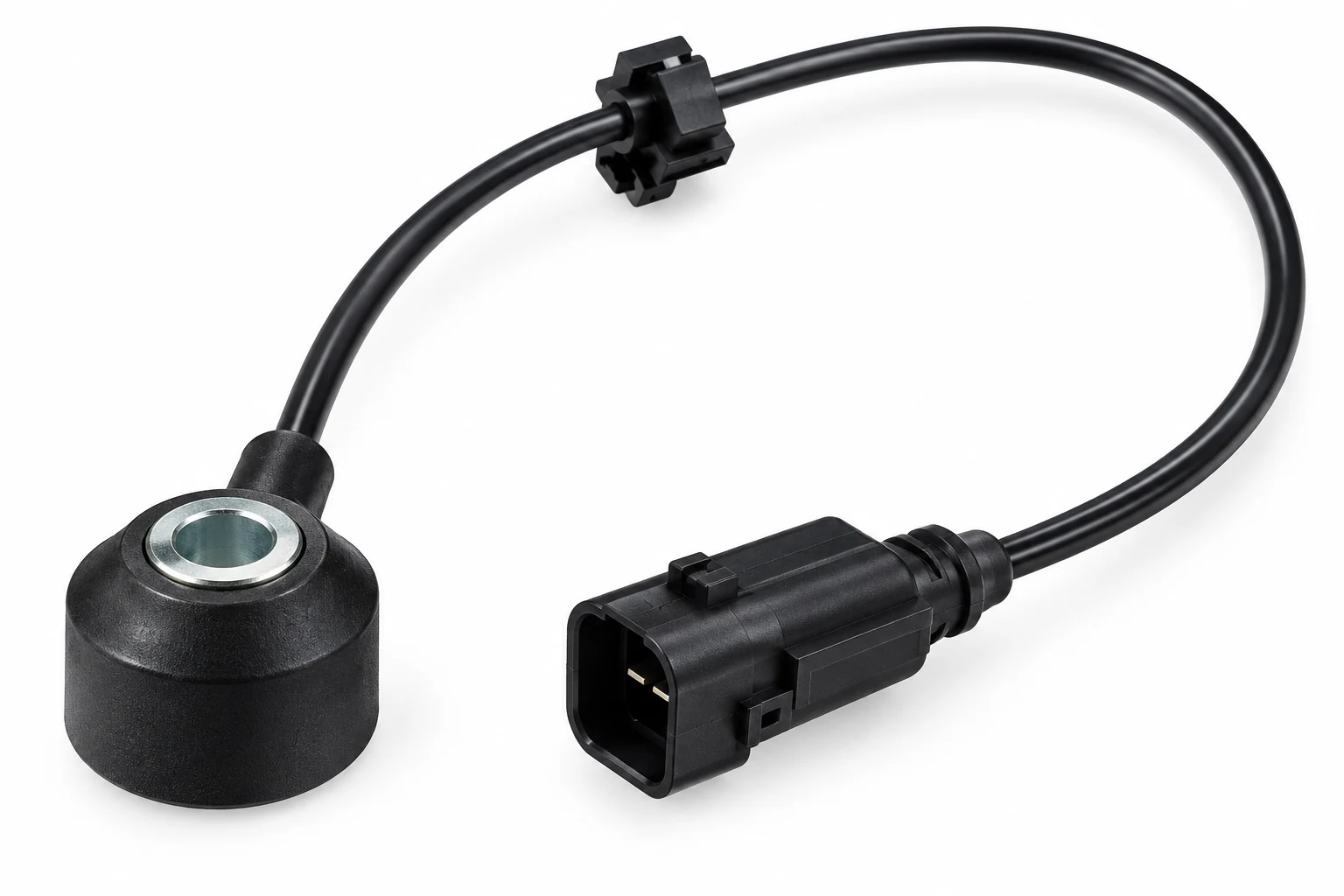
Mobile Knock Sensor Diagnostics in Daytona Beach
A trouble code containing the words “knock sensor” does not automatically prove that the sensor itself has failed.
Depending on the vehicle and fault, diagnosis can include checking:
- Knock-sensor trouble codes
- Freeze-frame information
- Knock-sensor signal
- Bias or reference voltage where applicable
- Sensor resistance or continuity where applicable
- Wiring integrity
- Connector condition
- Harness routing
- Shorts to ground or voltage
- Sensor mounting
- Mounting-bolt torque
- Engine-block contact surface
- Bank 1 or Bank 2 identification
- Ignition timing
- Knock-retard data where available
- Fuel trims
- Engine coolant temperature
- Air/fuel conditions
- Actual engine noise
- Fuel quality
- Mechanical engine condition
The objective is to determine whether the sensor cannot detect knock correctly, whether its signal cannot reach the engine computer, or whether the engine is actually producing abnormal combustion or mechanical vibration.
What Is a Knock Sensor?
A knock sensor is an engine-mounted vibration sensor designed to detect frequencies associated with abnormal combustion.
It is typically mounted directly to the:
- Engine block
- Cylinder-block valley
- Cylinder head on some designs
- Another structurally rigid engine location
Its mounting location allows combustion vibration to travel through the engine structure into the sensor.
What Does a Knock Sensor Do?
During normal combustion, the air-fuel mixture burns in a controlled manner.
Under certain conditions, abnormal combustion can create rapid pressure oscillations commonly described as:
- Spark knock
- Detonation
- Ping
- Pinging
The knock sensor detects vibration associated with this condition.
The engine computer can then respond by changing ignition timing or other operating strategies.
Why an Engine Needs Knock Detection
Modern engines often operate close to the ignition timing that produces efficient combustion and good torque.
However, the amount of ignition advance an engine can safely tolerate changes with:
- Fuel octane
- Engine temperature
- Load
- Intake temperature
- Combustion-chamber deposits
- Air/fuel mixture
- Boost pressure on turbocharged engines
Knock feedback gives the PCM a way to recognize abnormal combustion and react.
What Is Engine Knock?
Combustion knock occurs when pressure inside the cylinder develops abnormally instead of following the intended controlled combustion process.
The result can produce a metallic:
- Ping
- Rattle
- Knock
particularly under load.
Severe or prolonged detonation can place excessive stress on:
- Pistons
- Ring lands
- Bearings
- Cylinder walls
- Head gaskets
The knock sensor is part of the engine’s protection strategy.
Knock Sensor vs. Actual Engine Knock
These are not the same thing.
Knock Sensor
An electronic vibration sensor.
Engine Knock
A combustion or mechanical condition occurring inside the engine.
A vehicle can have:
- A bad knock sensor with no actual knock
- Actual detonation with a perfectly functioning knock sensor
Diagnosis must determine which condition exists.
Knock Sensor vs. Mechanical Engine Knock
A knock sensor can sometimes respond to mechanical vibration that resembles combustion knock.
Mechanical noises can come from:
- Worn bearings
- Piston slap
- Valve-train components
- Loose accessories
- Timing components
The PCM uses filtering and operating conditions to distinguish expected engine vibration from combustion knock, but abnormal mechanical noise can complicate diagnosis.
A loud engine knock should never automatically be treated as a sensor failure.
How a Knock Sensor Works
Many knock sensors use a piezoelectric element.
Piezoelectric material generates an electrical response when subjected to:
- Pressure
- Vibration
- Mechanical stress
Engine-block vibration therefore creates a changing electrical signal that can be interpreted by the PCM.
Piezoelectric Knock Sensor
Inside a typical knock sensor is a piezoelectric element designed to respond to a particular range of engine vibration.
When the engine block vibrates:
- Vibration reaches the sensor.
- The piezoelectric element is mechanically stressed.
- The element generates an electrical signal.
- The PCM analyzes the signal.
- If knock is detected, ignition strategy can be adjusted.
The sensor must be mounted correctly because its physical connection to the engine is part of how it operates.
Resonant Knock Sensor
Some knock sensors are designed to be particularly sensitive around a specific frequency range.
This is sometimes referred to as a resonant sensor.
The intended frequency is related to engine characteristics such as cylinder dimensions and expected knock frequency.
Broadband Knock Sensor
Other sensors operate over a broader vibration range.
The PCM performs more of the signal filtering electronically.
This allows the control system to analyze engine vibration over a wider spectrum.
Knock Sensor Signal
Unlike a simple switch, a knock sensor can generate a changing waveform corresponding to engine vibration.
The PCM may evaluate:
- Signal amplitude
- Frequency
- Engine RPM
- Engine load
- Crankshaft position
to determine whether the vibration represents combustion knock.
Knock Sensor Bias Voltage
Some knock-sensor circuits use a bias voltage supplied or monitored by the PCM.
This allows the computer to detect certain electrical faults such as:
- Open circuit
- Short to ground
- Short to voltage
The expected voltage is vehicle-specific.
A generic voltage specification should not be applied to every knock-sensor system.
Knock Sensor Resistance
Certain knock sensors can be checked electrically for resistance, while other designs should not be judged using a generic resistance test.
The correct specification depends on:
- Sensor design
- Vehicle
- Circuit configuration
A resistance reading alone also may not prove that the sensor responds correctly to actual vibration.
Knock Sensor Wiring
Depending on the design, a knock sensor may use:
- One signal wire with grounding through the sensor body
- Signal and dedicated low-reference wiring
- Shielded wiring
- Multiple terminals
The correct wiring diagram should be used before testing.
Shielded Knock Sensor Wiring
Because the knock sensor handles relatively small vibration signals, some systems use shielded wiring to protect the circuit from electrical interference.
Damage to the shielding can allow noise from other circuits to affect the signal.
Improper wiring repair can therefore create problems even if basic continuity appears normal.
Knock Sensor Connector
The connector should be inspected for:
- Corrosion
- Loose terminals
- Bent pins
- Broken locking tabs
- Oil contamination
- Coolant contamination
- Heat damage
- Damaged insulation
A replacement sensor cannot repair a defective connector.
Knock Sensor Harness Damage
Knock-sensor wiring can be damaged by:
- Engine heat
- Oil
- Coolant
- Rodents
- Previous engine repairs
- Harness chafing
- Connector deterioration
On engines where the sensor is located under the intake manifold, harness problems can be hidden from normal visual inspection.
Signs of a Bad Knock Sensor
Possible symptoms include:
- Check-engine light
- Reduced engine power
- Sluggish acceleration
- Poor throttle response
- Reduced fuel economy
- Conservative ignition timing
- Knock-sensor trouble codes
- Engine operating normally except for warning light
- Failed emissions inspection where applicable
A failed knock sensor does not necessarily create an obvious drivability problem.
The PCM may compensate by using a safer ignition strategy.
Can a Bad Knock Sensor Cause Loss of Power?
Yes.
If the PCM cannot reliably monitor combustion knock, it may use more conservative ignition timing.
Retarded timing can reduce:
- Engine torque
- Acceleration
- Efficiency
The amount of performance loss depends on the vehicle’s control strategy.
Knock Sensor and Poor Acceleration
A knock-sensor circuit fault can cause the PCM to limit ignition advance.
The engine may feel:
- Sluggish
- Less responsive
- Weaker under load
However, poor acceleration can also result from:
- Fuel-delivery problems
- Ignition misfire
- Restricted exhaust
- MAF problems
- Throttle-control faults
Performance symptoms alone do not prove a knock-sensor failure.
Knock Sensor and Fuel Economy
Retarded ignition timing can reduce engine efficiency.
A knock-sensor fault may therefore contribute to increased fuel consumption.
Poor fuel economy can also result from many other conditions, so the sensor should not be replaced based on fuel mileage alone.
Knock Sensor and Check-Engine Light
A knock-sensor electrical or performance problem can turn on the check-engine light.
Common code families include:
- P0324
- P0325
- P0326
- P0327
- P0328
- P0329
- P0330
- P0331
- P0332
- P0333
- P0334
The exact definition depends on vehicle configuration.
P0325 Knock Sensor Circuit
P0325 commonly identifies a problem with a knock-sensor circuit, often involving Bank 1 or Sensor 1 depending on the vehicle.
Possible causes include:
- Failed knock sensor
- Open wiring
- Connector problem
- Shorted circuit
- Improper sensor installation
The code identifies the circuit being monitored, not automatically the failed part.
P0326 Knock Sensor Range/Performance
P0326 commonly indicates that the knock-sensor signal is outside the expected performance range.
Possible causes include:
- Weak sensor response
- Improper mounting
- Incorrect torque
- Wiring problem
- Excessive mechanical engine noise
A performance code requires evaluating both the electrical signal and the physical sensor installation.
P0327 Knock Sensor Circuit Low
P0327 generally indicates a knock-sensor signal lower than the PCM expects.
Possible causes can include:
- Failed sensor
- Open circuit
- Short to ground
- Connector problem
- Sensor mounting issue
Circuit testing should be performed before replacement.
P0328 Knock Sensor Circuit High
P0328 generally indicates a signal higher than expected.
Possible causes include:
- Sensor fault
- Wiring short
- Electrical interference
- Excessive engine vibration
- Connector problem
Actual engine noise and circuit integrity should both be considered.
P0329 Intermittent Knock Sensor Circuit
An intermittent fault can result from:
- Loose connector
- Broken conductor
- Heat-related sensor failure
- Vibration-sensitive connection
An intermittent code is especially important because the circuit may test normally when the vehicle is stationary.
P0330 Knock Sensor Bank 2 Circuit
On engines with two cylinder banks, P0330 commonly identifies a knock-sensor circuit associated with Bank 2.
Correct bank identification is important before replacement.
Bank 1 and Bank 2 locations vary by engine design.
P0332 Knock Sensor Low Input
P0332 commonly identifies a low-input condition involving another knock-sensor circuit, often Bank 2 on applicable engines.
Possible causes remain similar:
- Sensor
- Wiring
- Connector
- Mounting
The exact sensor should be identified before parts are removed.
Bank 1 Knock Sensor
Bank 1 is the cylinder bank containing cylinder number 1.
On an inline engine, there is generally only one cylinder bank.
On V-type engines, Bank 1 can be located on either side depending on manufacturer and engine design.
It should never be identified solely by assuming:
- Driver side
- Passenger side
Vehicle-specific information should be used.
Bank 2 Knock Sensor
Bank 2 is the opposite cylinder bank from Bank 1 on an engine with two cylinder banks.
Some engines use:
- One sensor per bank
- Multiple sensors
- A different monitoring arrangement
The trouble code should be matched to the correct sensor and circuit.
Knock Sensor 1 vs. Knock Sensor 2
Some vehicles identify sensors numerically.
Sensor numbering may relate to:
- Cylinder bank
- Sensor location
- Engine-control strategy
The physical sensor should be positively identified before replacement.
Where Is the Knock Sensor Located?
Knock-sensor location varies significantly.
Common locations include:
- Side of engine block
- Front of block
- Rear of block
- Under intake manifold
- In engine valley
- Near cylinder head
Some sensors are easily accessible.
Others require significant intake-system disassembly.
Knock Sensor Under Intake Manifold
Many V6 and V8 engines place knock sensors in the valley beneath the intake manifold.
Access may require removing:
- Air intake components
- Throttle-body connections
- Upper intake manifold
- Lower intake components on some designs
- Electrical connectors
- Vacuum hoses
- Fuel-system components depending on design
This can make knock-sensor replacement considerably more involved than the sensor’s small size suggests.
Knock Sensor on Engine Block
Some engines mount the sensor externally on the side of the block.
These can be much easier to access.
Even with an externally mounted sensor, the mounting surface and torque remain important.
Why Knock Sensor Mounting Matters
The knock sensor must mechanically couple to the engine.
If the sensor is:
- Loose
- Overtightened
- Mounted on corrosion
- Installed over debris
- Installed incorrectly
its vibration response can change.
That can produce a poor signal even when the sensor electronics are functional.
Knock Sensor Mounting Surface
The surface beneath the sensor should generally be:
- Clean
- Flat
- Free of heavy corrosion
- Free of debris
Anything that changes how vibration passes from the engine block to the sensor can affect sensor performance.
Knock Sensor Torque
Knock-sensor mounting torque can be critical.
Too Loose
The sensor may not couple correctly to engine vibration.
Too Tight
The sensor may be mechanically stressed or its response characteristics may change.
The mounting bolt should be tightened to the vehicle-specific specification.
Can You Just Tighten a Knock Sensor?
If a sensor is found loose, correcting its mounting may be part of the repair.
However, the cause and sensor condition should still be evaluated.
Overtightening a knock sensor in an attempt to improve its signal is not appropriate.
Knock Sensor and Engine Detonation
If the engine is genuinely detonating, the knock sensor may be doing exactly what it is designed to do.
Possible causes of actual detonation include:
- Low-octane fuel
- Excessive engine temperature
- Lean air/fuel mixture
- Excessive ignition advance
- Carbon deposits
- High intake-air temperature
- Excessive boost on forced-induction engines
Replacing the sensor does not correct these causes.
Low-Octane Fuel and Knock Sensor
Fuel with insufficient octane resistance for the engine’s requirements can increase the tendency toward detonation.
The knock sensor may detect that combustion and the PCM may retard timing.
If the vehicle requires or recommends a particular fuel grade, the correct fuel should be used.
A working sensor should not be replaced merely because it detects real knock.
Premium Fuel and Knock Sensor
Some engines are calibrated to take advantage of higher-octane fuel.
If lower-octane fuel is used where permitted, the knock-control system may reduce timing under certain conditions.
That does not mean the knock sensor has failed.
Fuel requirements should follow the vehicle manufacturer’s specifications.
Bad Fuel and Knock
Contaminated or poor-quality fuel can affect combustion.
If knock symptoms begin immediately after refueling, fuel quality may deserve consideration.
The sensor is only reporting vibration; it does not determine fuel quality.
Knock Sensor and Overheating
High combustion-chamber and engine temperatures can increase the tendency toward detonation.
If the engine is overheating because of:
- Low coolant
- Thermostat problem
- Radiator issue
- Cooling-fan failure
- Water-pump problem
the cooling-system fault must be repaired.
A knock sensor cannot correct excessive engine temperature.
Knock Sensor and Coolant Temperature Sensor
The coolant temperature sensor tells the PCM how hot the engine coolant is.
The knock sensor detects engine vibration associated with combustion knock.
A false coolant-temperature reading can influence engine strategy, but these sensors perform completely different functions.
They should be diagnosed separately.
Knock Sensor and Lean Air/Fuel Mixture
A lean combustion condition can increase combustion temperature and make detonation more likely.
Possible lean causes include:
- Vacuum leak
- Intake leak
- Low fuel pressure
- Restricted injector
- Incorrect MAF data
If actual lean operation is causing knock, replacing the knock sensor would leave the root cause unresolved.
Knock Sensor and MAF Sensor
An inaccurate mass air flow sensor can affect fuel calculation and engine load information.
If the mixture becomes too lean under load, actual detonation may occur.
The MAF sensor should only be investigated when other data supports an airflow-measurement problem.
Knock Sensor and Oxygen Sensor
Oxygen sensors provide exhaust feedback for fuel control.
They do not directly measure knock.
An oxygen-sensor or fuel-control problem that causes abnormal combustion can indirectly affect knock activity.
The two systems should not be confused.
Knock Sensor and Ignition Timing
Ignition timing has a direct relationship with combustion knock.
If combustion begins too early under certain operating conditions, cylinder pressure can rise in a way that promotes knock.
When the PCM detects knock, it can reduce ignition advance.
This is often referred to as:
knock retard.
What Is Knock Retard?
Knock retard is the amount of ignition timing the PCM removes in response to detected or inferred knock.
Scan tools on some vehicles may display knock retard in degrees.
The amount varies with:
- Engine
- Load
- Fuel
- Operating conditions
- PCM strategy
A small amount of occasional correction does not automatically indicate a failed sensor or damaged engine.
High Knock Retard
Persistent or excessive knock retard can result from:
- Actual detonation
- Poor fuel
- High engine temperature
- Lean mixture
- Mechanical noise being interpreted as knock
- Sensor/circuit issue
The cause should be determined rather than assuming the sensor is defective.
No Knock Retard at All
Seeing zero knock retard does not automatically prove that the sensor is bad.
The engine may simply not be experiencing knock at that moment.
Sensor operation should be evaluated using the proper diagnostic procedure for that vehicle.
Knock Sensor and PCM Ignition Strategy
The PCM may maintain learned or adaptive knock information.
When knock is detected, it may modify timing for:
- Particular RPM ranges
- Engine load
- Individual cylinders on advanced systems
This allows the engine to operate efficiently while protecting itself from abnormal combustion.
Knock Sensor and Engine Performance
If the PCM cannot trust the knock signal, some vehicles use a conservative timing map.
The engine may still:
- Start normally
- Idle normally
- Drive normally
but produce less power under load.
This is why a knock-sensor failure may not create an obvious symptom beyond the check-engine light.
Knock Sensor and Rough Idle
A knock-sensor failure by itself does not usually create the classic cylinder-specific rough idle associated with:
- Bad spark plug
- Ignition coil
- Fuel injector
- Compression loss
If rough idle is the primary complaint, those systems may deserve more attention.
Knock Sensor and Misfire
A misfire can create abnormal crankshaft and engine vibration.
The knock sensor may detect some of that vibration.
However, a P030x misfire should not automatically be attributed to a knock sensor.
Misfire diagnosis should consider:
- Spark plugs
- Ignition coils
- Injectors
- Compression
- Intake leaks
Knock Sensor and Spark Plugs
Incorrect spark plugs can influence combustion if they have the wrong:
- Heat range
- Application
- Gap
But a worn spark plug and a failed knock sensor are separate faults.
Spark-plug condition should be evaluated when combustion evidence supports it.
Knock Sensor and Ignition Coil
An ignition coil generates the high voltage required to fire a spark plug.
A knock sensor monitors vibration.
A coil failure generally creates:
- Misfire
- Rough running
- P030x or ignition-related faults
It should not be replaced merely because a knock-sensor code is present.
Knock Sensor and Carbon Deposits
Heavy combustion-chamber deposits can:
- Increase effective compression
- Create hot spots
- Increase knock tendency
If actual combustion knock is being caused by deposits, the sensor may be operating correctly.
The underlying combustion condition must be addressed.
Knock Sensor and Mechanical Engine Noise
Mechanical noise can sometimes fall within frequencies that the knock-control system monitors.
Potential sources include:
- Rod bearing noise
- Piston slap
- Valve-train noise
- Timing-chain noise
- Loose components
A sensor that responds to genuine engine vibration is not necessarily defective.
Knock Sensor and Rod Knock
Rod knock is a serious mechanical bearing problem.
It is not repaired by replacing the knock sensor.
A deep metallic knock that changes with engine load or RPM should be evaluated mechanically.
Continuing to operate an engine with serious bearing noise can lead to major engine damage.
Knock Sensor and Piston Slap
Piston slap can produce mechanical noise, particularly under certain temperatures and operating conditions.
Depending on the engine and control strategy, mechanical noise can complicate knock-sensor interpretation.
The actual engine noise should be identified.
Knock Sensor and Timing-Chain Noise
A loose or worn timing chain can produce mechanical vibration and rattling.
If timing components are noisy, replacing the knock sensor will not repair the mechanical problem.
Timing-system condition should be evaluated where indicated.
Knock Sensor and Engine Mounts
Worn engine mounts can increase vibration transmitted through the vehicle.
They generally do not create the same combustion phenomenon the knock sensor is intended to monitor.
However, severe mechanical vibration should be considered when evaluating unusual knock-sensor activity.
Knock Sensor and Turbocharged Engines
Turbocharged engines can be particularly sensitive to detonation because increased cylinder pressure raises combustion stress.
The knock-control system may work alongside:
- Boost control
- Fuel enrichment
- Ignition timing
Actual knock on a turbocharged engine can be caused by:
- Excessive boost
- Lean mixture
- Poor fuel
- High intake temperature
- Calibration problems
Replacing the sensor is not a substitute for diagnosing those conditions.
Knock Sensor and Supercharged Engines
The same principle applies to supercharged engines.
Forced induction increases cylinder filling and combustion pressure.
The knock sensor provides important feedback, but actual detonation must be corrected at its source.
Testing a Knock Sensor With a Scan Tool
Depending on the vehicle, scan data may include:
- Knock retard
- Knock counts
- Individual-cylinder knock data
- Ignition advance
- Sensor-related diagnostic status
This information can help determine whether the PCM is receiving and responding to knock information.
Not every vehicle exposes raw knock-sensor data through a generic scan tool.
Knock Sensor Live Data
Live data should be interpreted in context.
A high knock value under heavy load is different from an abnormal signal:
- At idle
- With engine off
- Under conditions where knock should not occur
Vehicle-specific diagnostic information is important.
Testing a Knock Sensor With a Multimeter
Depending on sensor design, a multimeter may be useful for checking:
- Circuit continuity
- Bias voltage
- Short to ground
- Short to voltage
- Resistance where specified
A multimeter alone may not show the complete dynamic sensor response.
Oscilloscope Testing a Knock Sensor
An oscilloscope can display the changing electrical signal produced by engine vibration.
It may help evaluate:
- Signal activity
- Electrical noise
- Intermittent dropouts
- Sensor response
Waveform interpretation depends heavily on the sensor and engine.
Tap Test on Knock Sensor
Some diagnostic procedures use a controlled vibration near the sensor while observing:
- Sensor signal
- Ignition timing response
- Scan data
This must be performed carefully and according to the vehicle’s diagnostic procedure.
Striking the sensor directly or hitting the engine aggressively can:
- Damage components
- Produce misleading results
A crude “tap test” should not replace proper circuit diagnosis.
Can You Test a Knock Sensor by Unplugging It?
Disconnecting the sensor may cause the PCM to recognize an:
- Open circuit
- Missing signal
and set a code.
That only confirms the PCM can detect part of the circuit condition.
It does not prove whether the original sensor accurately detects engine vibration.
Can You Drive With a Bad Knock Sensor?
A vehicle may continue to run with a knock-sensor fault because the PCM can use a protective ignition strategy.
However:
- Performance may be reduced
- Fuel economy may decline
- Check-engine light remains on
- Knock protection may be limited
The fault should be diagnosed rather than ignored.
Is a Bad Knock Sensor Dangerous?
The immediate effect depends on the vehicle and failure.
The more important issue is distinguishing a failed sensor from actual engine knock.
If the engine is truly detonating or has serious mechanical knock, continued operation can cause engine damage.
Knock Sensor Replacement
Once testing confirms that the knock sensor itself is defective, replacement generally involves:
- Verify the complaint and trouble codes.
- Record freeze-frame information.
- Identify the correct knock sensor and cylinder bank.
- Inspect accessible wiring and connector condition.
- Test the sensor circuit as appropriate.
- Evaluate actual engine noise and combustion conditions.
- Rule out obvious overheating, lean operation, or mechanical knock where relevant.
- Turn the ignition off.
- Allow the engine to cool when required.
- Disconnect the battery when the service procedure requires it.
- Remove engine covers or intake ducting needed for access.
- Remove the intake manifold when required by sensor location.
- Disconnect the knock-sensor connector.
- Inspect the connector and harness carefully.
- Remove the knock-sensor retaining bolt.
- Remove the old sensor.
- Inspect the mounting surface.
- Remove corrosion or debris according to the service procedure.
- Compare the replacement sensor with the original.
- Position the sensor correctly.
- Install the retaining bolt.
- Torque the sensor to the correct specification.
- Reconnect the electrical connector.
- Reinstall intake components and other removed parts.
- Replace disturbed intake gaskets or seals where required.
- Reconnect vacuum and electrical connections.
- Start the engine.
- Check for intake or vacuum leaks after reassembly.
- Clear applicable trouble codes.
- Monitor knock-related and ignition data where appropriate.
- Road-test the vehicle under suitable conditions.
- Confirm the original fault does not return.
The exact replacement procedure varies substantially with sensor location and engine design.
Knock Sensor Replacement Under the Intake Manifold
Some knock-sensor repairs require removal of the intake manifold.
That adds important service considerations including:
- Intake gaskets
- Vacuum connections
- Electrical connectors
- Fuel-system components on some designs
- Proper manifold torque sequence
- Post-repair intake-leak checks
The sensor itself may be inexpensive while labor is primarily determined by access.
Knock Sensor Replacement on the Side of the Block
Externally mounted sensors may require much less disassembly.
Even on an easily accessible sensor, correct:
- Mounting surface
- Position
- Torque
- Connector engagement
remain essential.
Replacing Knock Sensors in Pairs
Not every vehicle requires both knock sensors to be replaced because one has failed.
Pair replacement may be considered when:
- Both sensors are the same age
- Both are buried under substantial shared disassembly
- Both show deterioration
- Manufacturer service guidance recommends it
But a second good sensor should not automatically be condemned simply because another sensor failed.
Knock Sensor Harness Replacement
On some engines, the internal or valley knock-sensor harness is a separately replaceable component.
If inspection reveals:
- Brittle wiring
- Corroded terminals
- Damaged connectors
the harness may need repair or replacement even when installing a new sensor.
Water Around Knock Sensors
Certain engine designs place knock sensors in areas where water or coolant can collect.
Moisture can cause:
- Corrosion
- Connector damage
- Circuit faults
If water intrusion is found, the source and sealing strategy should be addressed rather than simply installing another sensor.
Intake Manifold Gaskets During Knock Sensor Replacement
If the intake manifold must be removed, disturbed gaskets may require replacement.
Reusing a gasket that no longer seals correctly can create:
- Vacuum leaks
- Lean fuel trims
- Rough idle
The post-repair intake system should be checked for leaks.
Knock Sensor Torque After Replacement
Proper torque deserves special attention because the sensor’s mechanical mounting influences its response.
A sensor that is improperly tightened can potentially produce:
- Weak response
- Incorrect response
- Recurring code
The manufacturer’s torque specification should be followed.
Does a Knock Sensor Need Programming?
A conventional knock sensor generally does not require programming.
The PCM interprets its signal using existing calibration.
Depending on the vehicle and repair, it may be appropriate to:
- Clear trouble codes
- Reset certain learned information
- Complete a drive cycle
but the sensor itself normally is not programmed.
Knock Sensor Relearn
Most conventional knock-sensor replacements do not require a dedicated sensor relearn.
The PCM resumes monitoring the circuit after repair.
Manufacturer-specific procedures should still be followed when applicable.
New Knock Sensor but Code Comes Back
If a knock-sensor code returns after replacement, possible causes include:
- Wiring damage
- Connector fault
- Wrong sensor
- Poor-quality replacement sensor
- Incorrect mounting torque
- Corroded mounting surface
- Harness problem
- Actual engine vibration
- PCM circuit problem
Repeatedly replacing the sensor is not a substitute for diagnosing the circuit.
New Knock Sensor but P0325 Returns
A recurring P0325 should prompt renewed inspection of:
- Sensor circuit
- Connector
- Harness
- Sensor installation
- Correct part application
If the sensor is under the intake manifold, hidden harness damage is especially important.
New Knock Sensor but P0327 Returns
A recurring low-input fault may result from:
- Open wiring
- Poor connection
- Incorrect torque
- Incorrect sensor
- Damaged harness
The circuit should be tested at both the sensor and PCM side where appropriate.
New Knock Sensor but P0328 Returns
A recurring high-input condition can require checking:
- Wiring shorts
- Electrical interference
- Excessive mechanical vibration
- Sensor mounting
- Correct replacement part
The fact that the sensor is new does not prove the rest of the circuit is good.
New Knock Sensor but Car Still Has No Power
If performance remains poor after the knock-sensor fault has been corrected, possible causes include:
- Actual combustion knock
- Fuel-delivery problem
- Ignition problem
- Restricted exhaust
- Airflow problem
- Other stored engine faults
The engine should be evaluated based on the remaining symptoms and data.
New Knock Sensor but Engine Still Pings
If audible pinging remains after sensor replacement, the engine may have an actual combustion problem.
Possible causes include:
- Incorrect fuel octane
- Lean mixture
- Excessive temperature
- Carbon deposits
- Calibration issue
A new sensor does not physically prevent detonation. It provides information the PCM can use to respond to it.
OEM vs. Aftermarket Knock Sensors
Knock-sensor sensitivity and frequency response matter.
A replacement must correctly match the engine’s expected:
- Signal characteristics
- Frequency response
- Mounting design
- Connector
A sensor that physically fits is not necessarily correctly calibrated for the engine.
Cheap Knock Sensor Problems
A poor-quality sensor can potentially cause:
- Recurring codes
- Incorrect knock response
- Reduced performance
Because the sensor is part of a vibration-measurement system, correct construction and calibration are important.
This becomes especially significant when replacement requires major intake-manifold disassembly.
Used Knock Sensor
A used sensor may work, but its:
- Age
- Heat history
- Vibration exposure
- Internal condition
are unknown.
A quality new sensor is generally a more predictable repair, particularly when access is difficult.
Knock Sensor Replacement Cost
Knock sensor replacement cost depends heavily on:
- Vehicle year, make, and model
- Number of sensors
- Bank and sensor location
- External vs. under-manifold mounting
- Intake-manifold removal
- Harness condition
- Gaskets and seals
- Diagnostic time
An externally mounted knock sensor can be relatively straightforward, while a sensor buried beneath an intake manifold can require substantial disassembly.
Call Jimmy’s Mobile Care at (386) 308-2509 with your vehicle information and symptoms so we can determine what is involved in diagnosing and replacing the knock sensor.
Why Diagnose a Knock Sensor Before Replacing It?
The knock sensor is unusual because the signal it produces can represent both an electrical sensor condition and real engine vibration.
Is the Trouble Code a Circuit Fault or a Knock Condition?
Those are different diagnostic paths.
Is the Sensor Wiring Intact?
A broken harness can make a good sensor appear dead.
Is the Connector Corroded?
A poor electrical connection can produce intermittent or low-input faults.
Is the Sensor Mounted Correctly?
Incorrect mounting torque can affect vibration transfer.
Is the Mounting Surface Clean?
Corrosion or debris can interfere with sensor response.
Is the Engine Actually Detonating?
If so, the sensor may be functioning correctly.
Is the Engine Running Lean?
A lean mixture can promote real combustion knock.
Is the Engine Overheating?
Excessive combustion temperature can increase detonation tendency.
Is the Correct Fuel Being Used?
Insufficient octane can cause actual knock under load.
Is There Mechanical Engine Noise?
Bearing, piston, valve-train, or timing-system noise can complicate knock detection.
Is the Correct Bank and Sensor Being Tested?
Multi-bank engines may have more than one knock sensor.
Testing these areas helps prevent replacing a good sensor while leaving the actual engine or circuit problem unresolved.
Mobile Knock Sensor Diagnostics in Daytona Beach
Jimmy’s Mobile Care provides mobile car knock sensor diagnostics in Daytona Beach for vehicles experiencing:
- P0325
- P0326
- P0327
- P0328
- P0329
- P0330
- P0331
- P0332
- P0333
- P0334
- Check-engine light
- Reduced power
- Sluggish acceleration
- Suspected knock-sensor wiring problems
- Bank 1 or Bank 2 knock-sensor faults
- Knock-sensor circuit problems
We evaluate the knock-sensor circuit, wiring, connector, mounting, engine operating conditions, and actual vibration concerns before determining whether the sensor itself needs replacement.
Mobile Knock Sensor Replacement in Daytona Beach
When diagnostics confirm a defective knock sensor and the repair can be safely and appropriately completed on-site, Jimmy’s Mobile Care can replace many knock sensors at your Daytona Beach location.
After replacement, we can verify:
- Correct sensor identification
- Proper sensor mounting
- Correct mounting torque
- Secure electrical connection
- Harness condition
- Knock-sensor circuit operation
- Intake integrity when components were removed
- No immediate return of the original fault
Some vehicles place knock sensors beneath the intake manifold or in locations requiring substantial disassembly. The vehicle design and access requirements must therefore be evaluated before determining whether the entire repair is appropriate for mobile service.
Schedule Car Knock Sensor Diagnostics & Replacement in Daytona Beach
A P0325 code, check-engine light, loss of power, or knock-sensor circuit fault does not automatically mean the knock sensor itself has failed.
The problem may be a damaged connector, hidden wiring fault, incorrect sensor mounting, actual combustion knock, poor-quality fuel, overheating, lean operation, mechanical engine noise, or another engine-control condition.
Jimmy’s Mobile Care diagnoses the knock sensor and the conditions surrounding its signal before replacement so the sensor is replaced only when the evidence supports it.
Call Jimmy’s Mobile Care at (386) 308-2509 to schedule car knock sensor diagnostics and replacement in Daytona Beach, FL. Call today and we'll come to your location.