
Car Ball Joint Inspection & Replacement in Daytona Beach, FL
Ball joints connect suspension control arms to the steering knuckle while allowing the wheel to move up and down with the suspension and pivot as the vehicle steers. Because they carry suspension loads and allow movement in multiple directions, worn ball joints can affect steering control, tire wear, alignment, suspension noise, and vehicle safety.
Jimmy’s Mobile Care provides car ball joint inspection and replacement in Daytona Beach, FL. We inspect the ball joint itself, its boot, stud, socket, mounting points, and related suspension components before recommending replacement so a tie rod, wheel bearing, control-arm bushing, strut, shock absorber, or other front-end problem is not mistaken for a bad ball joint.
Mobile Ball Joint Inspection in Daytona Beach
A clunking front end or loose steering does not automatically mean a ball joint is bad.
Depending on the vehicle and suspension design, inspection can include checking:
- Upper ball joints
- Lower ball joints
- Ball-joint boots
- Ball-joint studs
- Ball-joint sockets
- Vertical play
- Lateral play
- Axial movement
- Radial movement
- Taper fit at steering knuckle
- Cotter pins and retaining nuts
- Snap rings
- Press-fit housings
- Bolt-in ball joints
- Riveted ball joints
- Grease leakage
- Rust or corrosion
- Control arms
- Steering knuckle
- Tie rods
- Wheel bearings
- Control-arm bushings
- Tires and wheel movement
The correct inspection method depends heavily on whether the ball joint is loaded or unloaded by the suspension spring.
What Is a Ball Joint?
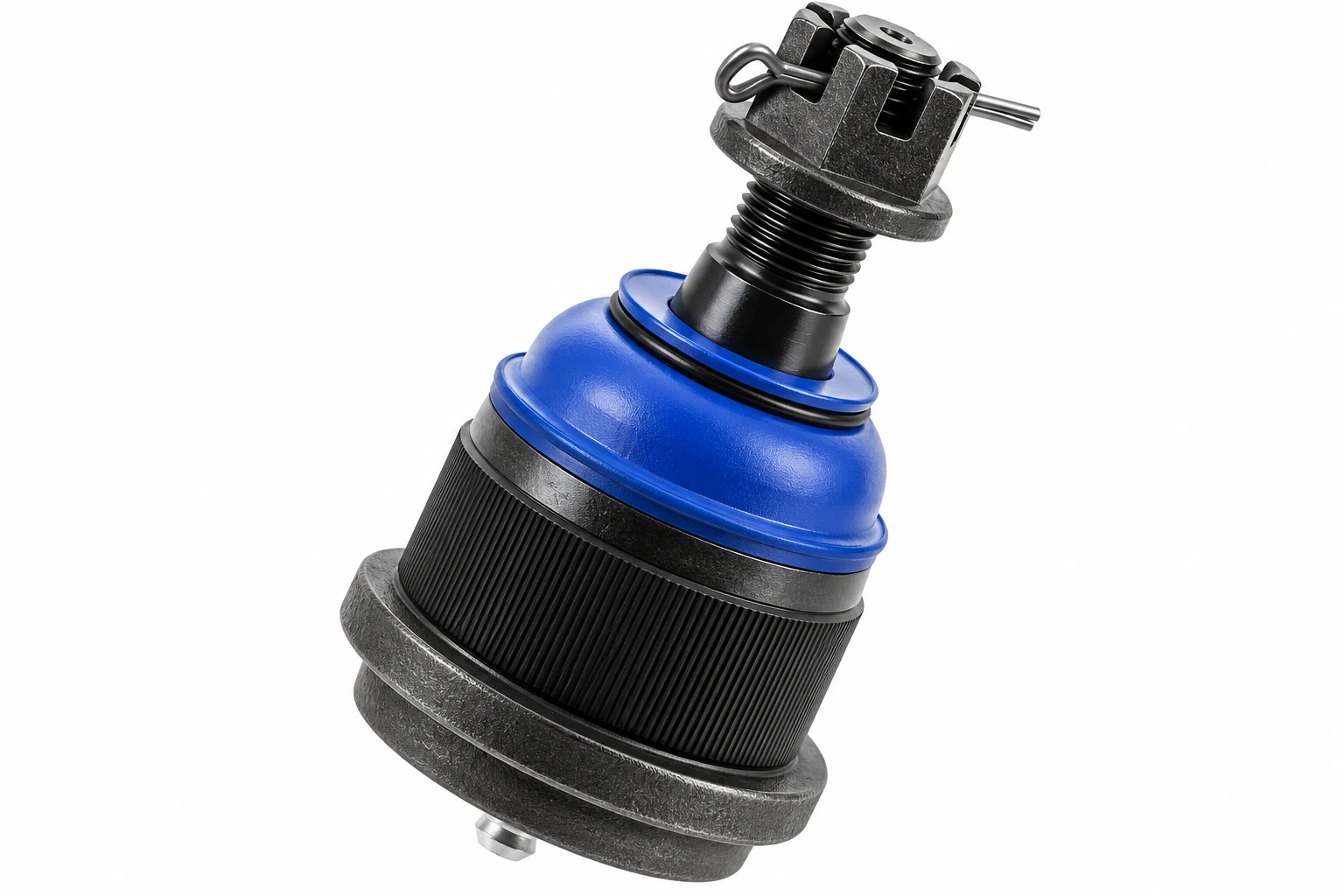
A suspension ball joint is a pivoting connection between the control arm and steering knuckle.
Inside a typical ball joint are:
- Ball-shaped stud
- Bearing or socket
- Housing
- Protective boot
- Lubricant
The stud can rotate and articulate inside the socket so the suspension can move while the wheel steers.
What Does a Ball Joint Do?
A ball joint allows movement in several directions at once.
It must accommodate:
- Steering angle
- Suspension compression
- Suspension rebound
- Body movement
At the same time, it helps maintain the physical relationship between the control arm and steering knuckle.
Because of this, significant ball-joint wear can affect both steering and suspension control.
Upper Ball Joint vs. Lower Ball Joint
Some suspension systems use both upper and lower ball joints.
Upper Ball Joint
Usually connects the upper control arm to the steering knuckle.
Lower Ball Joint
Usually connects the lower control arm to the steering knuckle.
Other vehicles, particularly many MacPherson-strut designs, may use only a lower ball joint because the strut performs the upper structural suspension function.
The actual suspension design should be identified before parts are ordered.
Lower Ball Joint
Lower ball joints are extremely common.
Depending on suspension design, the lower joint may:
- Carry substantial vehicle load
- Guide steering-knuckle movement
- Control suspension geometry
A worn lower ball joint can create:
- Clunking
- Steering looseness
- Tire wear
- Excess wheel movement
Its inspection method depends on how the spring loads the suspension.
Upper Ball Joint
Upper ball joints are common on vehicles with upper and lower control arms.
Possible symptoms of upper-joint wear include:
- Clunking
- Excessive wheel play
- Steering instability
- Irregular tire wear
On some vehicles, the upper ball joint is separately replaceable.
On others, it may be sold only with the upper control arm.
Loaded Ball Joint
A loaded ball joint carries the force of the vehicle spring.
The spring may push:
- Control arm toward the joint
- Steering knuckle against the joint
Because the suspension load can hold the joint tightly together, wear may not be apparent if the vehicle is lifted incorrectly.
The suspension may need to be supported in a specific location to unload the joint before checking play.
Unloaded Ball Joint
An unloaded or follower ball joint does not directly support the main spring load in the same way.
Its play may be checked using a different lifting method.
This is why there is no single universal “jack up the wheel and shake it” procedure for every ball joint.
Vehicle suspension design matters.
Why Ball Joint Inspection Method Matters
Testing a ball joint with the suspension loaded incorrectly can produce a false result.
A worn joint may appear tight because the spring force is pressing the stud and socket together.
Conversely, movement from a wheel bearing or control-arm bushing can sometimes be mistaken for ball-joint play.
A proper inspection isolates the joint.
Signs of a Bad Ball Joint
Possible symptoms include:
- Clunking over bumps
- Knocking from front suspension
- Loose steering
- Wandering
- Uneven tire wear
- Excessive wheel movement
- Steering instability
- Alignment that will not remain consistent
- Torn ball-joint boot
- Grease leakage
- Squeaking suspension
- Popping during steering movement
These symptoms are not unique to ball joints.
The suspension should be inspected before replacement.
Ball Joint Clunking
A worn ball joint can create a clunk as the stud moves inside an enlarged socket.
The noise may be noticeable during:
- Bumps
- Driveway entrances
- Braking
- Acceleration
- Steering transitions
However, similar clunks can come from:
- Sway-bar links
- Control-arm bushings
- Strut mounts
- Tie rods
The movement should be located before the ball joint is condemned.
Ball Joint Popping
A popping sound can occur if a worn or binding ball joint moves suddenly under suspension load.
Popping can also come from:
- Strut bearing
- CV joint
- Spring movement
- Steering components
The sound alone is not enough to identify the component.
Ball Joint Squeaking
A ball joint may squeak if:
- Lubrication is lost
- Boot tears
- Water enters
- Internal surfaces become dry
Some sealed joints are not serviceable with grease.
A squeak should still be localized because rubber suspension bushings can make similar noises.
Loose Steering and Ball Joints
Excessive ball-joint wear can allow the steering knuckle to move beyond its intended position.
This may contribute to:
- Wandering
- Delayed steering response
- Unstable handling
Tie rods, control-arm bushings, alignment, and tires can produce similar symptoms.
Ball Joint and Tire Wear
Ball-joint play can allow wheel alignment angles to change as the vehicle moves.
Possible tire effects include:
- Inner-edge wear
- Outer-edge wear
- Feathering
- Irregular tread wear
Tire wear alone cannot identify the ball joint as the cause.
Alignment and other suspension components must also be considered.
Ball Joint and Camber
Severe ball-joint wear can allow camber to change because the steering knuckle is no longer held in its intended position.
This can contribute to uneven tire wear.
However, camber problems can also result from:
- Bent suspension parts
- Worn control-arm bushings
- Strut damage
- Collision damage
The suspension geometry should be inspected as a whole.
Ball Joint and Wheel Alignment
A ball joint is part of the suspension geometry.
When it develops excessive play, alignment angles can vary dynamically even if the vehicle was aligned correctly while stationary.
Replacing a worn ball joint may therefore be necessary before attempting a final alignment.
Ball Joint Boot
The rubber or synthetic boot protects the joint from:
- Water
- Dirt
- Sand
- Road debris
It also keeps grease inside the joint.
A torn boot can significantly shorten ball-joint life.
Torn Ball Joint Boot
A torn boot can allow lubricant to escape and contamination to enter.
Whether the complete ball joint requires replacement depends on:
- Amount of contamination
- Joint play
- Corrosion
- Whether boot is separately serviceable
On many modern sealed ball joints, a damaged boot often leads to replacement of the complete joint or control arm.
Ball Joint Grease Leak
Grease around the ball-joint boot can come from:
- Torn boot
- Loose boot seal
- Excessive grease on serviceable joint
- Damaged housing
The joint should be cleaned and inspected to determine whether grease loss has compromised it.
Greasable Ball Joint
Some ball joints use a grease fitting, commonly called a zerk fitting.
These joints may require periodic lubrication according to the part manufacturer’s recommendations.
Overgreasing can damage the boot.
Greasing a badly worn joint does not restore the internal socket.
Sealed Ball Joint
Many modern ball joints are sealed and do not have a grease fitting.
Their lubricant is intended to last for the service life of the joint.
If the sealed boot fails or internal wear develops, replacement is generally required.
Can a Ball Joint Be Greased to Stop Noise?
Greasing a serviceable joint may reduce noise if the joint is dry but not mechanically worn.
However, lubrication cannot repair:
- Excessive socket clearance
- Damaged stud
- Corroded internal surfaces
- Loose housing
A joint with excessive play requires replacement regardless of whether grease temporarily reduces noise.
Ball Joint Play
Ball joints require controlled articulation but should not have excessive looseness.
Depending on design, allowable movement may be measured as:
- Axial play
- Radial play
Some manufacturers provide a numerical wear limit.
The joint should be evaluated according to the appropriate specification where available.
Vertical Ball Joint Play
Vertical movement may indicate wear on some joint designs.
However, the suspension must be supported correctly before this movement is interpreted.
Wheel-bearing play and control-arm movement can also appear as vertical wheel motion.
Side-to-Side Ball Joint Play
Lateral movement at the tire may come from:
- Ball joint
- Tie rod
- Wheel bearing
- Control-arm bushing
Observation at the actual joint is important while the wheel is moved.
The movement should be traced to the component rather than diagnosed solely by feel at the tire.
Pry-Bar Ball Joint Inspection
A pry bar can sometimes be used to load and unload a ball joint while observing movement.
The tool should be positioned so that:
- Suspension parts are not damaged
- Joint movement can be isolated
The correct procedure varies by suspension design.
Excessive force can create misleading movement or damage nearby components.
Dial Indicator Ball Joint Inspection
Some manufacturers specify measuring ball-joint movement with a dial indicator.
This provides a more precise measurement than visual inspection.
The measurement can then be compared with an allowable wear specification.
This is useful when a small amount of movement may be normal.
Ball Joint Wear Limit
There is no universal amount of allowable play for every ball joint.
Some joints should have virtually no perceptible looseness.
Others may have a specific allowable measurement.
Vehicle-specific specifications should be used when available.
Ball Joint and Wheel Bearing
A wheel bearing and ball joint are located near each other but perform different jobs.
Ball Joint
Allows steering and suspension articulation.
Wheel Bearing
Supports the wheel hub and allows it to rotate.
A worn wheel bearing may create:
- Humming
- Growling
- Wheel play
A worn ball joint more commonly creates:
- Suspension clunking
- Loose knuckle movement
Because both can create wheel play, each should be isolated during inspection.
Ball Joint and Tie Rod
Tie rods control steering movement.
Ball joints allow suspension and steering articulation.
A worn tie rod can cause:
- Steering looseness
- Toe change
- Tire wear
- Clunking
Movement at the tire should be traced to determine whether the tie rod or ball joint is responsible.
Ball Joint and Control-Arm Bushing
The control arm is usually attached to the chassis through one or more bushings.
A worn bushing can cause:
- Clunking
- Wheel movement
- Alignment changes
- Braking instability
A control-arm bushing problem can sometimes be mistaken for a loose ball joint.
Both areas should be observed during suspension loading.
Ball Joint and Strut
On a MacPherson-strut suspension, the strut connects the upper portion of the steering knuckle to the vehicle body.
The lower control arm typically connects to the knuckle through the lower ball joint.
The strut and ball joint therefore have different functions.
A worn strut does not automatically mean the ball joint is bad, and vice versa.
Ball Joint and Shock Absorber
A standalone shock absorber controls suspension damping.
It generally does not provide the steering pivot function of a ball joint.
A worn shock can cause:
- Bouncing
- Poor body control
but does not typically create direct ball-joint socket play.
Ball Joint and CV Axle
The CV axle passes through or near the steering knuckle and transfers torque to the wheel.
A worn outer CV joint may click while turning.
A worn ball joint may clunk or allow wheel movement.
The two components can create different but sometimes overlapping noises.
Ball Joint and Sway-Bar Link
A worn sway-bar link is one of the most common causes of front-end clunking over small bumps.
Because the link may be close to the ball joint, sound can travel through the suspension.
A clunk should therefore be located before replacement decisions are made.
Ball Joint and Steering Knuckle
The ball-joint stud fits into a tapered hole in the steering knuckle.
The taper creates a strong mechanical connection when the retaining nut is tightened properly.
Damage to the taper can create looseness even if the replacement ball joint itself is new.
Ball Joint Tapered Stud
The tapered stud is designed to lock tightly into the matching tapered hole.
Problems can occur if:
- Nut is loose
- Taper is damaged
- Incorrect ball joint installed
- Stud spins during tightening
The taper should seat fully before the retaining nut is torqued.
Loose Ball Joint Stud
A loose stud in the steering knuckle can damage both:
- Ball-joint stud
- Knuckle taper
Simply tightening a severely worn connection may not restore a secure fit.
The mating surfaces should be inspected.
Ball Joint Castle Nut
Some ball joints use a castellated or castle nut.
After the nut is tightened to specification, a cotter pin passes through the nut and stud to prevent loosening.
The nut should not be backed off excessively simply to align the cotter-pin hole unless the service procedure specifically allows it.
Ball Joint Cotter Pin
A cotter pin is a one-time locking device in many applications.
When removed, a new cotter pin should normally be installed.
It should be positioned so it cannot interfere with nearby components.
Ball Joint Snap Ring
Press-in ball joints often use a snap ring to retain the joint in the control arm or knuckle.
The snap ring must:
- Seat fully in groove
- Match correct orientation
A joint should not be considered securely installed if the retaining ring is not fully engaged.
Press-In Ball Joint
A press-in ball joint is installed into a control arm or steering knuckle using an interference fit.
Replacement generally requires a ball-joint press or hydraulic press.
The joint must be:
- Supported correctly
- Pressed squarely
- Installed to proper depth
Applying force to the wrong portion of the joint can damage it.
Bolt-In Ball Joint
Some ball joints are secured with bolts.
Replacement can involve:
- Removing retaining bolts
- Cleaning mounting surface
- Installing new joint
- Torquing fasteners
Correct hardware and torque are important because these bolts carry suspension loads.
Riveted Ball Joint
Some original ball joints are riveted to the control arm.
Replacement may require:
- Drilling rivets
- Grinding rivet heads
- Removing original fasteners
The replacement ball joint may then bolt into place.
Care must be taken not to damage the control arm.
Ball Joint Integrated Into Control Arm
On many modern vehicles, the ball joint is sold as part of the complete control arm.
Reasons can include:
- Non-serviceable joint design
- Factory installation method
- Control-arm bushing condition
- Parts availability
In these cases, replacing the entire control arm may be the correct repair even though the ball joint is the failed component.
Separate Ball Joint vs. Complete Control Arm
A separately replaceable ball joint may make sense when:
- Control-arm bushings are healthy
- Arm is not bent or corroded
- Correct service joint is available
A complete control-arm assembly may make more sense when:
- Ball joint is integrated
- Bushings are also worn
- Arm is damaged
- Replacement labor is reduced by using a complete assembly
The condition of the complete arm should be considered.
Ball Joint Press
A ball-joint press uses a screw-driven or hydraulic force system with cups and adapters.
The adapters support the control arm while force is applied to the ball-joint housing.
Using the correct adapter matters because pressure on the:
- Stud
- Boot
- Wrong edge of housing
can damage the new joint.
Ball Joint Separator
A ball-joint separator is used to release the tapered stud from the steering knuckle.
Common types include:
- Screw-type separator
- Lever-type separator
- Wedge-style fork
The method should avoid unnecessary damage to components being reused.
Pickle Fork and Ball Joints
A pickle fork can separate a tapered ball-joint stud.
However, it often damages the protective boot.
That may be acceptable when the joint is already being replaced.
It is generally not ideal when the ball joint is intended to be reused.
Hammering Ball Joint Stud
Striking the threaded end of a ball-joint stud directly can damage:
- Threads
- Stud
- Nut fit
If impact methods are used to release a taper, they should be applied properly to the knuckle area rather than destroying reusable threads.
Ball Joint Pressing Direction
Some press-in ball joints must be removed and installed in a specific direction.
Features such as:
- Flange
- Snap-ring groove
- Housing shoulder
determine orientation.
Pressing a joint the wrong direction can damage the control arm.
Ball Joint Orientation
Certain ball joints have orientation marks because the internal range of motion is not symmetrical.
The joint may need to be positioned according to:
- Mark
- Notch
- Grease fitting orientation
Incorrect orientation can restrict suspension travel or shorten joint life.
Ball Joint Boot During Installation
A new ball-joint boot should not be:
- Twisted
- Pinched
- Cut
- Punctured
A damaged boot can quickly allow contamination into a brand-new joint.
Ball Joint Replacement
Once inspection confirms excessive wear or damage, ball-joint replacement can generally involve:
- Identify the affected joint. Determine whether the vehicle uses an upper, lower, loaded, or unloaded ball joint.
- Inspect the opposite side. Similar mileage does not automatically mean both joints are bad, but both should be checked.
- Inspect the control arm. Check bushings, corrosion, and mounting condition.
- Inspect the steering knuckle and related suspension components.
- Raise and safely support the vehicle using the correct suspension points.
- Remove the wheel.
- Support the steering knuckle or control arm as necessary.
- Remove the cotter pin or locking device if used.
- Remove or loosen the ball-joint retaining nut according to procedure.
- Separate the tapered stud from the steering knuckle.
- Protect the brake hose, ABS wiring, and CV axle from excessive strain.
- Remove snap ring, bolts, rivets, or other joint-retaining components.
- Press or remove the old ball joint from the control arm when separately serviceable.
- Inspect the ball-joint bore or mounting surface.
- Compare the replacement joint with the original.
- Verify stud taper, housing dimensions, and orientation.
- Press or install the new joint correctly.
- Install retaining ring or bolts as required.
- Seat the ball-joint stud into the steering knuckle.
- Install and torque the retaining nut.
- Install a new cotter pin or locking device where required.
- Reconnect any components removed for access.
- Verify the ball-joint boot is undamaged and properly seated.
- Reinstall the wheel.
- Lower the vehicle.
- Check steering and suspension movement.
- Road-test the vehicle when appropriate.
- Check wheel alignment when the repair or existing tire wear indicates it is necessary.
The exact procedure depends on suspension design.
Lower Ball Joint Replacement
Lower ball-joint replacement can range from relatively straightforward to very involved.
The lower joint may be:
- Pressed into control arm
- Bolted to control arm
- Riveted
- Integrated into complete arm
The suspension may need to be supported carefully because the lower control arm can carry spring force on certain designs.
Upper Ball Joint Replacement
Upper ball joints may be:
- Bolted
- Pressed
- Integrated into upper control arm
On some trucks and SUVs, upper-joint replacement is a common service procedure.
On many modern vehicles, replacing the complete upper control arm is more practical.
Ball Joint Replacement and Coil Spring Load
This is one of the most important safety considerations.
On some suspension designs, the coil spring pushes directly against the control arm connected to the ball joint.
Separating the joint without properly supporting or unloading the spring can allow the suspension to move violently.
The spring arrangement must be understood before disassembly begins.
Ball Joint Replacement and CV Axle
On front-wheel-drive and four-wheel-drive vehicles, the CV axle often passes through the steering knuckle.
During ball-joint service, the knuckle may need to move enough to place stress on the CV joint.
The axle should not be:
- Overextended
- Pulled from transmission unintentionally
- Allowed to hang by the joint
Ball Joint Replacement and Brake Hose
The steering knuckle may move significantly when the ball joint is disconnected.
The brake hose must not be stretched or used to support the knuckle.
ABS wheel-speed sensor wiring should also be protected.
Ball Joint Replacement and Tie Rod
Some repairs provide enough movement without disconnecting the tie rod.
Others may require additional steering-knuckle movement.
The tie rod should only be disconnected when necessary.
A good tie-rod end does not automatically require replacement during ball-joint service.
Ball Joint Replacement and Wheel Bearing
The wheel bearing usually remains in place during ball-joint replacement.
However, existing bearing play should be identified before the repair.
Otherwise, wheel movement may remain afterward and be incorrectly blamed on the newly installed ball joint.
Ball Joint Replacement and Control-Arm Bushings
If the control arm is being reused, its bushings should be checked.
Installing a new ball joint into a control arm with badly deteriorated bushings may leave:
- Clunking
- Wheel movement
- Alignment instability
A complete control-arm replacement may be more appropriate when multiple components are worn.
Ball Joint Replacement and Alignment
Whether an alignment is required depends on:
- Vehicle design
- Components disturbed
- Existing tire wear
- Condition of suspension
Because ball joints influence wheel position, alignment is often advisable after replacement, especially if the vehicle previously had significant joint play.
New Ball Joint but Wheel Still Has Play
If looseness remains after replacement, possible causes include:
- Wheel bearing
- Tie rod
- Control-arm bushing
- Incorrect installation
- Damaged steering-knuckle taper
- Another worn ball joint
The movement should be isolated rather than assuming the new part is defective.
New Ball Joint Still Clunks
If a clunk remains after ball-joint replacement, inspect:
- Sway-bar link
- Control-arm bushing
- Strut mount
- Tie rod
- Loose hardware
The original noise may have had more than one source.
New Ball Joint Squeaks
A new ball joint should normally move quietly.
Squeaking after installation can result from:
- Damaged boot
- Improper installation
- Dry serviceable joint
- Incorrect part
- Nearby suspension bushing
The source should be rechecked.
Ball Joint Stud Spins While Tightening
The tapered stud normally locks into the steering knuckle as the nut is tightened.
If the stud spins, possible causes include:
- Taper not seated
- Contamination in taper
- Damaged taper
- Insufficient pressure holding joint together
The stud should not simply be clamped with damaging tools if the taper connection is defective.
Ball Joint Will Not Seat in Knuckle
Possible causes include:
- Wrong joint
- Rust or debris in taper
- Damaged knuckle
- Misalignment during assembly
The connection should seat naturally through the taper.
Forcing an incorrect stud into the knuckle can damage both parts.
Loose Press-Fit Ball Joint
A press-in joint depends on a secure interference fit.
If the control-arm bore is enlarged, corroded, or damaged, a new ball joint may not fit tightly.
A loose press fit is unsafe.
The control arm or knuckle may need replacement rather than installing another joint into a worn bore.
Oversized Ball Joints
Certain applications offer oversized ball joints for a worn mounting bore.
These parts should only be used when:
- Specifically designed for that application
- Correct oversize is measured
- Manufacturer procedure allows it
An oversized joint is not a universal repair for a damaged control arm.
Adjustable Ball Joints
Some aftermarket ball joints are designed to allow alignment correction.
They may provide adjustment for:
- Camber
- Caster
These are specialized components.
Installation orientation and adjustment must follow the product’s specifications.
Extended Ball Joints
Modified vehicles may use extended ball joints to alter suspension geometry.
They are sometimes found on:
- Lowered vehicles
- Performance suspensions
These are not direct substitutes for standard joints unless the suspension setup was designed for them.
Heavy-Duty Ball Joints
Heavy-duty replacement joints may use:
- Larger internal bearing surfaces
- Stronger housings
- Greasable designs
They may be useful for certain:
- Trucks
- Off-road vehicles
- Heavy-use applications
The part must still match the suspension dimensions and steering knuckle correctly.
Ball Joints on Lifted Trucks
Suspension lifts can increase ball-joint angles on certain designs.
Excessive operating angle can accelerate:
- Boot wear
- Joint wear
- Binding
Repeated ball-joint failure on a modified vehicle should prompt evaluation of suspension geometry, not just repeated replacement.
Ball Joints on Lowered Cars
Lowering can also alter operating angles and suspension travel.
Depending on the design, this can affect:
- Ball-joint articulation
- Control-arm angle
- Bump steer
Modified suspension geometry should be considered during diagnosis.
OEM vs. Aftermarket Ball Joints
Replacement options may include:
- Original-equipment joints
- Premium aftermarket joints
- Economy joints
- Heavy-duty joints
Important differences can include:
- Stud hardness
- Socket material
- Boot quality
- Grease retention
- Fit in control arm
- Serviceability
Correct fit and construction quality are more important than simply choosing the cheapest available part.
Greasable vs. Sealed Replacement Ball Joints
A replacement joint may differ from the original.
Greasable Joint
Allows periodic lubrication.
Sealed Joint
Uses permanently enclosed lubricant.
Both designs can be appropriate when engineered for the application.
A grease fitting is not automatically evidence that the part is stronger or better.
Should Ball Joints Be Replaced in Pairs?
Ball joints do not always need to be replaced in pairs.
If one joint is worn and the opposite side passes inspection, replacing only the failed side can be appropriate.
However, both sides should be inspected because they have experienced similar mileage and road conditions.
Condition should determine replacement.
Should Upper and Lower Ball Joints Be Replaced Together?
Not automatically.
An upper joint and lower joint can wear at different rates because they carry different loads and operate differently.
If:
- Lower joint is worn
- Upper joint is tight and healthy
there is no universal requirement to replace both.
Each joint should be evaluated individually.
Ball Joint Life Expectancy
There is no single mileage at which all ball joints require replacement.
Service life depends on:
- Road conditions
- Vehicle weight
- Suspension geometry
- Boot condition
- Lubrication
- Driving environment
- Component quality
A joint with an intact boot can last much longer than one exposed to contamination.
Potholes and Ball Joint Wear
Repeated hard impacts can increase stress on:
- Ball joints
- Control arms
- Wheel bearings
- Tires
One pothole does not automatically destroy a ball joint, but severe impact can accelerate wear or cause physical damage.
The suspension should be inspected after a significant impact if new symptoms develop.
Water and Ball Joint Wear
If a boot tears, water can enter the joint.
This can cause:
- Corrosion
- Grease contamination
- Accelerated wear
Once internal corrosion develops, adding grease cannot restore the damaged surfaces.
Can a Ball Joint Fail Completely?
Yes.
A severely worn ball joint can eventually separate.
If the stud pulls out of the socket or mounting point, the steering knuckle can move dramatically out of position.
Possible consequences include:
- Wheel collapse
- Loss of steering control
- Vehicle becoming undrivable
A ball joint with excessive confirmed play should not be ignored.
Ball Joint Separation
Ball-joint separation is a serious mechanical failure.
It can occur when:
- Internal joint is severely worn
- Stud connection becomes loose
- Mounting housing fails
- Installation is incorrect
If a joint is close to separation, replacement should be treated as a priority.
Can You Drive With a Bad Ball Joint?
The answer depends on the amount and type of wear.
Minor wear within specification is different from:
- Significant play
- Loose stud
- Damaged mounting bore
- Joint near separation
Because ball joints are structural suspension components, confirmed excessive wear should be repaired promptly.
Ball Joint Replacement Cost
Ball-joint replacement cost depends on factors such as:
- Vehicle year, make, and model
- Upper vs. lower joint
- One side vs. multiple joints
- Press-in vs. bolt-in joint
- Riveted original joint
- Integrated control-arm design
- Rust and corrosion
- Suspension spring arrangement
- Steering-knuckle condition
- Alignment requirements
A separately bolted ball joint can be very different from a press-in joint requiring substantial suspension disassembly.
Call Jimmy’s Mobile Care at (386) 308-2509 with your vehicle information and suspension symptoms so we can determine the appropriate inspection and replacement service.
Why Inspect a Ball Joint Before Replacing It?
Front-end symptoms can come from several components.
Is There Actual Ball-Joint Play?
The joint itself should be observed while the suspension is loaded correctly.
Is the Ball Joint Loaded or Unloaded?
Using the wrong inspection method can hide wear.
Is the Boot Torn?
A damaged boot increases risk of contamination but does not always prove that excessive wear has already occurred.
Is the Wheel Bearing Loose?
Bearing movement can imitate ball-joint play.
Is the Tie Rod Worn?
Tie-rod looseness can create steering movement and tire wear.
Are the Control-Arm Bushings Moving?
A worn bushing can allow the entire control arm to shift.
Is the Noise Actually From a Sway-Bar Link?
Sway-bar links commonly create clunks over small bumps.
Is the Steering-Knuckle Taper Damaged?
A secure ball joint still requires a sound mating surface.
Inspecting these areas helps ensure that the ball joint is replaced because it is actually defective.
Mobile Ball Joint Inspection in Daytona Beach
Jimmy’s Mobile Care provides mobile car ball joint inspection in Daytona Beach for vehicles experiencing:
- Front-end clunking
- Suspension popping
- Loose steering
- Wandering
- Uneven tire wear
- Excessive wheel movement
- Torn ball-joint boot
- Grease leakage
- Suspected upper ball-joint wear
- Suspected lower ball-joint wear
We inspect the ball joint using a method appropriate for the suspension design and check nearby steering and suspension components that can create similar symptoms.
Mobile Ball Joint Replacement in Daytona Beach
When inspection confirms a worn or damaged ball joint and the repair is appropriate for mobile service, Jimmy’s Mobile Care can replace many upper and lower ball joints at your Daytona Beach location.
Depending on the vehicle, repair may involve:
- Press-in ball-joint replacement
- Bolt-in ball-joint replacement
- Riveted ball-joint replacement
- Complete control-arm replacement
After installation, we verify:
- Ball-joint seating
- Stud engagement
- Retaining hardware
- Boot condition
- Suspension movement
- No abnormal joint play
Vehicles with severe corrosion, damaged control-arm bores, damaged steering-knuckle tapers, specialized suspension systems, or repairs requiring extensive spring disassembly may require additional equipment or procedures.
Schedule Car Ball Joint Inspection & Replacement in Daytona Beach
A clunk, loose steering feel, or uneven tire wear does not automatically mean the ball joint is bad.
The problem may instead involve a tie rod, control-arm bushing, wheel bearing, sway-bar link, strut, shock absorber, or another suspension component.
Jimmy’s Mobile Care inspects the ball joint and surrounding suspension before replacement so the joint is replaced only when its condition supports it.
Call Jimmy’s Mobile Care at (386) 308-2509 to schedule car ball joint inspection and replacement in Daytona Beach, FL. Call today and we'll come to your location.