
Car AC Refrigerant Leak Diagnostics & Repair in Daytona Beach, FL
A car AC system is designed to keep refrigerant sealed inside a closed circuit. If the refrigerant level becomes low enough to reduce cooling, there is usually a leak somewhere in the system.
The leak may be obvious, such as a damaged condenser or split hose, or it may be extremely small and only release refrigerant under certain temperature or pressure conditions.
Jimmy’s Mobile Care provides car AC refrigerant leak diagnostics and repair in Daytona Beach, FL. We inspect the refrigerant circuit, look for evidence of leakage, use appropriate leak-detection methods, and determine which component or connection is actually allowing refrigerant to escape before recommending repair.
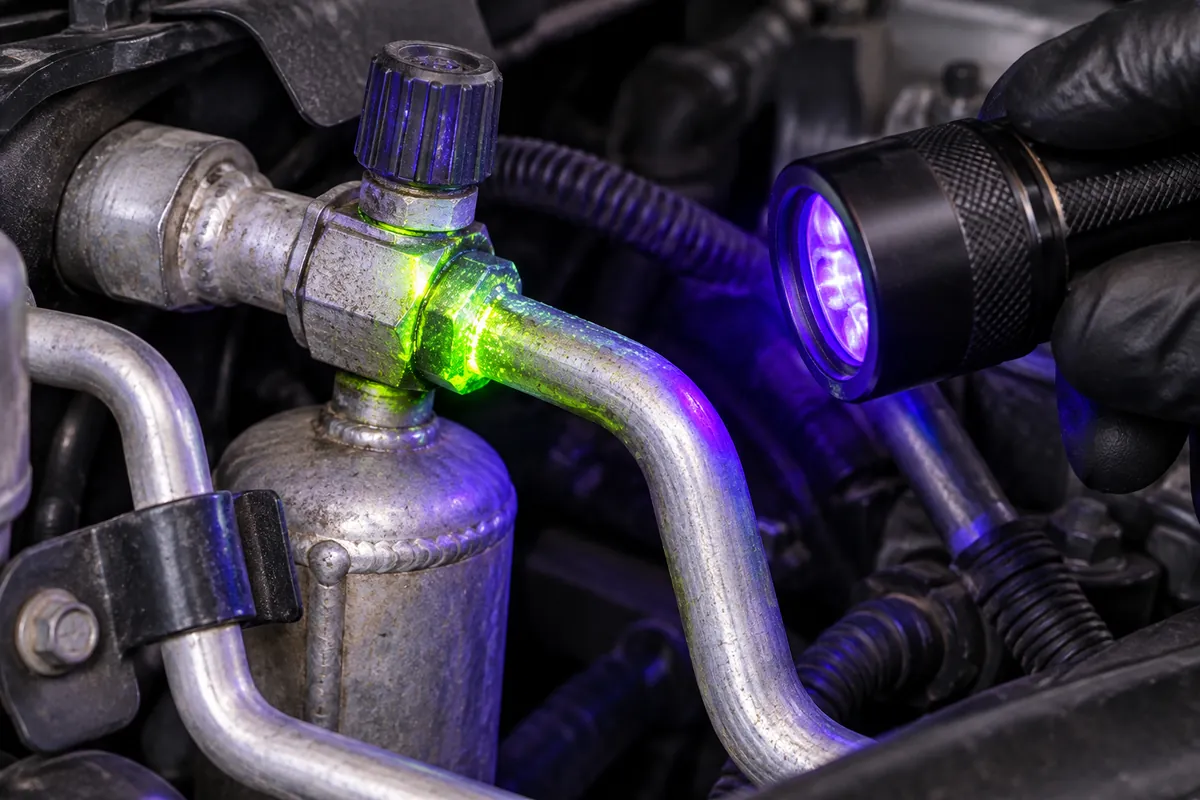
Mobile Car AC Refrigerant Leak Diagnostics in Daytona Beach
Finding an automotive refrigerant leak can require more than looking for a wet spot.
Refrigerant can escape from many parts of the AC system, including:
- Compressor
- Condenser
- Evaporator
- Refrigerant hoses
- Aluminum refrigerant lines
- O-rings
- Compressor shaft seals
- Service ports
- Expansion-valve connections
- Accumulator or receiver-drier connections
- Pressure sensors and switches
- Component fittings
Depending on the symptoms and system condition, leak diagnosis can involve:
- Visual inspection
- Refrigerant pressure testing
- Electronic leak detection
- UV dye inspection
- Inspection for refrigerant oil residue
- Service-port inspection
- Condenser inspection
- Hose and line inspection
- Compressor inspection
- Evaporator-area testing
- Vacuum testing where appropriate
- Pressure-based leak testing where appropriate
The objective is to identify the actual point of refrigerant loss, not simply confirm that the system is low.
Does Car AC Refrigerant Normally Leak Out?
A properly sealed automotive AC system is intended to retain its refrigerant.
Refrigerant does not get consumed by the AC system during normal operation.
It circulates continuously through the:
- Compressor
- Condenser
- Metering device
- Evaporator
- Hoses and lines
If enough refrigerant disappears that the AC begins blowing warm, leakage should be considered.
A very small leak may take months or longer to noticeably reduce the charge.
A larger leak can empty the system much faster.
Signs of a Car AC Refrigerant Leak
Possible signs include:
- AC gradually becomes less cold
- AC was recharged but becomes warm again
- Compressor stops operating because pressure becomes too low
- Refrigerant pressure is below expected range
- Oily residue appears around an AC fitting or component
- UV dye appears around a refrigerant leak
- Electronic leak detector responds near a component
- Refrigerant charge repeatedly becomes low
- AC performance improves after recharge but later deteriorates
These symptoms indicate that refrigerant loss may be occurring, but the leak location still needs to be identified.
Car AC Keeps Losing Refrigerant
If your AC cools after being recharged but eventually becomes warm again, the system may be losing refrigerant.
Repeatedly adding refrigerant can create a cycle:
- Refrigerant leaks out.
- System charge becomes low.
- AC cooling decreases.
- Refrigerant is added.
- Cooling returns.
- Refrigerant continues escaping.
- The original problem returns.
At that point, the useful question is no longer simply “Does it need refrigerant?”
The question becomes:
“Where is the refrigerant going?”
“Freon Leak” vs. Refrigerant Leak
Drivers often use the word Freon to describe automotive AC refrigerant.
Modern vehicles may use different refrigerants, including:
- R-134a
- R-1234yf
Older vehicles may have originally used R-12 or may have been converted to another refrigerant.
Regardless of the refrigerant type, the diagnostic problem is the same: a sealed system is losing refrigerant somewhere.
For that reason, technicians typically refer to the problem as a refrigerant leak rather than assuming every vehicle contains the same type of “Freon.”
Why Finding the Leak Matters Before Recharging
Adding refrigerant can temporarily restore cooling if the system is undercharged.
But recharge alone does not repair the leak.
If the leak remains:
- Refrigerant can escape again
- Cooling can deteriorate again
- Compressor lubrication may be affected if the system becomes severely low
- The vehicle may repeatedly require refrigerant service
- A larger failure can go unnoticed
Leak diagnosis helps determine whether the system needs a simple seal repair, a hose, a condenser, an evaporator, a compressor repair, or another component.
Visual Inspection for AC Refrigerant Leaks
One of the first diagnostic steps is inspecting accessible parts of the AC system.
We look around:
- Compressor
- Condenser
- Refrigerant hoses
- Aluminum lines
- Service ports
- Fittings
- Receiver-drier or accumulator
- Expansion-valve connections
- Pressure sensors
- Firewall connections
We look for evidence such as:
- Oily residue
- Dirt stuck to oily areas
- Green or yellow fluorescent dye
- Corrosion
- Cracked hoses
- Damaged fittings
- Impact damage
- Rub-through on refrigerant lines
A visible leak can sometimes be identified without more complex testing.
Why AC Refrigerant Leaks Often Look Oily
Refrigerant oil circulates through the AC system with the refrigerant.
When refrigerant escapes through a leak, some oil may escape with it.
That can leave an oily film around:
- Fittings
- Compressor seals
- Hose crimps
- Condenser damage
- Refrigerant lines
Dust and dirt often stick to this oil, making the leak area look dark or greasy.
Oil residue is useful evidence, but it should still be interpreted carefully because engine oil or other fluids can contaminate nearby AC components.
UV Dye Leak Detection
Fluorescent dye can help identify small refrigerant leaks.
If compatible dye is already present in the AC system, leaked refrigerant and oil can carry the dye out through the failed area.
Under ultraviolet light, the dye becomes easier to see.
Possible leak locations revealed by UV dye can include:
- Condenser
- Compressor
- AC hose connections
- O-rings
- Refrigerant lines
- Service ports
- Evaporator drain
UV dye is especially useful when the leak is too small to create an obvious wet spot during a normal visual inspection.
Electronic Refrigerant Leak Detection
An electronic refrigerant leak detector is another useful diagnostic tool.
The detector senses refrigerant escaping into the surrounding air.
It can be used around areas such as:
- Compressor seals
- Condenser fittings
- Hose crimps
- Service ports
- Evaporator drain
- HVAC vents
- Refrigerant line connections
The probe needs to be moved carefully because air movement can carry refrigerant away from the exact leak point.
A strong response near one area should therefore be narrowed down before assuming a particular component has failed.
Why Wind Can Affect Leak Detection
Refrigerant escaping from a small leak can be moved by:
- Radiator fans
- Condenser fans
- Engine cooling airflow
- Outdoor wind
- Blower airflow
That can make electronic detection more difficult.
For example, refrigerant leaking from a condenser fitting may be carried across another part of the engine compartment.
The detector response should therefore be traced back toward the actual source rather than assuming the first location where refrigerant is detected is the failure point.
Pressure Testing for AC Refrigerant Leaks
Pressure testing can sometimes help identify leaks that are difficult to locate under normal operating conditions.
The exact method depends on the refrigerant system and the available equipment.
The principle is to place the system under controlled pressure and then check whether pressure escapes.
This can help identify leaks that:
- Do not show clearly under vacuum
- Occur only under positive pressure
- Are too slow to immediately reveal themselves during a visual inspection
Pressure testing should be performed using methods appropriate for automotive AC systems.
AC Holds Vacuum but Still Leaks Refrigerant
Yes, this can happen.
A system holding vacuum does not guarantee that it will remain leak-free under operating pressure.
A leak may behave differently when:
- The system is under positive pressure
- Components become hot
- Aluminum expands
- Rubber seals change shape
- Compressor vibration is present
- High-side pressure rises
A very small leak may also be too slow to show a meaningful vacuum change during a short test.
This is why vacuum testing is useful, but it is not the only method used to diagnose refrigerant leaks.
Vacuum Testing After AC Repair
After a refrigerant circuit has been opened and repaired, the system is normally evacuated before charging.
Observing whether the system maintains vacuum can help identify a significant remaining leak.
If vacuum falls rapidly, the system should not simply be charged without investigating why.
However, passing a vacuum test should be considered one part of system verification rather than absolute proof that no microscopic leak exists.
Small Refrigerant Leaks
Some automotive AC leaks are extremely small.
The vehicle may:
- Cool normally after a recharge
- Operate correctly for weeks or months
- Gradually lose cooling
- Eventually become undercharged again
This can happen with tiny leaks at:
- O-rings
- Compressor seals
- Condenser joints
- Evaporator cores
- Hose crimps
- Service valves
Small leaks often require more careful diagnosis because the refrigerant may not escape fast enough to create an obvious visible sign.
Large Refrigerant Leaks
A larger leak may cause refrigerant to escape rapidly.
Possible causes include:
- Punctured condenser
- Broken refrigerant line
- Split hose
- Failed fitting
- Major compressor seal failure
- Collision damage
A large leak may prevent the AC from maintaining pressure long enough to operate properly.
In these cases, the physical failure may be easier to identify.
AC Condenser Refrigerant Leaks
The condenser is located near the front of the vehicle and is exposed to road debris.
Common condenser leak causes include:
- Stone impact
- Corrosion
- Cracked joints
- Damaged tubes
- Front-end collision damage
- Failed refrigerant connections
Evidence may include oil or dye around the damaged area.
When the condenser core itself is leaking, replacement is often required.
Condenser inspection and replacement are covered in greater depth on our dedicated AC condenser page.
AC Evaporator Refrigerant Leaks
Evaporator leaks are more difficult to find because the evaporator is normally hidden inside the HVAC housing.
Possible diagnostic evidence can include:
- Electronic leak detection at the evaporator drain
- UV dye appearing in condensate
- Refrigerant detected through HVAC vents
- Repeated refrigerant loss with no external leak found
Because evaporator replacement can require substantial dashboard disassembly, we look for convincing evidence before recommending replacement.
Compressor Refrigerant Leaks
The compressor contains several possible leak points.
Depending on compressor design, leakage can occur around:
- Shaft seal
- Case joints
- Rear head
- Refrigerant fittings
- Pressure relief area
Oil residue around the compressor may provide evidence of leakage.
However, a compressor can become oily from another engine leak, so the refrigerant source should be confirmed before condemning the compressor.
AC Compressor Shaft Seal Leaks
The compressor shaft seal allows the rotating compressor shaft to remain sealed against refrigerant loss.
Over time, the seal can deteriorate.
Possible evidence includes refrigerant oil or dye near the front of the compressor behind the clutch or pulley area.
A shaft-seal leak can sometimes be difficult to see because the rotating pulley may spread oil around nearby surfaces.
The leak pattern needs to be distinguished from other fluid contamination.
AC Hose Leaks
Refrigerant hoses must flex with engine movement and vehicle operation.
Leaks can develop from:
- Aging rubber
- Cracks
- Abrasion
- Heat damage
- Hose crimps
- Fittings
- Physical damage
The crimped area where flexible hose meets metal fittings is a common place to inspect.
A leaking hose normally needs repair or replacement rather than repeated refrigerant additions.
Aluminum AC Line Leaks
Many automotive AC systems use rigid aluminum refrigerant lines.
These lines can leak because of:
- Corrosion
- Vibration
- Contact with another component
- Cracks
- Damaged fittings
- Accident damage
A refrigerant line rubbing against a bracket or another metal part can eventually wear through.
The entire affected section should be inspected rather than only the immediate visible leak.
AC O-Ring Leaks
O-rings seal many refrigerant connections throughout the AC system.
They can leak because of:
- Age
- Hardening
- Improper installation
- Damage during previous repairs
- Incorrect seal size
- Incorrect seal material
- Corrosion at the sealing surface
An O-ring repair may be relatively straightforward compared with replacing an entire AC component, which is why accurately locating the source matters.
Refrigerant Leak at an AC Fitting
Not every leak near a major component means that component itself is defective.
For example, refrigerant may escape where a hose attaches to the condenser.
The condenser core may still be good.
Similarly, a leak at the evaporator-line connection is different from a leaking evaporator core.
Diagnosis should identify whether the leak is coming from:
- Component body
- Refrigerant fitting
- O-ring
- Hose
- Line
That distinction can significantly change the repair.
AC Service Port Leaks
The high-side and low-side service ports contain valves used during AC service.
These valves can develop leaks.
Possible leak points include:
- Valve core
- Port seal
- Damaged fitting
- Protective cap seal
Because service ports are frequently accessed during AC work, they should be inspected when unexplained refrigerant loss is present.
A leaking service valve can sometimes be repaired without replacing a major AC component.
Why AC Service Port Caps Matter
Service-port caps are not merely decorative.
Depending on design, the cap provides an additional barrier against refrigerant leakage and protects the valve from contamination.
A missing or damaged cap should be corrected.
However, a cap should not be used to hide a badly leaking service valve.
The underlying valve should still be repaired if it is not sealing properly.
Expansion Valve Connection Leaks
Expansion valves often connect directly to refrigerant lines or the evaporator.
These connections rely on seals to contain refrigerant.
Leakage can occur around:
- O-rings
- Valve block connections
- Evaporator fittings
- Damaged sealing surfaces
A connection leak is different from an internally defective expansion valve.
The source should be identified before replacing the valve itself.
Orifice Tube Line Connection Leaks
A fixed orifice tube is normally installed inside a refrigerant line.
The line may need to be separated to access the tube.
Leaks near this area can come from:
- O-rings
- Tube connections
- Damaged refrigerant lines
- Improper previous assembly
A leaking fitting should not automatically be blamed on the orifice tube inside the line.
Accumulator and Receiver-Drier Leaks
Depending on AC design, the system may contain an:
- Accumulator
- Receiver-drier
These components can develop leakage at:
- Fittings
- Seams
- Pressure switches
- Sensor ports
- Corroded surfaces
Because they are part of the sealed refrigerant circuit, leakage from these components can slowly reduce the refrigerant charge.
Refrigerant Pressure Sensor Leaks
Some AC pressure sensors or switches connect directly to the refrigerant circuit.
Leaks can develop around:
- Sensor seals
- Threads
- O-rings
- Port connections
An electrical AC fault and a refrigerant leak at the sensor are two separate issues.
The sensor area should be inspected for both electrical operation and physical sealing when applicable.
Refrigerant Leak After Recent AC Repair
If an AC system begins losing refrigerant soon after another repair, possible causes can include:
- Pinched O-ring
- Reused damaged seal
- Loose fitting
- Incorrect seal
- Damaged sealing surface
- Hose or line disturbed during repair
- Component installation problem
The recently serviced connections are logical places to inspect first.
That does not prove the previous repair caused the leak, but repair history provides useful diagnostic direction.
Refrigerant Leak After Front-End Collision
Even a minor collision can damage AC components at the front of the vehicle.
Possible damage includes:
- Punctured condenser
- Bent refrigerant line
- Cracked fitting
- Damaged hose
- Broken mounting bracket
- Stressed connection
A condenser can sometimes appear mostly intact while containing a small puncture.
Leak testing becomes important when AC cooling deteriorates after front-end damage.
Can a Refrigerant Leak Cause the Compressor to Stop Working?
Yes.
Many vehicles monitor refrigerant pressure.
If the charge becomes too low, the control system may prevent compressor operation to help protect the system.
The driver may think the compressor has failed because it does not engage.
But the compressor may actually be disabled because refrigerant pressure is below the allowable range.
The refrigerant condition should therefore be checked before automatically replacing the compressor.
Low Refrigerant and Compressor Lubrication
Refrigerant oil circulates through much of the AC system with the refrigerant.
If refrigerant becomes severely low, oil circulation can also be affected.
Continued operation under poor refrigerant conditions can increase compressor risk.
This is another reason a known refrigerant leak should be addressed rather than repeatedly allowing the system to become empty.
Can AC Refrigerant Leak Into the Passenger Compartment?
If the evaporator leaks, refrigerant can escape inside the HVAC housing.
Because the evaporator is inside the vehicle's ventilation system, refrigerant can potentially move through:
- HVAC ducts
- Evaporator drain
- Dashboard vents
An evaporator leak therefore requires a different diagnostic approach from an under-hood condenser or hose leak.
AC Refrigerant Leak and Water Under the Car
Clear water dripping under a vehicle with the AC running is normally condensation, not refrigerant.
The evaporator removes moisture from humid cabin air.
That water exits through the evaporator drain.
In Daytona Beach's humid climate, a significant amount of water can drip beneath the vehicle during normal AC operation.
Refrigerant does not normally leave a puddle of clear liquid under the car.
Does Refrigerant Have a Smell?
Refrigerant should not be identified by smell alone.
Very small AC leaks may have no obvious odor.
Other materials under the hood can produce smells that are easily confused with an AC problem.
Leak diagnosis should rely on actual evidence such as:
- Electronic detection
- UV dye
- Oil residue
- Pressure behavior
- Physical inspection
AC Stop-Leak Products
Some consumer refrigerant products include substances marketed to seal small AC leaks.
These products do not replace proper leak diagnosis.
Potential concerns include:
- The actual failed component remains unrepaired
- Sealant may not stop the leak
- Future service can become more difficult
- Additives may contaminate service equipment
- Internal restrictions may develop depending on the product and system
Jimmy’s Mobile Care focuses on finding the failed seal, hose, line, or component and repairing the physical source of refrigerant loss.
Why We Don't Rely on AC Stop Leak
A leaking O-ring, punctured condenser, damaged hose, or corroded evaporator is a physical failure.
Adding sealant does not tell us:
- Where the leak is
- How severe it is
- Whether the component is structurally damaged
- Whether another leak exists
- Whether contamination is present
A direct repair provides a more controlled solution.
Can a Refrigerant Leak Be Repaired Without Replacing a Major Component?
Sometimes.
The required repair depends entirely on the leak location.
Examples of repairs that may not require a major component include:
- Replacing an O-ring
- Repairing a service valve
- Correcting a fitting
- Replacing a damaged refrigerant hose
- Repairing or replacing a section of line where appropriate
But if the actual condenser core, evaporator core, or compressor housing is leaking, component replacement may be necessary.
Accurate diagnosis determines which repair is justified.
Refrigerant Leak Repair Process
The exact repair depends on the source, but a typical process can include:
- Confirm that refrigerant loss is occurring. We evaluate pressures, cooling performance, and service history.
- Inspect accessible AC components. Hoses, lines, condenser, compressor, fittings, and service ports are checked.
- Use leak-detection methods as needed. Electronic detection, UV dye, and other appropriate testing can help isolate small leaks.
- Identify the exact source. We determine whether the leak comes from a component, hose, line, fitting, O-ring, or service valve.
- Recover remaining refrigerant when required. The refrigerant circuit must be properly serviced before opening it.
- Repair or replace the failed part. The appropriate seal, line, hose, or AC component is repaired or replaced.
- Replace applicable seals. Opened refrigerant connections receive appropriate O-rings or seals.
- Reassemble the refrigerant circuit. Connections are properly secured.
- Evacuate the system. Air and moisture are removed.
- Evaluate system integrity. We check for evidence that the repaired system is sealing properly.
- Charge the specified refrigerant amount. The correct refrigerant and quantity are restored.
- Operate and verify the AC system. Pressures, cooling performance, and the repaired area are rechecked.
Leak repair is complete only when the failed area has been corrected and the system is capable of operating with the proper charge.
Why AC Leak Repair Usually Requires a Recharge
When the refrigerant circuit is opened to repair a leak, refrigerant must be removed or may already have escaped.
After the repair, the system generally needs to be:
- Evacuated
- Checked
- Recharged to specification
The recharge restores the correct refrigerant quantity.
It does not replace the leak repair itself.
This is why AC refrigerant leak repair and AC recharge are related services but not the same service.
Finding More Than One Refrigerant Leak
An older or previously damaged AC system can have more than one leak.
Repairing the most obvious leak may reveal another smaller leak after the system is restored to operating pressure.
This is especially possible when:
- Seals have aged throughout the system
- Corrosion affects multiple components
- Previous repairs have been performed
- The system has been empty for a long time
The complete system should be evaluated rather than assuming the first leak found must be the only leak.
How Much Does Car AC Refrigerant Leak Repair Cost?
The cost of automotive AC leak repair depends primarily on where the refrigerant is escaping.
Factors can include:
- Vehicle year, make, and model
- Leak location
- Refrigerant type
- Refrigerant quantity
- Diagnostic time
- Accessibility
- O-ring or seal replacement
- Hose replacement
- Line repair or replacement
- Condenser replacement
- Evaporator replacement
- Compressor repair or replacement
- Refrigerant recovery
- Evacuation
- Recharge
A leaking service-port valve is a completely different repair from a leaking evaporator buried behind the dashboard.
That is why an accurate estimate depends on identifying the leak first.
Call Jimmy’s Mobile Care at (386) 308-2509 with your vehicle information and AC symptoms so we can determine the appropriate leak-diagnostic service.
Why Diagnose the Refrigerant Leak Before Replacing Parts?
Refrigerant can escape from many different points in the system.
Diagnosis helps answer the questions that actually determine the repair.
Is the System Really Losing Refrigerant?
Warm air alone does not prove a leak.
Where Is the Refrigerant Escaping?
The compressor, condenser, evaporator, hose, line, fitting, O-ring, or service port may each require a different repair.
Is the Leak at a Connection or the Component Itself?
A leaking seal at a condenser fitting does not necessarily mean the condenser needs replacement.
Is There More Than One Leak?
Multiple aged seals or components can leak at the same time.
Does the System Hold Vacuum but Leak Under Pressure?
Some leaks behave differently under operating pressure.
Is the AC Low Because of a Leak or Another Problem?
Abnormal cooling can also result from compressor, metering-device, condenser-airflow, or HVAC faults.
Does the System Need Repair Before Recharge?
Adding refrigerant to an unrepaired leaking system may provide only temporary cooling.
Identifying the actual leak prevents unnecessary component replacement and repeated recharging.
Mobile Car AC Refrigerant Leak Diagnostics in Daytona Beach
Jimmy’s Mobile Care provides mobile car AC refrigerant leak diagnostics in Daytona Beach.
If your AC keeps losing refrigerant, becomes warm after being recharged, or has an obvious leak, we can inspect the system and determine where refrigerant is escaping.
We use the evidence appropriate to the problem, including physical inspection, oil residue, UV dye where applicable, electronic refrigerant detection, pressure behavior, and component-specific testing.
Mobile AC Refrigerant Leak Repair in Daytona Beach
Once the leak source has been confirmed, we can determine the appropriate repair.
Depending on the failure, that may involve:
- O-ring replacement
- Service-port repair
- Hose replacement
- Refrigerant-line repair or replacement
- Condenser replacement
- Compressor-related repair
- Other refrigerant connection repair
Repairs involving components such as an evaporator may require substantially more disassembly and are evaluated based on the vehicle and whether the work is appropriate for mobile service.
After the leak is repaired, the AC system can be evacuated, recharged to the correct specification, and retested.
Schedule Car AC Refrigerant Leak Diagnostics & Repair in Daytona Beach
If your vehicle keeps losing refrigerant, repeated recharging is not the same as repairing the problem.
Jimmy’s Mobile Care works to identify where the refrigerant is escaping, determine whether the failure is a seal, fitting, hose, line, or AC component, and repair the source before restoring the proper refrigerant charge.
Call Jimmy’s Mobile Care at (386) 308-2509 to schedule car AC refrigerant leak diagnostics and repair in Daytona Beach, FL. Call today and we'll come to your location.