
Car AC Orifice Tube Inspection & Replacement in Daytona Beach, FL
The AC orifice tube is a small but important refrigerant-metering device used in many automotive air-conditioning systems. It creates a restriction between the high-pressure and low-pressure sides of the system so refrigerant entering the evaporator can expand, cool, and absorb heat from the passenger compartment.
Unlike a thermal expansion valve, a fixed orifice tube does not actively open and close to regulate refrigerant flow. Its opening is a fixed size. Because of that design, contamination, debris, or damage to the tube can significantly affect refrigerant flow and AC performance.
Jimmy’s Mobile Care provides car AC orifice tube inspection and replacement in Daytona Beach, FL. We evaluate system pressures, refrigerant flow, cooling performance, and the condition of the removed orifice tube to determine whether restriction, contamination, or damage is affecting the AC system.
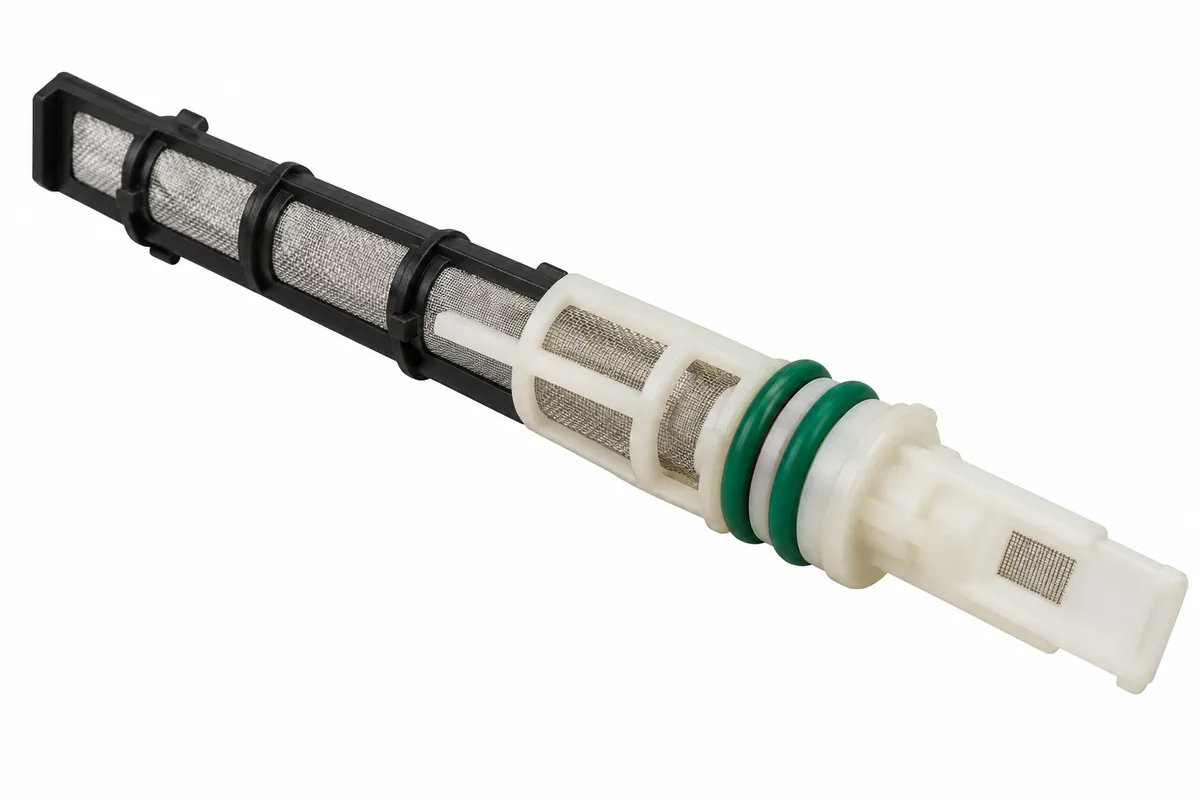
Mobile AC Orifice Tube Inspection in Daytona Beach
An orifice tube problem can cause poor cooling and abnormal refrigerant pressures, but those symptoms can also result from other AC faults.
Depending on the vehicle and symptoms, diagnosis can include:
- High-side and low-side refrigerant pressure checks
- Refrigerant temperature evaluation
- AC vent-temperature testing
- Compressor performance evaluation
- Refrigerant charge assessment
- Checking for a restriction in the metering circuit
- Inspecting the removed orifice tube screen
- Looking for metal particles or other contamination
- Checking for oil or debris accumulation
- Determining whether compressor failure has contaminated the system
Because the orifice tube is often inexpensive compared with major AC components, it can be tempting to replace it based only on symptoms. The better approach is to understand what the refrigerant circuit is doing and inspect the tube when appropriate.
What Does an AC Orifice Tube Do?
The orifice tube creates the pressure drop required before refrigerant enters the evaporator.
High-pressure liquid refrigerant flows from the condenser side of the system toward the orifice tube.
As refrigerant passes through the small calibrated opening, pressure drops significantly.
The lower-pressure refrigerant then enters the evaporator, where it absorbs heat from air moving through the HVAC case.
The orifice tube therefore separates two important operating areas:
Before the orifice tube: high-pressure side.
After the orifice tube: low-pressure evaporator side.
Without the required restriction, the AC system cannot maintain the pressure relationship needed for normal cooling.
Why It Is Called a Fixed Orifice Tube
The term fixed orifice tube refers to the fact that the opening through which refrigerant passes has a fixed calibrated size.
The tube does not continuously adjust its opening in response to evaporator conditions.
Instead, refrigerant flow depends largely on:
- Pressure difference across the tube
- Size of the calibrated opening
- Refrigerant charge
- Compressor operation
- Overall AC-system conditions
The system uses other control strategies to manage operation around that fixed restriction.
Orifice Tube vs. Expansion Valve
The orifice tube and thermal expansion valve both meter refrigerant before the evaporator, but they do it differently.
Fixed Orifice Tube
A fixed orifice tube has a calibrated opening that does not actively change size.
Thermal Expansion Valve
A thermal expansion valve, often called a TXV, actively changes refrigerant flow in response to evaporator operating conditions.
The two components perform related functions, but they are not interchangeable service concepts.
A vehicle designed around a fixed-orifice-tube system should be diagnosed as that type of system.
Jimmy’s Mobile Care treats AC expansion valves separately because their operating principles and failure patterns are different.
Where Is the AC Orifice Tube Located?
The orifice tube is installed in a refrigerant line before the evaporator.
Its exact location varies by vehicle.
Common locations include:
- Liquid refrigerant line
- Condenser outlet line
- Evaporator inlet line
- Near the firewall
- Inside a dedicated section of AC tubing
On many systems, the tube sits inside the refrigerant line rather than being visibly mounted as an external component.
The line may have a change in diameter, fitting, or other design feature indicating the orifice tube location.
What Does an Orifice Tube Look Like?
A typical automotive orifice tube is a small cylindrical component.
Depending on design, it can contain:
- Plastic body
- Fine mesh screen
- Calibrated refrigerant opening
- O-rings or sealing features
- Colored plastic sections identifying a particular calibration
The screen is especially useful during inspection because trapped material can reveal what is happening elsewhere in the AC system.
Signs of a Bad or Restricted AC Orifice Tube
Possible symptoms can include:
- AC blowing warm
- Poor cooling
- Intermittent cooling
- Abnormal high-side pressure
- Abnormally low low-side pressure
- Frost near the metering point
- Evaporator not receiving enough refrigerant
- Compressor operating under abnormal conditions
- Evidence of refrigerant restriction
These symptoms do not prove the orifice tube is defective.
Refrigerant charge, compressor condition, condenser performance, and other restrictions can create similar behavior.
Clogged AC Orifice Tube
Because the orifice opening is small, contamination can restrict refrigerant flow.
A clogged orifice tube may contain:
- Metal particles
- Compressor debris
- Desiccant material
- Contaminated oil
- Foreign material
- Internal AC-system debris
A severe restriction can reduce the amount of refrigerant reaching the evaporator.
That can result in poor cooling even though the compressor continues to operate.
Inspecting the Orifice Tube Screen
The screen on the orifice tube is one of the most useful features for AC-system diagnosis.
When the tube is removed, we can inspect it for material trapped in the refrigerant stream.
What appears on the screen can provide clues about the rest of the system.
For example:
- Fine metallic particles can point toward compressor wear.
- Larger metal fragments can suggest more serious compressor damage.
- Dark contaminated oil can indicate internal deterioration.
- Desiccant-like material can suggest a problem involving a moisture-control component.
- Little or no debris may suggest that the restriction originated elsewhere.
The orifice tube can therefore act almost like a small filter showing what has circulated through the system.
Metal on the Orifice Tube
Metal particles on an orifice tube deserve attention.
The tube itself normally does not create metallic debris.
Metal contamination can originate from a deteriorating compressor or another internal component.
If metal is present, simply installing a clean new orifice tube may not be enough.
The underlying source must be considered because remaining debris can:
- Clog the replacement tube
- Restrict refrigerant flow
- Damage the compressor
- Contaminate other AC components
The appearance of the removed tube can therefore change the entire repair plan.
Black Debris on an AC Orifice Tube
Dark or black contamination on the orifice tube can indicate deterioration somewhere within the refrigerant system.
Possible causes can include:
- Compressor wear
- Degraded oil
- Contamination from internal component failure
- Heat-related deterioration
The exact meaning depends on the material present and the history of the AC system.
Heavy contamination should not be treated as though the orifice tube simply clogged on its own.
Compressor Failure and the Orifice Tube
The orifice tube is especially useful when evaluating the effects of compressor failure.
A failing compressor can release particles into the refrigerant stream.
Those particles can travel through the high-pressure side of the system and become trapped at the orifice-tube screen.
If a compressor has failed internally, inspection of the tube can help determine whether contamination has spread through the system.
This can influence decisions involving:
- Condenser replacement
- Flushing applicable refrigerant lines
- Accumulator replacement
- Metering-device replacement
- Protecting the replacement compressor
The orifice tube should not be viewed only as an isolated part in this situation.
Orifice Tube Restriction and Refrigerant Pressure
A restricted orifice tube can create an abnormal pressure difference across the metering point.
Depending on operating conditions, a severe restriction may contribute to:
- Higher pressure before the restriction
- Very low pressure after the restriction
- Reduced refrigerant flow into the evaporator
- Poor cooling
However, refrigerant pressures must be interpreted in context.
Similar pressure readings can occur with:
- Low refrigerant charge
- Compressor problems
- Other system restrictions
- Incorrect airflow
- Temperature-related operating conditions
Pressure gauges provide evidence, not an automatic parts diagnosis.
Frost Near an AC Orifice Tube
Frost appearing near the orifice tube or liquid line can sometimes indicate a significant temperature drop at that point.
Some temperature reduction at the metering device is expected.
Abnormal or concentrated frost may suggest:
- Restriction
- Incorrect refrigerant condition
- Moisture freezing within the circuit
- Abnormal pressure drop
The frost location and system pressures should be evaluated together.
Frost alone should not be used as the sole reason to replace the tube.
Orifice Tube vs. Low Refrigerant
Low refrigerant can mimic certain symptoms of a restricted orifice tube.
Both conditions can reduce evaporator performance and produce low suction pressure.
The difference is important.
A low refrigerant charge normally means refrigerant has escaped from somewhere in the system.
A restricted orifice tube limits refrigerant flow even when the system may contain the appropriate overall charge.
Replacing the tube will not repair a refrigerant leak.
That is why system charge and leakage need to be considered as part of diagnosis.
Orifice Tube vs. Weak AC Compressor
A weak compressor can also cause poor cooling and abnormal pressure readings.
The compressor creates refrigerant circulation and pressure.
The orifice tube creates a fixed restriction in that flow.
A compressor that cannot pump effectively creates a different problem from a metering device that is obstructing refrigerant.
Looking at the overall high-side and low-side relationship helps determine which part of the refrigeration cycle is behaving abnormally.
Orifice Tube vs. Condenser Restriction
A restriction inside the condenser occurs upstream of the orifice tube.
A clogged orifice tube occurs at the metering point just before the evaporator.
Both can affect pressure and refrigerant flow.
Diagnosis can involve:
- Pressure readings
- Temperature changes across components
- Refrigerant-line temperatures
- System history
- Inspection of the removed orifice tube
Locating the actual restriction is important before replacing parts.
Orifice Tube vs. Evaporator Problem
A restricted orifice tube can starve a good evaporator of refrigerant.
If insufficient refrigerant reaches the evaporator, cabin cooling drops.
The evaporator may therefore appear to be malfunctioning even though the core itself is not damaged.
This is one reason the metering device needs to be considered when evaporator temperatures and system pressures do not behave normally.
Moisture Can Restrict an Orifice Tube
Moisture contamination can create intermittent restrictions in an AC system.
At the metering point, refrigerant temperature can drop dramatically.
If moisture reaches this area, it can freeze and partially block refrigerant flow.
When the system is shut off and warms up, the ice may melt.
This can create a repeating pattern:
- AC cools normally.
- Cooling gradually decreases.
- Pressures become abnormal.
- The system is turned off.
- Cooling works again after sitting.
An intermittent restriction like this can sometimes be mistaken for other AC faults.
Moisture control and proper system evacuation become especially important in these situations.
The Orifice Tube and the Accumulator
Fixed-orifice-tube AC systems commonly use an accumulator on the low-pressure side.
The two components perform different jobs.
Orifice Tube
Meters refrigerant entering the evaporator.
Accumulator
Helps prevent liquid refrigerant from reaching the compressor and contains desiccant for moisture control.
Because they operate within the same system design, problems involving contamination or moisture may require considering both components.
The accumulator is not a substitute for the orifice tube, and the orifice tube does not perform the accumulator's job.
Why Orifice Tube Color Can Matter
Some replacement orifice tubes use different colors to identify different calibrated opening sizes or applications.
The color itself is not a universal performance rating.
A different orifice size changes refrigerant flow characteristics and can affect:
- System pressures
- Evaporator performance
- Compressor operation
- Cooling performance
For normal repair, the replacement tube should match the specification intended for the vehicle's AC system.
Installing a different tube simply in an attempt to make the AC colder is not a substitute for correct diagnosis and repair.
“Colder AC” Orifice Tubes
Some replacement parts are marketed around changing orifice size to alter AC performance.
Changing the calibrated restriction can also change:
- High-side pressure
- Low-side pressure
- Refrigerant flow
- Evaporator temperature
- Compressor operating conditions
Automotive AC systems are designed around a particular refrigerant charge, compressor, evaporator, condenser, and metering strategy.
Jimmy’s Mobile Care focuses on restoring the system with the correct application rather than treating the orifice tube as a tuning device.
Inspecting the Orifice Tube During AC Repairs
Because the orifice tube can trap debris, inspecting it can be valuable during certain repairs even when the tube was not originally suspected.
This is particularly useful after:
- Compressor failure
- Severe refrigerant contamination
- Unexplained AC restriction
- Major AC-system repair
- Repeated metering-device blockage
The condition of the tube can provide information that would otherwise remain hidden inside the refrigerant circuit.
Can an AC Orifice Tube Be Cleaned?
A contaminated orifice tube is generally inexpensive enough that replacement is preferable to attempting to clean and reuse it.
More importantly, simply cleaning the screen does not address the reason contamination reached it.
If the tube contains metal or other significant debris, the source needs to be investigated.
Installing a clean tube into a contaminated system can result in another blockage.
Can an Orifice Tube Be Installed Backward?
Correct orientation matters.
The tube is designed for refrigerant to flow through it in a particular direction.
Installing the component incorrectly can interfere with:
- Refrigerant flow
- Seating
- Removal
- System performance
Replacement should follow the direction and position specified for the vehicle.
Broken Orifice Tube During Removal
An older orifice tube can sometimes become difficult to remove because of:
- Heat
- Age
- Debris
- Distorted plastic
- Contamination
- Damage to the tube body
The plastic portion can break while being extracted.
If that happens, the remaining pieces need to be removed without damaging the refrigerant line.
The line should also be inspected because a severely stuck tube may indicate contamination or deterioration.
AC Orifice Tube Replacement
Once inspection or diagnosis shows that the orifice tube should be replaced, a typical service can include:
- Confirming the system uses a fixed orifice tube. Not every vehicle uses this type of metering device.
- Evaluating AC pressures and cooling performance. We establish why a restriction or metering problem is suspected.
- Recovering the refrigerant. The refrigerant must be properly recovered before opening the system.
- Locating the orifice tube. The correct refrigerant line and tube position are identified.
- Opening the refrigerant connection. The line is separated using the appropriate procedure.
- Removing the existing orifice tube. The tube is carefully extracted from the refrigerant line.
- Inspecting the old tube. Screen contamination, metal, oil condition, and physical damage are evaluated.
- Investigating significant contamination. Heavy debris can indicate a problem elsewhere in the AC system.
- Installing the correct replacement tube. The proper fixed-orifice specification and orientation are used.
- Replacing applicable refrigerant seals. O-rings are renewed where required.
- Restoring the refrigerant line connection. The opened circuit is correctly reassembled.
- Evacuating the AC system. Air and moisture are removed.
- Checking system integrity. The repaired system is evaluated for leakage.
- Charging the specified refrigerant quantity. The correct refrigerant charge is restored.
- Testing AC performance. High-side pressure, low-side pressure, vent temperature, and cooling operation are rechecked.
The removed tube provides important diagnostic evidence and should be examined rather than immediately discarded.
Orifice Tube O-Rings and Refrigerant Seals
The refrigerant line must be opened to access the orifice tube.
Applicable seals need to be installed correctly when the connection is restored.
A damaged or improperly installed O-ring can cause a new refrigerant leak after replacement.
The correct:
- Seal size
- Seal material
- Lubrication
- Installation position
all matter.
Why the AC System Must Be Evacuated After Orifice Tube Replacement
Opening the refrigerant circuit allows atmospheric air and moisture to enter.
After the new tube is installed, vacuum evacuation removes this contamination before the system is recharged.
This is particularly important with a fixed-orifice system because moisture can contribute to icing and restriction at the metering point.
Replacing a clogged tube while leaving moisture in the refrigerant circuit can allow the same type of problem to return.
Refrigerant Recharge After Orifice Tube Replacement
The AC system needs the specified refrigerant quantity after evacuation.
The correct charge is important because refrigerant flow through a fixed orifice depends on the pressure conditions created by the complete system.
Too little or too much refrigerant can alter pressure readings and cooling performance.
The repaired system should therefore be charged to vehicle specifications before final evaluation.
Orifice Tube Replacement After Compressor Failure
If the compressor has failed internally, replacing the orifice tube is often only one part of the repair.
Inspection of the old tube can reveal whether compressor debris has circulated into the system.
Depending on the extent of contamination, additional work can involve:
- Compressor replacement
- Condenser replacement
- Accumulator replacement
- Flushing serviceable refrigerant lines
- Refrigerant-system cleaning
- Oil correction
- New orifice tube
The exact repair depends on the system design and severity of compressor failure.
Installing only a new tube when the system remains full of metallic debris can result in immediate recontamination.
Why a New Orifice Tube May Not Fix the AC
If poor cooling is being caused by something else, installing another orifice tube will not correct the problem.
The AC may continue to perform poorly because of:
- Refrigerant leak
- Incorrect refrigerant charge
- Weak compressor
- Compressor control problem
- Condenser airflow problem
- Internal condenser restriction
- Evaporator airflow problem
- Cooling fan problem
- System contamination
Replacement should therefore be based on evidence that the tube is restricted, damaged, contaminated, or otherwise requires service.
Does an AC Orifice Tube Require Programming?
No conventional fixed orifice tube contains electronics or software.
It does not require programming.
It is a mechanical refrigerant-metering component with a calibrated opening.
After replacement, the important procedures involve:
- Correct installation
- Proper sealing
- System evacuation
- Correct refrigerant charge
- Verification of AC pressures and cooling
How Much Does Car AC Orifice Tube Replacement Cost?
AC orifice tube replacement cost varies depending on the vehicle and the condition of the refrigerant system.
Factors can include:
- Vehicle year, make, and model
- Orifice tube accessibility
- Refrigerant type
- Refrigerant quantity
- Refrigerant recovery and recharge
- Condition of refrigerant-line connections
- O-rings and seals
- Contamination
- Compressor damage
- Accumulator requirements
- Condenser involvement
- Additional AC faults
A straightforward tube replacement is very different from finding a tube packed with metal after an internal compressor failure.
The condition of the removed component can therefore have a major effect on the total repair.
Call Jimmy’s Mobile Care at (386) 308-2509 with your vehicle information and AC symptoms so we can discuss the appropriate inspection.
Why Inspect the AC Orifice Tube Before and During Replacement?
The orifice tube is one of the few components that can provide direct physical evidence of what has circulated through the AC system.
Inspection helps answer several important questions.
Is the Tube Actually Restricted?
A blocked screen or opening provides direct evidence of a metering restriction.
What Is Blocking It?
Metal, contaminated oil, desiccant, or other material can point toward different upstream problems.
Is the Compressor Deteriorating?
Metal trapped at the screen can indicate internal compressor wear or failure.
Is Moisture Contributing to an Intermittent Restriction?
Repeated temperature-related restriction can suggest contamination that extends beyond the tube itself.
Is the Refrigerant Charge the Real Problem?
An undercharged system can resemble a restricted metering device without an actual blockage.
Does the System Need More Than a New Orifice Tube?
Heavy contamination may require additional AC-system work to prevent the replacement tube from becoming clogged again.
The condition of the tube can therefore tell us much more than simply whether the old part should be thrown away.
Mobile AC Orifice Tube Inspection & Replacement in Daytona Beach
Jimmy’s Mobile Care provides mobile AC orifice tube inspection and replacement in Daytona Beach.
If your AC has poor cooling, abnormal refrigerant pressures, evidence of a restriction, or contamination following compressor failure, we can evaluate whether the fixed metering device is contributing to the problem.
When replacement is appropriate and suitable for mobile service, we can remove and inspect the old tube, install the correct replacement, restore the refrigerant circuit, evacuate the system, recharge it to specification, and verify AC performance.
Schedule AC Orifice Tube Inspection & Replacement in Daytona Beach
A clogged orifice tube can restrict refrigerant entering the evaporator, but abnormal AC pressures do not automatically mean the tube is bad.
Jimmy’s Mobile Care evaluates refrigerant pressures and system operation, then uses the condition of the orifice tube itself to help identify restriction, contamination, and possible compressor-related debris.
Call Jimmy’s Mobile Care at (386) 308-2509 to schedule car AC orifice tube inspection and replacement in Daytona Beach, FL. Call today and we'll come to your location.