
Car MAP Sensor Diagnostics & Replacement in Daytona Beach, FL
The manifold absolute pressure sensor helps the engine computer determine how much pressure exists inside the intake manifold. That information is used to estimate engine load, calculate fueling, adjust ignition timing, control boost on some turbocharged engines, and verify whether the airflow entering the engine makes sense for the current throttle position and operating conditions.
When the MAP sensor becomes contaminated, electrically faulty, inaccurate, or its pressure signal no longer matches actual manifold conditions, the engine may run poorly, hesitate, idle rough, lose power, use excessive fuel, run lean or rich, stall, or turn on the check-engine light.
Jimmy’s Mobile Care provides car MAP sensor diagnostics and replacement in Daytona Beach, FL. We test MAP pressure data, the 5-volt reference and ground circuits, signal response, intake-manifold conditions, and related engine data before recommending replacement so a vacuum leak, throttle-body problem, MAF sensor issue, wiring fault, incorrect barometric-pressure reading, boost leak, fuel-delivery problem, or mechanical engine condition is not mistaken for a bad MAP sensor.
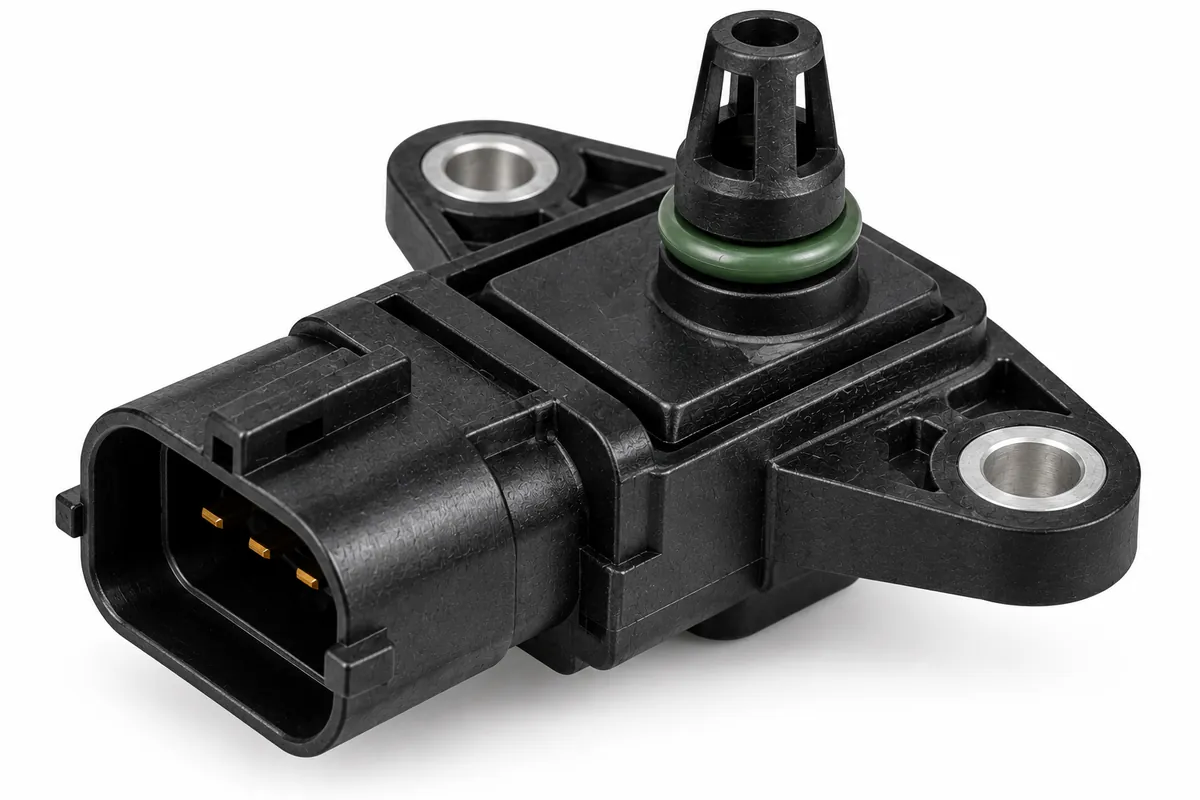
Mobile MAP Sensor Diagnostics in Daytona Beach
A MAP-sensor trouble code does not automatically mean the sensor itself has failed.
Depending on the vehicle and symptoms, diagnosis can include checking:
- MAP pressure reading
- MAP voltage
- MAP frequency where applicable
- Key-on engine-off pressure
- Idle manifold pressure
- Pressure response to throttle changes
- 5-volt reference
- Sensor ground
- Signal circuit
- Connector condition
- Wiring harness
- Vacuum hose where used
- Sensor vacuum port
- Intake-manifold leaks
- Throttle position
- Engine RPM
- Barometric pressure
- MAF data
- Fuel trims
- Oxygen-sensor data
- Engine coolant temperature
- Boost pressure on turbocharged engines
- Related trouble codes
- Freeze-frame data
The goal is to determine whether the MAP sensor is truly reporting manifold pressure incorrectly or whether another engine condition is causing the unusual reading.
What Is a MAP Sensor?
MAP stands for:
Manifold Absolute Pressure
The sensor measures the absolute pressure inside the intake manifold.
On a naturally aspirated gasoline engine, manifold pressure changes significantly according to:
- Throttle opening
- Engine speed
- Engine load
On a turbocharged or supercharged engine, the sensor may also measure pressure above atmospheric pressure when the engine is under boost.
What Does a MAP Sensor Do?
The engine computer can use the MAP signal to help determine:
- Engine load
- Airflow estimation
- Fuel delivery
- Ignition timing
- EGR operation
- Boost control
- Variable valve timing strategy
- Diagnostic plausibility
Some engines rely heavily on the MAP sensor for calculating airflow.
Others use the MAP sensor alongside a mass air flow sensor.
MAP Sensor vs. MAF Sensor
These sensors are related but very different.
MAP Sensor
Measures intake-manifold pressure.
MAF Sensor
Measures the actual mass of air entering the engine.
Some vehicles use:
- MAP only
- MAF only
- Both MAP and MAF
When both are present, the engine computer may compare their information for plausibility.
A MAP-related fault should not automatically be blamed on the MAF sensor, and a MAF code should not automatically lead to MAP replacement.
MAP Sensor vs. Barometric Pressure Sensor
A barometric-pressure sensor measures atmospheric pressure outside the engine.
A MAP sensor measures pressure inside the intake manifold.
On some vehicles, the MAP sensor also provides barometric information when the engine is not running.
On others, the vehicle may have a separate:
- BARO sensor
- Combined MAP/BARO strategy
This distinction matters when diagnosing implausible pressure readings.
MAP Sensor vs. Boost Pressure Sensor
On forced-induction engines, terminology can vary.
A sensor may be called:
- MAP sensor
- Boost pressure sensor
- Charge pressure sensor
- Intake manifold pressure sensor
Some vehicles use one sensor for multiple functions.
Others use separate pressure sensors before and after the throttle body.
Correct sensor identification is important.
MAP Sensor vs. TMAP Sensor
Some vehicles use a TMAP sensor, which combines:
- Manifold pressure
- Intake air temperature
in one housing.
A TMAP sensor may therefore have more terminals than a simple pressure-only MAP sensor.
A fault in the temperature portion does not automatically mean the pressure portion has failed.
What Does Absolute Pressure Mean?
MAP sensors measure absolute pressure, not just vacuum.
Absolute pressure is referenced to a complete vacuum.
At sea level with the engine off, atmospheric pressure is approximately:
- 14.7 psi absolute
- 101 kPa absolute
Actual atmospheric pressure changes with:
- Weather
- Altitude
This is why a MAP sensor can display a substantial pressure value even when the engine is not running.
MAP Sensor Units
Scan tools may display manifold pressure in:
- kPa
- psi
- inHg
- bar
The most common scan-data unit is often:
kilopascals, or kPa
The correct value depends on:
- Atmospheric pressure
- Engine load
- Throttle opening
- Boost level
There is no single normal MAP reading for all operating conditions.
MAP Sensor Key-On Engine-Off Reading
With the ignition on and engine off, intake-manifold pressure should normally be very close to atmospheric pressure because the engine is not producing manifold vacuum.
This is one of the most useful MAP plausibility checks.
The reading can be compared with:
- Barometric pressure data
- Local atmospheric pressure
- Another known-good pressure source
A large difference with the engine off may indicate:
- Sensor calibration problem
- Wiring fault
- Incorrect sensor
- Barometric-data issue
MAP Sensor Reading at Idle
Once a gasoline engine starts and idles with the throttle mostly closed, intake vacuum develops.
As vacuum increases, absolute manifold pressure decreases.
A healthy naturally aspirated gasoline engine at warm idle may commonly show a MAP value substantially below atmospheric pressure.
The exact number varies with:
- Engine design
- Altitude
- Camshaft timing
- Idle speed
- Engine load
A generic idle value should not be used as an absolute pass/fail specification.
MAP Sensor Under Wide-Open Throttle
As the throttle opens under heavy load on a naturally aspirated engine, intake-manifold pressure rises toward atmospheric pressure.
The MAP signal should respond quickly.
A reading that remains abnormally low under heavy load can indicate:
- Sensor problem
- Restricted intake
- Signal issue
but engine operating conditions must be considered.
MAP Sensor on Turbocharged Engines
A turbocharged engine can raise intake-manifold pressure above atmospheric pressure.
The MAP sensor may therefore need to measure:
- Vacuum
- Atmospheric pressure
- Positive boost
A sensor designed only for naturally aspirated pressure ranges may not be appropriate for a boosted application.
1-Bar, 2-Bar, 3-Bar and 4-Bar MAP Sensors
MAP sensors are sometimes described by their pressure range.
1-Bar MAP Sensor
Typically measures approximately one atmosphere of absolute pressure and is generally suited to naturally aspirated applications.
2-Bar MAP Sensor
Can measure approximately twice atmospheric absolute pressure.
3-Bar MAP Sensor
Can measure a higher boost range.
4-Bar or Higher MAP Sensor
Used for applications requiring still greater pressure measurement.
The sensor range must match:
- Engine control software
- Calibration
- Expected boost pressure
Installing a higher-range sensor without the correct PCM calibration can produce incorrect pressure information.
MAP Sensor and Speed-Density Fueling
Some engines use a strategy commonly called speed density.
Instead of directly measuring incoming air mass with a MAF sensor, the PCM estimates airflow using information including:
- MAP
- RPM
- Intake air temperature
- Engine displacement
- Volumetric-efficiency calculations
On these systems, an inaccurate MAP signal can have a major effect on fuel calculation.
MAP Sensor Voltage
Many MAP sensors produce an analog voltage that changes with pressure.
A common general pattern is:
- Lower manifold pressure = lower signal voltage
- Higher manifold pressure = higher signal voltage
However, exact values vary by sensor and vehicle.
A universal voltage specification should not be applied to every MAP sensor.
MAP Sensor 5-Volt Reference
Many MAP sensors are supplied with a regulated:
5-volt reference
from the PCM.
The three basic circuits may include:
- 5-volt reference
- Sensor ground
- Signal
If the 5-volt supply is missing, the MAP sensor cannot produce the expected output.
Replacing the sensor will not repair a failed reference circuit.
Shared 5-Volt Reference
The MAP sensor may share its 5-volt reference with other sensors.
Depending on the vehicle, these may include:
- Throttle position sensor
- AC pressure sensor
- Fuel pressure sensor
- Accelerator pedal sensor
A shorted sensor elsewhere on the shared reference circuit can pull down the voltage and make the MAP sensor appear defective.
This is an important reason to test the reference circuit before replacing the sensor.
MAP Sensor Ground
A poor sensor ground can distort the MAP signal.
Possible causes include:
- Corroded splice
- Broken wire
- Loose terminal
- High-resistance connection
Ground quality should be checked under appropriate conditions.
MAP Sensor Signal Wire
The signal circuit carries the pressure information to the PCM.
Possible problems include:
- Open circuit
- Short to ground
- Short to voltage
- Excessive resistance
- Intermittent connection
The signal should change smoothly when manifold pressure changes.
MAP Sensor Connector
The connector should be inspected for:
- Corrosion
- Loose terminals
- Bent pins
- Broken locking tab
- Oil contamination
- Water intrusion
- Heat damage
A new MAP sensor cannot correct an unreliable electrical connection.
MAP Sensor Vacuum Hose
Some older MAP sensors are mounted remotely from the intake manifold and connected by a vacuum hose.
If that hose is:
- Cracked
- Split
- Disconnected
- Collapsed
- Restricted
the sensor may receive incorrect pressure even though the sensor itself is functioning correctly.
The hose must be inspected before replacement.
MAP Sensor Mounted Directly in Intake Manifold
Many modern sensors plug directly into:
- Intake manifold
- Throttle body area
- Charge pipe
They may use an O-ring for sealing.
The pressure port can become contaminated by:
- Oil vapor
- Carbon
- Dirt
The sensor and passage should be inspected carefully.
Dirty MAP Sensor
MAP sensors can become contaminated by:
- Oil vapor
- Carbon deposits
- Intake residue
Contamination can obstruct the pressure port or interfere with the sensing element.
The effect depends on sensor design.
Can a MAP Sensor Be Cleaned?
Sometimes a contaminated MAP sensor or pressure port can be cleaned carefully.
However, cleaning does not repair:
- Failed electronics
- Damaged pressure diaphragm
- Broken connector
- Internal circuit failure
The sensor design should be considered before applying any chemical cleaner.
Cleaning a MAP Sensor
If cleaning is appropriate:
- Remove the sensor carefully
- Use a sensor-safe cleaner where specified
- Do not mechanically damage the sensing element
- Allow the sensor to dry fully before installation
Harsh solvents should not be used indiscriminately.
Signs of a Bad MAP Sensor
Possible symptoms include:
- Check-engine light
- Rough idle
- Hesitation
- Poor acceleration
- Reduced power
- Stalling
- Hard starting
- Poor fuel economy
- Rich running
- Lean running
- Black exhaust smoke
- Surging
- Incorrect boost control
- Engine operating in reduced-power mode
These symptoms overlap with numerous other engine faults.
The sensor should be tested before replacement.
MAP Sensor and Rough Idle
An incorrect MAP signal can cause the PCM to calculate the wrong engine load and fuel requirement.
However, rough idle can also result from:
- Vacuum leak
- Ignition misfire
- Fuel injector
- Dirty throttle body
- Compression problem
MAP data should be interpreted with other engine information.
MAP Sensor and Hesitation
A MAP signal that responds slowly or inaccurately during throttle changes can affect:
- Fueling
- Ignition timing
- Load calculation
This may produce hesitation.
Other possible causes include:
- Fuel-pressure problem
- MAF issue
- Throttle-control fault
- Ignition problem
MAP Sensor and Stalling
A severely inaccurate MAP signal may contribute to unstable fueling or idle control.
However, stalling can also come from:
- Crankshaft sensor
- Fuel pump
- Throttle body
- Charging voltage
- Vacuum leak
The MAP signal should be evaluated during the actual fault when possible.
MAP Sensor and Hard Starting
A false pressure reading during startup can influence fuel calculation.
However, hard starting can also result from:
- Fuel-pressure loss
- Coolant temperature sensor
- Crankshaft sensor
- Injector leakage
- Battery condition
A MAP sensor should not be replaced based solely on a hard-start symptom.
MAP Sensor and Poor Fuel Economy
If the MAP sensor reports excessive engine load, the PCM may command more fuel than necessary.
Possible effects include:
- Increased fuel consumption
- Rich exhaust
- Negative fuel trims
Poor fuel economy alone is not enough to condemn the sensor.
MAP Sensor and Black Smoke
A MAP sensor that causes the PCM to overestimate engine load can contribute to excessive fueling on some systems.
Black smoke can also result from:
- Leaking injector
- Excessive fuel pressure
- MAF problem
- Coolant-temperature sensor issue
The actual rich condition should be diagnosed.
MAP Sensor and Lean Running
If the sensor underestimates engine load on a speed-density system, fueling may be insufficient.
Possible results include:
- Hesitation
- Positive fuel trims
- Lean codes
Vacuum leaks, low fuel pressure, and injector restrictions can create similar conditions.
MAP Sensor and Fuel Trims
Fuel trims can provide useful supporting information.
Positive Fuel Trim
The PCM is adding fuel.
Possible reasons include:
- Vacuum leak
- Low fuel pressure
- MAP underreporting on certain systems
Negative Fuel Trim
The PCM is removing fuel.
Possible reasons include:
- MAP overreporting load
- Excessive fuel pressure
- Leaking injector
Fuel trims should be evaluated across different operating conditions.
MAP Sensor and Vacuum Leak
A vacuum leak changes actual intake-manifold pressure.
The MAP sensor may correctly report that change.
For example, a significant vacuum leak can cause:
- Higher-than-normal manifold absolute pressure at idle
- Lean fuel trims
- Rough idle
The MAP sensor should not be replaced simply because its reading is abnormal if the reading accurately reflects a real intake leak.
MAP Sensor and Intake-Manifold Leak
Leaks can occur at:
- Intake gasket
- Vacuum hose
- Brake-booster hose
- PCV system
- Throttle-body gasket
- EVAP purge circuit
A leak can alter manifold pressure and make the MAP reading appear suspicious.
Smoke testing may be appropriate when an intake leak is suspected.
MAP Sensor and Brake Booster Vacuum Leak
A leaking brake-booster diaphragm or vacuum hose can introduce a significant intake leak.
Possible symptoms include:
- High or rough idle
- Lean fuel trims
- Abnormal MAP reading
The sensor may be accurately showing reduced manifold vacuum.
MAP Sensor and PCV System
A stuck-open or damaged PCV system can create excessive unmetered airflow.
On a speed-density system, this can significantly affect manifold pressure.
PCV hoses and valves should be considered when MAP data at idle is abnormal.
MAP Sensor and Throttle Body
The throttle body controls how much air can enter the intake manifold.
At idle:
- Throttle mostly closed
- Manifold vacuum is relatively high
- Absolute pressure is relatively low
At heavy throttle:
- Throttle opens
- Manifold vacuum decreases
- Absolute pressure rises
A throttle-body problem can therefore alter actual MAP readings without the sensor being defective.
MAP Sensor and Electronic Throttle Control
Modern engines can compare:
- Throttle angle
- MAP
- MAF
- RPM
- Engine load
If these values do not agree, the PCM may set plausibility codes.
The data should be compared rather than replacing the MAP sensor automatically.
MAP Sensor and MAF Correlation
When a vehicle uses both sensors, the engine computer can compare:
- Measured airflow
- Intake pressure
- Throttle position
- RPM
A large disagreement may indicate:
- MAP problem
- MAF problem
- Intake leak
- Incorrect airflow
The goal is to identify which input is implausible.
MAP Sensor and Barometric Pressure
With the engine off, MAP pressure should normally be close to atmospheric pressure.
If the PCM provides both:
- MAP
- BARO
the two values can be compared.
A large difference under key-on engine-off conditions can be a valuable diagnostic clue.
MAP Sensor and Altitude
Atmospheric pressure decreases as altitude increases.
Therefore, key-on engine-off MAP pressure will be lower at higher elevation than near sea level.
A fixed atmospheric-pressure number should not be used as a universal specification.
MAP Sensor and Daytona Beach Conditions
Daytona Beach is close to sea level, so atmospheric pressure will often be relatively close to standard sea-level pressure, but weather systems still cause normal variation.
The sensor should be judged against actual atmospheric conditions rather than a fixed textbook number.
MAP Sensor and Engine Load
MAP data is a major engine-load indicator.
Low Load
Manifold pressure is generally lower on a naturally aspirated gasoline engine.
High Load
Pressure rises closer to atmospheric pressure.
Turbocharged High Load
Pressure can rise above atmospheric pressure.
A MAP signal that does not respond to engine load requires further testing.
MAP Sensor Response Test
A useful diagnostic check is to monitor MAP while changing throttle position.
The reading should respond quickly as manifold pressure changes.
A sensor that:
- Responds very slowly
- Stays fixed
- Jumps erratically
- Drops out
may have a sensor or circuit problem.
Snap-Throttle MAP Test
A rapid throttle opening can cause manifold pressure to rise quickly toward atmospheric pressure.
When the throttle closes, vacuum should return.
This can help verify:
- Sensor response
- Intake-manifold behavior
The exact waveform depends on engine operation and control strategy.
MAP Sensor and Engine Vacuum
Traditional vacuum gauges measure pressure below atmospheric pressure.
MAP sensors report absolute pressure.
This creates an important relationship:
Higher vacuum = lower MAP pressure
and:
Lower vacuum = higher MAP pressure
Understanding this prevents scan-data misinterpretation.
High MAP Reading at Idle
If MAP pressure is unusually high at idle, possible causes include:
- Vacuum leak
- Late valve timing
- Low compression
- Throttle open too far
- MAP sensor reading too high
The engine’s actual vacuum condition must be determined before blaming the sensor.
Low MAP Reading at Idle
A low MAP value generally corresponds to stronger engine vacuum.
An unusually low or implausible value could result from:
- Sensor calibration issue
- Signal problem
but vehicle-specific operating conditions must be considered.
MAP Sensor and Engine Mechanical Condition
MAP readings can provide clues about engine condition because intake vacuum depends on how effectively the engine pumps air.
Abnormal manifold pressure can be associated with:
- Low compression
- Incorrect valve timing
- Restricted exhaust
- Valve problems
A MAP sensor may be accurately reporting a mechanical engine fault.
MAP Sensor and Timing Chain
A stretched or incorrectly timed chain can change valve timing and manifold vacuum.
This may cause MAP readings that appear abnormal.
If other evidence suggests mechanical timing problems, replacing the pressure sensor will not correct the underlying condition.
MAP Sensor and Timing Belt
A timing belt that has jumped a tooth can cause:
- Low manifold vacuum
- Poor power
- Rough idle
- Abnormal MAP data
The sensor can be completely functional while reporting the changed engine condition.
MAP Sensor and Restricted Exhaust
A severely restricted catalytic converter or exhaust system can affect engine breathing and manifold pressure.
Possible symptoms include:
- Loss of power
- Abnormal MAP under load
The MAP sensor may help identify the restriction rather than being the cause of the problem.
MAP Sensor and Fuel Pressure
MAP data influences expected engine load, but fuel pressure determines whether the engine can actually receive the necessary fuel.
Low fuel pressure can cause:
- Lean operation
- Hesitation
- Lack of power
even when MAP data is accurate.
MAP Sensor and Fuel Injectors
Restricted or leaking injectors affect fuel delivery.
The MAP sensor cannot identify individual injector performance.
A cylinder-specific misfire should not automatically be blamed on the MAP sensor.
MAP Sensor and Oxygen Sensors
Oxygen sensors provide exhaust feedback after combustion.
MAP information is used earlier in the fuel-calculation process.
If incorrect MAP data causes poor fueling, oxygen-sensor readings and fuel trims may reflect the result.
The oxygen sensors themselves may be working correctly.
MAP Sensor and Coolant Temperature Sensor
Coolant temperature influences fuel strategy during:
- Cold start
- Warm-up
An incorrect coolant-temperature signal can cause rich or lean operation that resembles a MAP-related fueling problem.
Both data points should be evaluated when necessary.
MAP Sensor and Intake Air Temperature
Intake air temperature is particularly important on speed-density systems because air density changes with temperature.
The PCM may calculate airflow using:
- MAP
- Intake air temperature
- RPM
A TMAP sensor may combine pressure and temperature in one housing.
MAP Sensor and Misfire
A severely inaccurate MAP signal can potentially cause mixture problems that contribute to misfire.
However, common misfire causes include:
- Spark plugs
- Ignition coils
- Injectors
- Compression
- Vacuum leaks
A P030x code does not prove the MAP sensor is faulty.
MAP Sensor and P0105
P0105 generally identifies a MAP or barometric-pressure circuit problem.
Possible causes include:
- MAP sensor
- Wiring
- Connector
- Reference voltage
- Ground
The electrical circuit should be tested.
P0106 MAP Range/Performance
P0106 commonly indicates that MAP data is outside the expected range or does not agree with other engine information.
Possible causes include:
- Inaccurate MAP sensor
- Vacuum leak
- Blocked sensor port
- Wiring fault
- Engine mechanical problem
- Incorrect throttle or airflow data
P0106 is often a plausibility code, so replacing the sensor without comparing data can lead to an unnecessary repair.
P0107 MAP Circuit Low
P0107 generally indicates MAP signal voltage is lower than expected.
Possible causes include:
- Signal short to ground
- Sensor fault
- Missing reference voltage
- Wiring issue
The 5-volt supply, ground, and signal circuit should be tested.
P0108 MAP Circuit High
P0108 generally indicates a higher-than-expected signal voltage.
Possible causes include:
- Signal short to voltage
- Open ground
- Sensor fault
- Connector problem
The circuit should be verified before replacement.
P0109 Intermittent MAP Circuit
P0109 commonly indicates intermittent MAP or barometric-pressure circuit behavior.
Possible causes include:
- Loose connector
- Broken wire
- Sensor internal dropout
- Harness chafing
Monitoring the signal while manipulating the harness carefully can help locate the fault.
MAP Sensor and P0068
P0068 commonly involves a correlation problem between:
- Throttle position
- MAP
- MAF or airflow calculation
Possible causes can include:
- Vacuum leak
- Throttle-body problem
- MAP sensor
- MAF sensor
- Wiring
The code does not identify one part automatically.
MAP Sensor and Boost Codes
Turbocharged engines may set pressure-performance or underboost/overboost codes if measured pressure does not match expected pressure.
Possible causes include:
- MAP sensor
- Boost leak
- Wastegate problem
- Turbocharger problem
- Boost-control solenoid
- Charge-air restriction
Pressure data should be compared with actual boost-system operation.
MAP Sensor and Turbo Boost Leak
A leak in the charge-air system can cause measured pressure to remain lower than commanded.
Possible leak points include:
- Intercooler hose
- Charge pipe
- Intercooler
- Coupler
- Clamp
The MAP sensor may correctly report low pressure.
Replacing it will not repair a boost leak.
MAP Sensor and Wastegate Problems
A stuck-open or improperly controlled wastegate can reduce boost.
The MAP sensor may correctly show the resulting low pressure.
Likewise, overboost can result from:
- Wastegate control
- Boost solenoid
- Mechanical turbocharger issue
The sensor should not be blamed simply because boost is incorrect.
MAP Sensor and Turbocharger Failure
A weak or damaged turbocharger can cause:
- Low boost
- Poor power
- Abnormal pressure readings
The MAP sensor may simply be measuring the actual lack of boost.
Sensor replacement is not a turbocharger repair.
MAP Sensor and Supercharged Engines
Supercharged engines also use intake pressure information for:
- Load calculation
- Fueling
- Ignition strategy
As with turbocharged engines, the pressure sensor must have the correct range for the expected boost level.
MAP Sensor Range and Modified Engines
Performance-modified engines may use higher-range MAP sensors such as:
- 2-bar
- 3-bar
- 4-bar
Installing one requires matching software calibration.
A PCM calibrated for one sensor range will not correctly interpret another range merely because the connector fits.
MAP Sensor Frequency Output
Some pressure sensors use a frequency output instead of simple analog voltage.
The frequency changes as pressure changes.
These systems must be tested according to their design.
A voltage test intended for a conventional analog sensor may be misleading.
Digital MAP Sensors
Modern vehicles may use more advanced digital pressure sensors.
The scan tool may provide the primary diagnostic information, while oscilloscope or network-level testing may be required for some faults.
The sensor type should be identified before testing.
Testing MAP Sensor With a Multimeter
On a conventional analog MAP sensor, a multimeter may be used to check:
- 5-volt reference
- Ground
- Signal voltage
The signal should change as pressure changes.
However, exact expected voltage must come from vehicle-specific information.
Testing MAP Sensor With a Vacuum Pump
For sensors connected to manifold vacuum, a hand vacuum pump can sometimes be used to apply controlled pressure changes while monitoring:
- Sensor voltage
- Scan data
The response should be:
- Smooth
- Repeatable
- Consistent
A sensor that has sudden dead spots or erratic response may be defective.
Comparing Applied Vacuum to MAP Data
When controlled vacuum is applied, the sensor output can be compared with the known pressure.
This is a stronger test than simply checking whether the sensor produces any voltage at all.
A sensor can remain electrically active while being inaccurately calibrated.
MAP Sensor Oscilloscope Testing
An oscilloscope can help evaluate:
- Signal response
- Electrical noise
- Dropouts
- Frequency output where applicable
It can be particularly useful for intermittent faults that are too quick for a basic scan-tool display.
MAP Sensor Wiring Wiggle Test
If the reading drops out intermittently, carefully moving the harness while monitoring live data can reveal:
- Signal spikes
- Sudden pressure changes
- Complete dropout
The wiring should not be pulled aggressively.
MAP Sensor Plausibility Testing
One of the most important questions is:
Does the MAP reading make sense for the engine’s actual operating condition?
Useful comparisons include:
- Key-on engine-off MAP vs. barometric pressure
- MAP vs. throttle position
- MAP vs. RPM
- MAP vs. MAF
- MAP vs. engine load
- MAP vs. fuel trims
This often reveals more than simply checking for a trouble code.
Engine Off MAP vs. Barometric Pressure
With the engine off, there should be little or no vacuum inside the manifold.
Therefore:
MAP should approximately equal atmospheric pressure.
If BARO shows one realistic value but MAP is significantly different with the engine off, the MAP sensor or circuit deserves further investigation.
MAP Reading Changes When Engine Starts
When a healthy gasoline engine starts and begins idling:
- Manifold vacuum develops
- Absolute pressure drops
If the MAP reading remains near atmospheric pressure despite a normal-running engine with strong vacuum, possible causes include:
- Sensor not seeing manifold pressure
- Blocked port
- Vacuum hose disconnected
- Sensor or signal fault
Blocked MAP Sensor Port
Carbon or oil deposits can obstruct the pressure passage.
The sensor may then respond:
- Slowly
- Inaccurately
- Not at all
The port should be inspected when contamination is possible.
Oil in MAP Sensor
Oil vapor from the crankcase ventilation system can sometimes reach the sensor.
A light film may not necessarily cause failure.
Heavy contamination can interfere with certain designs.
The source of excessive oil should also be considered.
MAP Sensor Replacement
Once diagnostics confirm that the MAP sensor itself is faulty, replacement commonly involves:
- Verify the complaint and trouble codes.
- Review freeze-frame information.
- Check key-on engine-off MAP data.
- Compare MAP with barometric pressure where available.
- Monitor MAP at idle and during throttle changes.
- Evaluate fuel trims and related sensor information.
- Inspect for vacuum or intake leaks.
- Verify 5-volt reference.
- Verify sensor ground.
- Check signal circuit.
- Inspect connector condition.
- Inspect any MAP vacuum hose.
- Inspect sensor pressure port for contamination.
- Turn the ignition off.
- Remove intake components required for access.
- Disconnect the MAP electrical connector.
- Remove retaining screws or bolts.
- Carefully remove the sensor.
- Inspect the sensor opening or pressure port.
- Compare the replacement sensor with the original.
- Install a new O-ring or seal where required.
- Install the sensor in the correct orientation.
- Tighten mounting hardware appropriately.
- Reconnect the electrical connector.
- Reconnect any vacuum hose.
- Reinstall removed components.
- Start the engine.
- Check MAP live data.
- Confirm plausible idle pressure.
- Verify throttle response.
- Check fuel trims when appropriate.
- Clear applicable codes.
- Road-test the vehicle if needed.
- Confirm the original fault does not return.
The exact procedure depends on sensor design and location.
MAP Sensor O-Ring
Many intake-mounted MAP sensors use an O-ring to seal the sensor into the manifold or pressure passage.
A damaged O-ring can create:
- Vacuum leak
- Boost leak on forced-induction systems
The seal should be inspected and replaced when appropriate.
MAP Sensor Installed Incorrectly
An improperly seated sensor can produce problems if:
- O-ring is pinched
- Sensor does not fully seat
- Pressure port is blocked
- Connector is not fully engaged
Installation should be checked before assuming a new sensor is defective.
Does a MAP Sensor Need Programming?
A conventional replacement MAP sensor generally does not require programming.
However, the PCM must be calibrated for the correct sensor pressure range.
A stock replacement sensor of the correct specification can normally be installed without programming.
A different-range performance sensor may require engine-computer calibration.
MAP Sensor Relearn
Most standard MAP sensor replacements do not require a dedicated relearn.
Depending on the vehicle, it may be appropriate to:
- Clear trouble codes
- Reset adaptive values
- Allow normal fuel trims to relearn
Vehicle-specific procedures should be followed.
New MAP Sensor but P0106 Returns
If P0106 returns after sensor replacement, possible causes include:
- Vacuum leak
- Incorrect replacement sensor
- Wiring fault
- Blocked pressure passage
- Throttle-body issue
- MAF correlation problem
- Engine mechanical condition
Installing another MAP sensor without testing these areas is unlikely to solve the problem.
New MAP Sensor but P0107 Returns
A recurring low-input code may indicate:
- Missing 5-volt reference
- Shorted signal
- Wiring problem
- Shared-reference circuit fault
The circuit should be tested.
New MAP Sensor but P0108 Returns
A recurring high-input condition can be caused by:
- Signal short to voltage
- Ground circuit problem
- Connector fault
- Incorrect sensor
The wiring should be inspected before another sensor is installed.
New MAP Sensor but Car Still Runs Rough
Possible causes include:
- Vacuum leak
- Ignition misfire
- Fuel injector
- MAF sensor
- Compression problem
- Throttle-body issue
A MAP replacement will not correct an unrelated engine fault.
New MAP Sensor but Fuel Trims Are Still Wrong
Persistent fuel-trim problems can result from:
- Intake leak
- Low or excessive fuel pressure
- Injector problem
- MAF error
- Oxygen-sensor feedback issue
The MAP sensor is only one input used by the engine computer.
New MAP Sensor but Boost Is Still Low
On a turbocharged engine, low boost after MAP replacement can indicate:
- Charge-air leak
- Wastegate problem
- Boost-control solenoid
- Turbocharger problem
Pressure should be tested as a system.
OEM vs. Aftermarket MAP Sensors
MAP sensor calibration is important.
The engine computer expects a precise relationship between:
- Pressure
- Signal voltage or frequency
A sensor can physically fit but still have the wrong calibration.
A quality replacement matched to the exact vehicle application is important.
Cheap MAP Sensor Problems
A poorly calibrated sensor may create:
- P0106
- Rich or lean operation
- Incorrect load calculation
- Poor throttle response
- Boost-control problems
If symptoms begin immediately after replacement, the replacement part should be reconsidered.
Used MAP Sensor
A used sensor may work, but its:
- Age
- Contamination
- Heat exposure
- Calibration condition
are unknown.
A quality new replacement is generally more predictable.
MAP Sensor Replacement Cost
MAP sensor replacement cost depends on factors such as:
- Vehicle year, make, and model
- Sensor type
- MAP vs. combined TMAP design
- Sensor location
- Intake access
- Turbocharged vs. naturally aspirated engine
- Wiring or connector repair
- Diagnostic time
A simple intake-mounted pressure sensor can be straightforward to replace, while a pressure problem caused by wiring, boost leaks, or engine mechanical conditions requires more extensive diagnosis.
Call Jimmy’s Mobile Care at (386) 308-2509 with your vehicle information and symptoms so we can determine the appropriate MAP-sensor diagnostic service.
Why Diagnose a MAP Sensor Before Replacing It?
MAP pressure is affected by the actual way the engine breathes, so an abnormal reading does not necessarily mean the sensor is wrong.
Does MAP Match Atmospheric Pressure With the Engine Off?
If not, the sensor or circuit may be inaccurate.
Does MAP Drop When the Engine Starts?
A gasoline engine should normally develop intake vacuum at idle.
Does the Signal Respond to Throttle Changes?
A sensor that stays fixed or responds slowly requires further testing.
Is the 5-Volt Reference Present?
A new sensor cannot repair a missing reference circuit.
Is the Sensor Ground Good?
Ground resistance can alter the signal.
Is the Intake Manifold Leaking?
A vacuum leak can cause genuinely abnormal manifold pressure.
Is the MAP Pressure Port Blocked?
Contamination can prevent the sensor from seeing actual manifold pressure.
Does MAF Data Agree With MAP, RPM and Throttle Position?
Correlation between several sensors can identify which input is implausible.
Is the Engine Mechanically Healthy?
Incorrect valve timing or low compression can change manifold vacuum.
Is a Turbocharged Engine Actually Making the Expected Boost?
A boost leak or wastegate problem can create a low MAP reading with a perfectly good sensor.
Testing these areas helps prevent unnecessary MAP sensor replacement.
Mobile MAP Sensor Diagnostics in Daytona Beach
Jimmy’s Mobile Care provides mobile car MAP sensor diagnostics in Daytona Beach for vehicles experiencing:
- P0105
- P0106
- P0107
- P0108
- P0109
- P0068
- Rough idle
- Hesitation
- Poor acceleration
- Rich or lean running
- Poor fuel economy
- Abnormal manifold-pressure readings
- Boost-pressure problems
- Suspected MAP sensor wiring faults
- Check-engine light
We evaluate pressure data, electrical circuits, intake-manifold conditions, and related engine information before determining whether the MAP sensor itself requires replacement.
Mobile MAP Sensor Replacement in Daytona Beach
When diagnostics confirm a defective MAP sensor and the repair is appropriate for on-site service, Jimmy’s Mobile Care can replace many manifold absolute pressure sensors at your Daytona Beach location.
After replacement, we can verify:
- Correct sensor installation
- Secure electrical connection
- Proper sensor sealing
- Plausible key-on engine-off pressure
- Normal pressure response at idle
- Proper response to throttle changes
- Fuel-trim improvement where applicable
- No immediate return of the original fault
If the actual problem is a vacuum leak, damaged wiring, shared 5-volt reference fault, blocked pressure passage, boost leak, throttle-control problem, MAF fault, or engine mechanical condition, that problem must be corrected instead of unnecessarily replacing the MAP sensor.
Schedule Car MAP Sensor Diagnostics & Replacement in Daytona Beach
A P0106 code, rough idle, loss of power, rich or lean fuel mixture, or abnormal manifold-pressure reading does not automatically mean the MAP sensor has failed.
The sensor may be accurately reporting a vacuum leak, low engine vacuum, boost-control problem, throttle condition, or mechanical engine fault. Wiring and shared reference-voltage problems can also make a good sensor appear defective.
Jimmy’s Mobile Care tests the MAP sensor in relation to actual manifold pressure, electrical integrity, engine load, and related sensor data before replacement so the part is replaced only when the diagnosis supports it.
Call Jimmy’s Mobile Care at (386) 308-2509 to schedule car MAP sensor diagnostics and replacement in Daytona Beach, FL. Call today and we'll come to your location.