
Car AC Hose Inspection & Replacement in Daytona Beach, FL
Automotive AC hoses carry refrigerant between major components while allowing for engine movement, vibration, and changes in position that rigid metal lines cannot easily accommodate. These flexible refrigerant hoses operate under pressure and must remain sealed while exposed to heat, vibration, oil, road debris, and years of engine-compartment movement.
A leaking or damaged AC hose can gradually lower the refrigerant charge until cooling becomes weak or stops altogether.
Jimmy’s Mobile Care provides car AC hose inspection and replacement in Daytona Beach, FL. We inspect flexible refrigerant hoses, crimped fittings, connections, routing, and signs of refrigerant leakage before determining whether a hose assembly needs replacement.
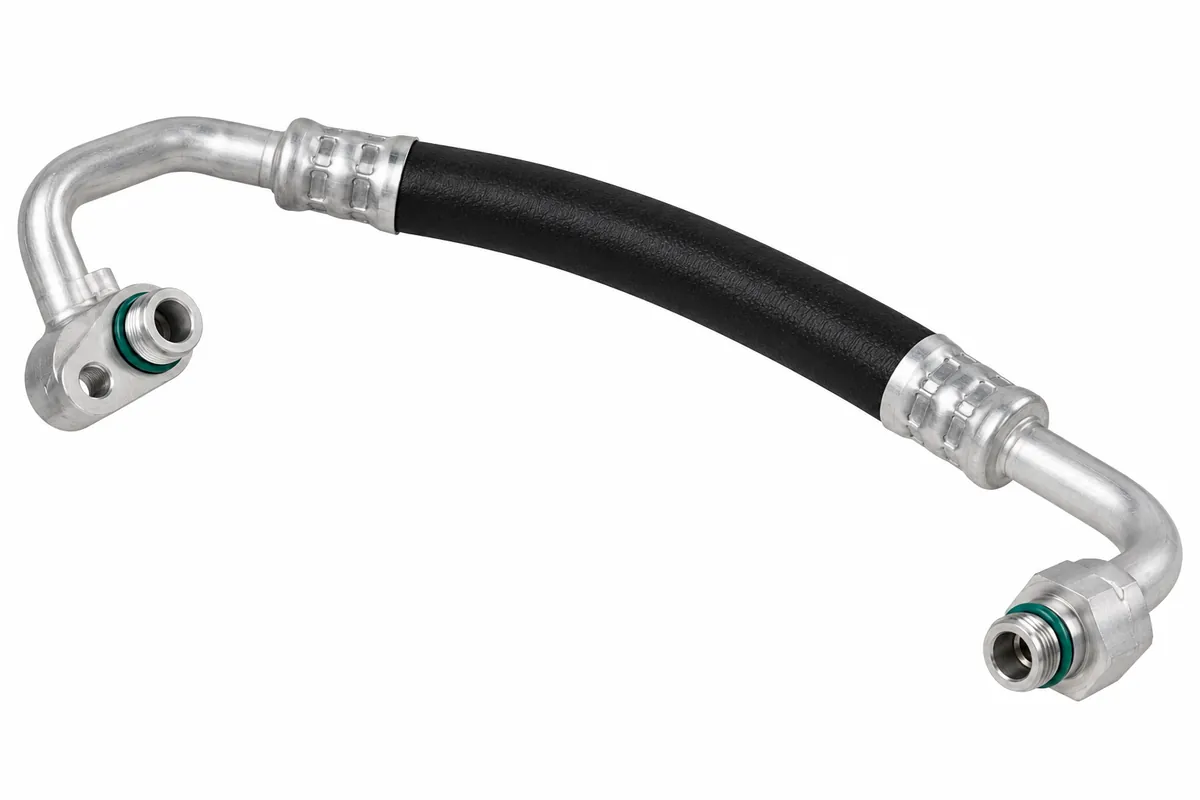
Mobile Car AC Hose Inspection in Daytona Beach
A flexible AC hose should be evaluated as part of the complete refrigerant circuit rather than replaced simply because refrigerant is low.
Inspection can include checking for:
- Refrigerant oil residue
- UV dye
- Cracked or deteriorated hose material
- Abrasion
- Chafing
- Heat damage
- Swelling
- Kinks
- Damaged crimp fittings
- Leaking hose ends
- Damaged O-rings
- Loose or stressed connections
- Contact with moving components
- Improper routing
- Refrigerant leakage under pressure
The objective is to determine whether the flexible hose itself, the crimped fitting, or the connection at another AC component is actually leaking.
What Does a Car AC Hose Do?
AC hoses move refrigerant between components in the air-conditioning system.
Depending on system design, flexible hose sections may connect components such as the:
- Compressor
- Condenser
- Evaporator circuit
- Accumulator
- Receiver-drier
- Refrigerant lines
The hose must contain refrigerant while tolerating:
- High pressure
- Low pressure
- Compressor vibration
- Engine movement
- Heat
- Refrigerant oil
- Temperature changes
That combination of flexibility and pressure containment is what makes an automotive AC hose different from ordinary rubber tubing.
AC Hose vs. AC Line
The terms AC hose and AC line are sometimes used interchangeably, but they are not always the same thing.
AC Hose
An AC hose is a flexible reinforced refrigerant section designed to tolerate movement and vibration.
AC Line
An AC line is often a rigid aluminum or metal tube carrying refrigerant through a fixed section of the vehicle.
Many factory refrigerant assemblies combine both materials.
A single assembly may contain:
- Flexible rubber hose
- Aluminum tubing
- Crimped transitions
- Fittings at each end
This page focuses primarily on flexible automotive AC hose assemblies and their crimped connections.
AC Hose vs. AC Recharge Hose
A vehicle's AC hose should also not be confused with a service or recharge hose.
An automotive AC hose is permanently installed in the vehicle and carries refrigerant during normal AC operation.
An AC recharge hose is external service equipment used to connect refrigerant or gauges to the vehicle.
Jimmy’s Mobile Care services the refrigerant hoses installed on the vehicle rather than consumer recharge hoses.
Types of Car AC Hoses
Depending on system design, automotive AC hose assemblies can include:
- Compressor discharge hose
- Compressor suction hose
- High-pressure hose
- Low-pressure hose
- Refrigerant liquid hose sections
- Combination hose-and-aluminum-line assemblies
Each section experiences different pressures and temperatures.
That means the location and type of hose matter when diagnosing damage.
AC Discharge Hose
The compressor discharge hose carries hot, high-pressure refrigerant away from the compressor toward the condenser.
This section of the system can experience substantial:
- Heat
- Pressure
- Engine vibration
A discharge hose problem can include:
- Cracked hose material
- Leaking crimps
- Oil residue
- Damaged fittings
- Heat deterioration
- Abrasion from nearby components
Because it is on the high-pressure side, a significant leak may become more noticeable while the AC is operating.
AC Suction Hose
The suction hose carries lower-pressure refrigerant back toward the compressor.
It is usually larger in diameter than the high-pressure discharge hose because of the condition and volume of refrigerant moving through it.
Possible suction-hose problems include:
- Cracking
- Deterioration
- Oil seepage
- Damaged crimps
- Collapsed or kinked sections
- Leaking connections
The suction hose may also become cold during AC operation and can show condensation on its exterior.
Normal condensation should not be confused with refrigerant leakage.
High-Pressure AC Hose
High-pressure refrigerant hoses operate between the compressor and other high-side components.
Damage can be more serious because system pressure can become substantial during hot-weather operation.
Inspection should include:
- Hose body
- Crimp joints
- Fittings
- Routing
- Heat exposure
- Abrasion
- Nearby moving components
A visibly deteriorated high-pressure hose should not be ignored simply because it has not yet developed a large leak.
Low-Pressure AC Hose
Low-pressure AC hoses operate on the suction side of the refrigeration circuit.
They may experience lower refrigerant pressure than discharge hoses, but they still need to remain completely sealed.
Problems can develop at:
- Flexible hose sections
- Compressor connection
- Accumulator connection
- Crimped transitions
- O-rings
- Fittings
A slow leak can gradually lower the system charge without creating an obvious sudden failure.
Signs of a Bad Car AC Hose
Possible symptoms of a damaged AC hose include:
- AC gradually stops cooling
- Refrigerant charge repeatedly becomes low
- Oily residue on a hose
- UV dye around a hose or crimp
- Visible hose cracking
- Abrasion through the outer hose layer
- Swollen hose
- Refrigerant detected near a hose
- Hissing after a severe hose failure
- Damaged or bent fitting
- AC stopped working after another under-hood repair
These symptoms still need inspection because refrigerant can travel along surfaces and make the apparent leak location misleading.
Refrigerant Leaking From an AC Hose
AC hoses contain both refrigerant and refrigerant oil.
When a hose develops a leak, escaping refrigerant may carry a small amount of oil with it.
This can leave:
- Greasy residue
- Dirt accumulation
- UV dye
- Dark staining
The exact leak point may be in the rubber hose or at a connection.
That distinction matters because the required repair can be different.
AC Hose Crimp Leaks
One of the most important areas to inspect is where the flexible hose is crimped to its metal fitting.
The crimp must permanently seal the hose against the fitting while holding refrigerant pressure.
Over time, leakage can develop because of:
- Age
- Hose deterioration
- Corrosion
- Movement
- Crimp failure
- Heat cycling
Oil or fluorescent dye concentrated around the crimp is useful evidence of leakage.
When the crimp itself has failed, the complete hose assembly commonly requires replacement or professional hose reconstruction depending on the application.
Cracked AC Hoses
Aging flexible refrigerant hoses can develop cracks in the outer material.
Not every superficial surface mark means refrigerant is leaking.
However, deep cracking can indicate deterioration of the hose structure.
We look at:
- Depth of cracking
- Location
- Hose age
- Flexibility
- Evidence of refrigerant oil
- Whether reinforcement is exposed
- Whether the hose has become hard or brittle
The condition of the entire hose matters more than one small cosmetic mark.
AC Hose Abrasion and Chafing
A hose rubbing against another component can gradually wear through its outer layers.
Common contact points can include:
- Brackets
- Engine covers
- Metal edges
- Radiator supports
- Other hoses
- Wiring retainers
Engine movement can make the rubbing worse over time.
A hose that has been damaged by chafing should also be checked for the reason it was contacting another component.
Replacing the hose without correcting the routing can allow the new hose to fail in the same place.
Heat-Damaged AC Hoses
Engine compartments contain numerous high-temperature components.
An AC hose routed too close to excessive heat can deteriorate.
Possible heat damage can include:
- Hardened rubber
- Cracking
- Discoloration
- Blistering
- Deformation
Heat shielding and factory routing are important for protecting refrigerant hoses.
If a hose failed because of abnormal heat exposure, the cause of that exposure should be corrected during replacement.
Swollen AC Hose
A refrigerant hose that appears swollen or distorted may have suffered internal deterioration.
Swelling is different from the normal diameter of a reinforced hose.
Possible concerns include:
- Weakened hose construction
- Internal damage
- Chemical deterioration
- Excessive pressure exposure
A suspiciously swollen section should be compared with the rest of the hose assembly and evaluated before continued operation.
Kinked AC Hose
A flexible AC hose can become kinked if it is:
- Incorrectly routed
- Twisted during installation
- Forced around another component
- Damaged in a collision
- Installed with improper alignment
A severe kink can reduce refrigerant flow and place stress on the hose reinforcement.
It can also create abnormal pressure behavior that might initially look like another AC restriction.
Twisted AC Hose
A hose should be installed without unnecessary twisting.
A twisted hose can:
- Stress crimp connections
- Change routing
- Rub nearby components
- Develop premature damage
- Place tension on fittings
Factory fitting orientation often determines the correct installed position.
If a replacement hose must be forced or twisted to align with its connections, the part or routing should be rechecked.
AC Hose Fittings
Refrigerant hoses terminate in metal fittings that connect to other AC components.
These may attach to:
- Compressor
- Condenser
- Accumulator
- Receiver-drier
- Refrigerant lines
The fitting itself can develop problems such as:
- Corrosion
- Bent sealing surfaces
- Damaged threads
- Cracks
- Physical distortion
A damaged fitting can cause leakage even when the flexible hose remains intact.
AC Hose O-Ring Leaks
Many hose connections use O-rings to seal refrigerant.
An apparent hose leak near a component may actually come from the O-ring at the fitting.
O-rings can leak because of:
- Age
- Hardening
- Incorrect size
- Pinching
- Improper installation
- Wrong material
- Damaged sealing surface
This distinction is important.
A leaking O-ring may not require replacement of the entire hose assembly if the hose and fitting are otherwise in good condition.
Refrigerant Leak at the Compressor Hose Connection
Both suction and discharge hose assemblies commonly attach directly to the compressor.
Leakage in this area can come from:
- O-ring
- Manifold seal
- Fitting
- Hose crimp
- Compressor body
Oil around the compressor does not automatically prove that the compressor itself is leaking.
The exact source should be identified before replacing either the compressor or hose.
Refrigerant Leak at the Condenser Hose Connection
A hose or refrigerant line may connect directly to the condenser.
If leakage is found there, the source may be:
- O-ring
- Fitting
- Damaged hose
- Damaged metal line
- Condenser connection
- Condenser itself
The condenser should not be replaced solely because refrigerant is visible near its inlet or outlet.
The actual leak point needs to be isolated.
AC Hose Damage From Engine Movement
Some hose sections are flexible specifically because the engine moves relative to the vehicle body.
Normal movement occurs during:
- Acceleration
- Deceleration
- Starting
- Shifting
- Engine torque changes
If a motor mount is badly worn, engine movement can become excessive and place additional stress on AC hoses.
That can contribute to:
- Stretching
- Crimp stress
- Abrasion
- Fitting damage
When a hose failure appears related to abnormal movement, the underlying mechanical condition should also be considered.
AC Hose Damage After Other Repairs
A refrigerant hose can be damaged during unrelated engine-compartment work.
Possible problems include:
- Hose pinched under a bracket
- Hose left rubbing a pulley
- Incorrect routing
- Missing retaining clips
- Fitting placed under tension
- Heat shield not reinstalled
If the AC began losing refrigerant shortly after another repair, disturbed hose routing and connections are useful places to inspect.
AC Hose Retainers and Brackets
Factory brackets and retainers prevent AC hoses from moving into unsafe positions.
Missing retainers can allow a hose to:
- Rub against metal
- Contact a belt or pulley
- Rest against a hot component
- Vibrate excessively
During hose replacement, the supporting clips and brackets should be restored rather than leaving the new hose unsupported.
AC Hose Leak Detection With UV Dye
If compatible fluorescent dye is present in the refrigerant system, leaking refrigerant can carry dye through the failed hose area.
Under ultraviolet light, dye may be visible around:
- Hose crimps
- Fittings
- O-rings
- Abraded areas
- Damaged sections
UV inspection can be particularly useful for small leaks that leave only limited oil residue.
Electronic Leak Detection Around AC Hoses
An electronic refrigerant detector can also help identify hose leaks.
The detector can be passed slowly around:
- Flexible hose sections
- Crimp joints
- Compressor connections
- Condenser connections
- Other fittings
Airflow in the engine compartment can move escaping refrigerant, so the strongest detector response should be narrowed back toward the actual source.
Why a Hose Can Leak Only Under Certain Conditions
Not every refrigerant leak occurs at the same rate all the time.
A hose or fitting may leak differently when:
- AC pressure rises
- Engine temperature increases
- The hose flexes
- The engine moves
- Components expand from heat
This means a hose can appear dry when the vehicle is off but leak under normal AC operating pressure.
Service history and operating conditions can be important when tracking an intermittent leak.
Can an AC Hose Leak Without Looking Damaged?
Yes.
A hose can leak from:
- Tiny cracks
- Internal deterioration
- Crimp joint
- Connection
- Permeation through damaged material
without having an obvious hole.
A hose that appears normal externally should not automatically be ruled out when electronic or dye evidence identifies it as the source.
AC Hose Permeation
Refrigerant hoses are specifically constructed to minimize refrigerant passing through the hose material.
Older or deteriorated hose construction can become less effective at containing refrigerant.
Modern barrier hoses incorporate internal layers designed to reduce this permeation.
When replacing older refrigerant hoses, the replacement assembly needs to be compatible with the refrigerant system and intended application.
Barrier AC Hose
Modern automotive refrigerant hoses commonly use barrier construction.
The internal barrier helps contain refrigerant molecules while the reinforcement layers provide strength and the exterior protects the assembly from the engine compartment.
This construction is one reason ordinary rubber hose cannot be substituted for automotive AC hose.
The replacement hose must be designed for refrigerant service.
Can Ordinary Rubber Hose Be Used for Car AC?
No.
Automotive AC hose is specifically designed to withstand:
- Refrigerant
- Refrigerant oil
- Pressure
- Temperature changes
- Permeation requirements
Ordinary rubber hose is not an appropriate substitute.
Using the correct refrigerant-rated hose assembly is essential for safety and reliable sealing.
AC Hose Replacement
Once inspection confirms that a hose assembly is leaking or physically damaged, a typical replacement can involve:
- Confirming the hose failure. We identify the actual leak or damage before opening the refrigerant system.
- Identifying the correct hose assembly. Suction, discharge, and combination hose assemblies are not interchangeable.
- Recovering remaining refrigerant. Refrigerant must be properly recovered before opening the sealed circuit.
- Removing necessary access components. Covers, brackets, air-intake parts, or other components may need to be moved.
- Disconnecting the hose fittings. Connections are opened carefully to avoid damaging adjoining components.
- Removing hose retainers and brackets. Factory support points are released.
- Removing the damaged hose assembly. The hose is taken out without forcing adjacent refrigerant lines.
- Inspecting mating connections. Compressor, condenser, or line sealing surfaces are checked for damage or corrosion.
- Comparing the replacement hose. Routing, fitting orientation, and connection locations are verified.
- Installing new refrigerant seals. Appropriate O-rings or seals are replaced as required.
- Routing the replacement hose correctly. The hose is positioned away from moving, sharp, and excessively hot components.
- Restoring brackets and retainers. Factory support points are reinstalled.
- Connecting refrigerant fittings. Connections are properly secured without twisting the hose.
- Evacuating the AC system. Air and moisture are removed from the opened circuit.
- Checking system integrity. The repaired system is evaluated for leakage.
- Charging the specified refrigerant amount. The proper refrigerant quantity is restored.
- Operating and inspecting the AC system. Pressures, cooling performance, and the repaired hose connections are rechecked.
Why AC Hose Replacement Requires Refrigerant Recovery
An AC hose is part of the sealed refrigerant circuit.
Disconnecting a hose while the system contains refrigerant would open that pressurized circuit.
Remaining refrigerant must therefore be handled appropriately before the connection is opened.
After replacement, the system must also be evacuated and recharged before normal AC operation can resume.
Why the AC System Must Be Evacuated After Hose Replacement
Once a hose connection has been opened, atmospheric air and moisture can enter the refrigerant system.
Before recharging, the system needs vacuum evacuation.
This helps remove:
- Air
- Moisture
- Non-condensable gases
Correct evacuation is part of the hose repair—not an optional separate step when the system has been opened.
AC Recharge After Hose Replacement
After the replacement hose has been installed and the system evacuated, the AC must be charged with:
- Correct refrigerant type
- Correct refrigerant quantity
Charging by vehicle specification helps establish proper system operation.
The final repair should include verification that the new hose and connections remain leak-free under operating conditions.
Does Refrigerant Oil Need to Be Added After AC Hose Replacement?
Not automatically.
Some refrigerant oil may be lost when a leaking hose releases refrigerant, but the appropriate amount depends on:
- Severity of the leak
- Oil visible at the failed area
- Hose assembly being replaced
- Other components serviced
- Vehicle specifications
Adding too much oil can reduce AC performance.
Too little can affect compressor lubrication.
Oil should therefore be handled according to the repair and system requirements rather than automatically added during every hose replacement.
Can an AC Hose Be Repaired?
Some automotive AC hose assemblies can be professionally rebuilt or repaired depending on:
- Hose construction
- Fitting condition
- Damage location
- Availability of replacement hose
- System pressure
- Application
A proper AC hose repair requires refrigerant-rated materials and fittings.
A damaged flexible refrigerant hose should not be repaired with:
- Tape
- Generic clamps
- Ordinary rubber hose
- Adhesive
- Household sealant
The repair must safely contain AC system pressure and remain compatible with refrigerant and oil.
AC Hose Crimp Repair
If the flexible portion of a specialized hose assembly has failed but the unique hard-line fittings are still usable, professional hose reconstruction may sometimes be an option.
This can involve:
- Removing the damaged hose section
- Using refrigerant-rated barrier hose
- Installing proper AC fittings or retaining suitable original ends
- Creating new professional crimps
Whether this makes sense depends on the specific assembly.
For readily available replacement hoses, complete assembly replacement may be more practical.
Custom AC Hose Assemblies
Certain older, modified, rare, or discontinued vehicles may require a custom refrigerant hose assembly.
Custom work can involve combining:
- Refrigerant-rated barrier hose
- Correct fittings
- Existing hard-line sections
- Proper crimp connections
This is different from installing generic rubber hose.
The completed assembly must be suitable for the refrigerant, pressure, routing, and fittings used by the vehicle.
Does an AC Hose Need to Be Replaced in Pairs?
Usually not.
Unlike certain wear components, refrigerant hoses are generally replaced based on their individual condition.
If one hose is leaking, the other hoses should still be inspected for:
- Age
- Cracking
- Abrasion
- Oil residue
- Crimp deterioration
But a good hose does not automatically need replacement merely because another hose failed.
Why a New AC Hose Can Still Leak
A newly installed hose can leak if the actual problem is at its connection rather than the hose body.
Possible causes include:
- Pinched O-ring
- Incorrect seal
- Damaged sealing surface
- Improper fitting alignment
- Corrosion
- Loose connection
- Hose installed under tension
This is why the mating connections should be inspected during replacement and the repair retested afterward.
How Much Does Car AC Hose Replacement Cost?
Car AC hose replacement cost depends on the hose assembly and how the vehicle is constructed.
Factors can include:
- Vehicle year, make, and model
- Suction vs. discharge hose
- Hose assembly price
- Hose accessibility
- Combination hose-and-line construction
- Refrigerant type
- Refrigerant quantity
- Refrigerant recovery
- Evacuation and recharge
- O-rings and seals
- Damaged fittings
- Additional refrigerant leaks
- Need for custom hose reconstruction
A readily accessible hose with conventional fittings can be a very different repair from a complex assembly routed through a crowded engine compartment.
Call Jimmy’s Mobile Care at (386) 308-2509 with your vehicle information and AC symptoms so we can discuss the appropriate inspection.
Why Inspect an AC Hose Before Replacing It?
Refrigerant leakage around a hose assembly can originate from several different places.
Inspection helps answer the questions that determine the correct repair.
Is the Flexible Hose Actually Leaking?
Oil residue nearby may have come from another AC component.
Is the Crimp Joint Leaking?
A failed crimp is different from damage in the middle of the hose.
Is the O-Ring the Real Problem?
A fitting leak may be repaired without replacing a good hose.
Did the Hose Rub Through?
Routing and retainers need to be corrected so the replacement does not fail again.
Was the Hose Damaged by Heat?
The source of excessive heat should be addressed along with the hose.
Is There More Than One Refrigerant Leak?
The rest of the AC system should still be considered when refrigerant loss has been significant.
Is the Problem Actually a Rigid AC Line?
A damaged aluminum refrigerant line should not automatically be described as a flexible-hose failure.
Determining exactly where and why the assembly failed helps prevent unnecessary replacement.
Mobile Car AC Hose Replacement in Daytona Beach
Jimmy’s Mobile Care provides mobile car AC hose inspection and replacement in Daytona Beach.
If your AC is losing refrigerant or you notice oil, UV dye, cracking, abrasion, or damage around a flexible refrigerant hose, we can inspect the hose body, crimps, fittings, routing, and connections to determine where the problem originates.
When replacement is appropriate and suitable for mobile service, we can replace the damaged hose assembly, install applicable refrigerant seals, evacuate the system, recharge it to specification, and verify that the repaired connections remain sealed.
Schedule Car AC Hose Inspection & Replacement in Daytona Beach
A refrigerant leak near an AC hose does not always mean the entire hose is defective. The failure may be in the flexible material, crimped fitting, O-ring, or adjoining connection.
Jimmy’s Mobile Care inspects the complete hose assembly and its mounting points before determining what actually needs replacement.
Call Jimmy’s Mobile Care at (386) 308-2509 to schedule car AC hose inspection and replacement in Daytona Beach, FL. Call today and we'll come to your location.