
Car Ignition Coil Diagnostics & Replacement in Daytona Beach, FL
Ignition coils create the high voltage needed for the spark plugs to ignite the air-fuel mixture inside the engine. When an ignition coil becomes weak, electrically open, internally shorted, heat-sensitive, or unable to produce sufficient spark energy, the engine may misfire, shake, hesitate, lose power, run poorly under load, or trigger the check-engine light.
Jimmy’s Mobile Care provides car ignition coil diagnostics and replacement in Daytona Beach, FL. We diagnose the ignition system before replacing a coil so a worn spark plug, damaged connector, wiring problem, fuel injector fault, vacuum leak, low compression, or engine-control problem is not mistaken for a bad ignition coil.
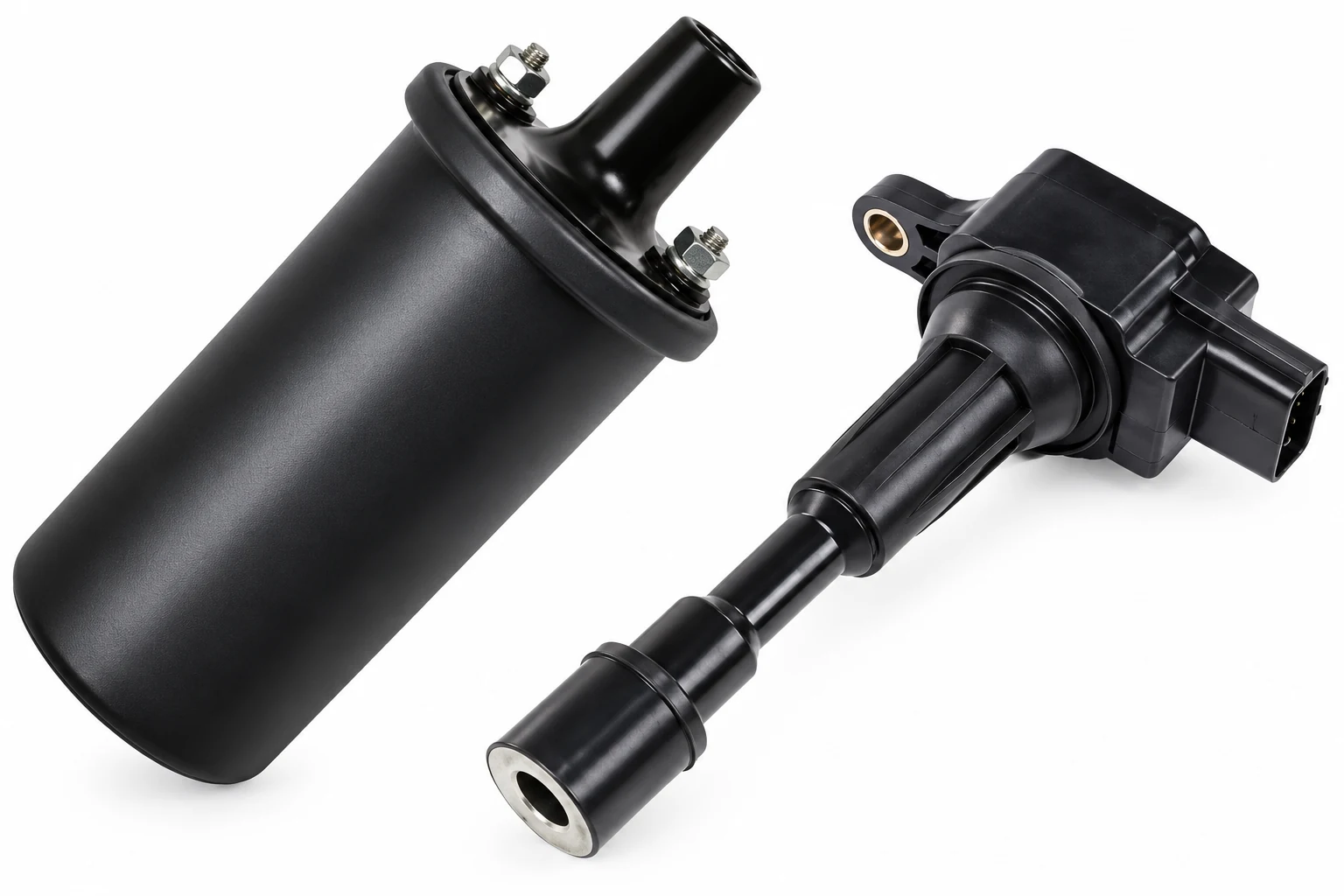
Mobile Ignition Coil Diagnostics in Daytona Beach
An ignition coil should not be replaced solely because a cylinder has a misfire code.
Depending on the vehicle and symptoms, ignition-coil diagnosis can include checking:
- Diagnostic trouble codes
- Cylinder-specific misfire data
- Misfire counters
- Ignition-coil power supply
- Coil ground
- Coil trigger or control signal
- Spark output
- Coil primary electrical behavior
- Coil current where appropriate
- Coil-on-plug boot condition
- Spark plug condition
- Coil connector and terminals
- Wiring
- Oil or water contamination in the spark-plug well
- Fuel injector operation
- Engine compression when necessary
The purpose is to establish whether the ignition coil itself is failing and whether the failure is electrical, thermal, mechanical, or secondary to another problem.
What Does an Ignition Coil Do?
An ignition coil converts the vehicle’s relatively low battery voltage into the much higher voltage required to create a spark across the spark-plug gap.
The engine-control system determines when each cylinder should fire.
Depending on the ignition system, the coil may serve:
- One spark plug
- Two spark plugs
- Several cylinders
Modern vehicles commonly use one ignition coil directly above each spark plug.
Ignition Coil vs. Coil Pack
The terms ignition coil and coil pack are often used interchangeably, but they can describe different designs.
Individual Ignition Coil
One coil generally serves one cylinder.
Coil Pack
A single assembly may contain coils for multiple cylinders.
Some vehicles use:
- Individual coil-on-plug units
- Paired coils
- Multi-coil rail or cassette assemblies
The system design affects both diagnosis and replacement.
Coil-on-Plug Ignition
Coil-on-plug, often abbreviated COP, places an individual ignition coil directly over each spark plug.
Advantages include:
- Short secondary-voltage path
- Individual cylinder control
- Precise ignition timing
A coil-on-plug engine usually allows individual cylinders to be diagnosed separately.
Coil Pack Ignition System
Some engines use a coil pack that fires multiple spark plugs.
A coil pack may contain:
- Two coils
- Three coils
- Four or more internal coil sections
Failure can affect:
- One cylinder
- A paired set of cylinders
- Several cylinders
The internal arrangement should be understood before condemning the complete assembly.
Ignition Coil Rail
Certain engines use a long ignition-coil rail or cassette mounted across several spark plugs.
The assembly may contain multiple coils in one housing.
If one internal coil fails, replacement of the complete rail may be required depending on design.
This differs from engines with separately replaceable individual coils.
Signs of a Bad Ignition Coil
Possible ignition-coil symptoms include:
- Check-engine light
- Engine misfire
- Rough idle
- Engine shaking
- Hesitation
- Poor acceleration
- Loss of power
- Misfire under load
- Hard starting
- Intermittent misfire
- Engine runs worse when hot
- Flashing check-engine light
- Increased fuel consumption
- Raw-fuel smell from exhaust
These symptoms can also result from spark plugs, fuel delivery, compression, vacuum leaks, or wiring problems.
Diagnosis should confirm the coil.
Bad Ignition Coil and Engine Misfire
A weak or failed coil may not provide enough spark energy for its cylinder.
This can cause a misfire.
However, a cylinder misfire can also be caused by:
- Spark plug
- Fuel injector
- Vacuum leak
- Compression loss
- Valve problem
- Wiring fault
A misfire code identifies the cylinder experiencing combustion failure. It does not automatically identify the failed component.
P0300 Random Misfire
A P0300 code generally indicates random or multiple-cylinder misfires.
Possible causes extend well beyond ignition coils and can include:
- Multiple worn spark plugs
- Fuel-pressure problem
- Vacuum leak
- Injector problems
- Mechanical engine problem
- Timing issue
Replacing several ignition coils simply because P0300 is present is not proper diagnosis.
Cylinder-Specific Misfire Codes
Codes such as:
- P0301
- P0302
- P0303
- P0304
generally identify a misfire on a particular cylinder.
For example, P0302 usually refers to cylinder 2.
That does not mean the ignition coil on cylinder 2 has necessarily failed.
The coil, spark plug, injector, wiring, and mechanical condition of that cylinder may all need consideration.
Flashing Check-Engine Light
A flashing check-engine light often indicates an active misfire severe enough to potentially damage the catalytic converter.
Unburned fuel can enter the exhaust and cause excessive converter temperatures.
If the light is flashing and the engine is running badly, continued driving should be minimized until the cause is diagnosed.
Ignition Coil Swap Test
On engines with individual coils, one useful diagnostic method can be moving the suspected coil to another cylinder.
If:
- Misfire moves with the coil
that strongly supports a coil fault.
If:
- Misfire stays on the original cylinder
the cause may instead involve:
- Spark plug
- Injector
- Compression
- Wiring
- Intake leak
A swap test is useful when access and coil design allow it.
Why a Coil Swap Test Is Useful
A swap test compares the suspect component against another cylinder under the same operating conditions.
For example:
- Cylinder 3 is misfiring.
- Coil from cylinder 3 is moved to cylinder 1.
- Misfire data is cleared or monitored.
- Misfire now appears on cylinder 1.
That provides much stronger evidence of a failed coil than simply replacing the coil because cylinder 3 originally misfired.
When a Coil Swap Test Is Not Enough
A swap test may not be appropriate or conclusive when:
- Coil pack serves multiple cylinders
- Failure is intermittent
- Connector is damaged
- Spark plug is also faulty
- Coil fails only under certain load conditions
Additional testing may still be necessary.
Weak Ignition Coil
An ignition coil does not always fail completely.
A weak coil may:
- Work at idle
- Misfire during acceleration
- Fail under high cylinder pressure
- Work when cold
- Fail when hot
This is why a vehicle can appear to run normally in the driveway yet misfire when driven under load.
Ignition Coil Failure Under Load
It takes more voltage to fire a spark plug when cylinder pressure increases.
A weak ignition coil may therefore perform normally at:
- Idle
- Light throttle
but misfire during:
- Hard acceleration
- Hill climbing
- Higher engine load
- Boost on turbocharged engines
A load-related misfire is an important diagnostic clue.
Ignition Coil Fails When Hot
Some coils develop internal electrical faults that worsen as temperature increases.
Possible symptoms include:
- Engine runs normally cold
- Misfire begins after warm-up
- Engine stalls or runs rough when hot
- Coil works again after cooling
Heat-related failures may require diagnosis while the symptom is occurring.
Intermittent Ignition Coil Failure
An intermittent coil can make diagnosis more difficult.
The problem may appear only:
- At specific temperatures
- At certain RPM
- During acceleration
- In wet weather
- After extended driving
Misfire history, freeze-frame data, live misfire counters, and electrical testing can help isolate the fault.
Ignition Coil Power Supply
An ignition coil requires proper electrical power.
Many modern coils receive:
- Battery or system voltage
- Ground
- Trigger or control signal from engine computer
If power is missing, replacing the coil will not repair the problem.
Possible causes of missing power include:
- Fuse
- Relay
- Wiring
- Connector problem
Ignition Coil Ground
Some ignition coils have a dedicated ground circuit.
Others ground through:
- Wiring harness
- Engine
- Mounting arrangement
A poor ground can cause weak or missing spark even if the coil itself is good.
Ground integrity should be verified when the electrical circuit is suspect.
Ignition Coil Trigger Signal
The engine-control module commands the ignition coil to charge and discharge at the correct time.
If the trigger signal is missing, possible causes include:
- Wiring problem
- Connector problem
- Engine-control module issue
- Missing crankshaft or camshaft position information
A coil cannot fire if it is never being commanded.
Ignition Coil Connector Problems
Ignition-coil connectors are exposed to:
- Engine heat
- Vibration
- Oil
- Water
- Repeated service
Problems can include:
- Broken locking tab
- Loose terminal
- Backed-out pin
- Corrosion
- Melted connector
- Damaged wire near connector
Replacing the ignition coil without repairing a bad connector can leave the misfire unchanged.
Broken Ignition Coil Connector
Plastic ignition connectors can become brittle from age and engine heat.
A broken locking tab may allow the connector to loosen.
Possible symptoms include:
- Intermittent misfire
- Misfire when engine moves
- Cylinder cutting in and out
The electrical connection should be repaired securely rather than relying on a loose connector.
Ignition Coil Wiring Problems
Coil wiring can be damaged by:
- Heat
- Abrasion
- Previous repairs
- Rodents
- Oil contamination
- Harness tension
A damaged control or power wire can produce the same symptom as a failed coil.
Circuit testing should be performed when the expected electrical signals are missing.
Ignition Coil Resistance Testing
Older ignition-coil designs were often tested by measuring resistance across:
- Primary winding
- Secondary winding
Resistance testing can still be useful on certain designs.
However, many modern coil-on-plug modules contain:
- Internal electronics
- Integrated drivers
- Diodes
that make simple resistance measurements less useful or potentially misleading.
Vehicle-specific test procedures should be followed.
Primary Ignition Coil Circuit
The primary side of the coil is the low-voltage side that builds the magnetic field used to generate spark.
Problems can involve:
- Power supply
- Internal primary winding
- Coil driver
- Ground
- Trigger circuit
Advanced testing can evaluate current flow and coil charging behavior.
Secondary Ignition Coil Circuit
The secondary side produces the high voltage delivered to the spark plug.
Problems on this side can involve:
- Internal winding
- Coil boot
- Spring contact
- Carbon tracking
- Spark plug
- Excessive spark-plug gap
A secondary-side problem can make a good coil appear weak.
Ignition Coil Current Ramp
More advanced ignition testing can examine how coil current builds during the charging period.
A current waveform can sometimes reveal:
- Primary circuit behavior
- Coil saturation
- Driver operation
- Internal electrical faults
This type of testing provides more information than a basic resistance check on certain systems.
Ignition Coil Dwell
Dwell refers to the time the ignition coil is allowed to charge before firing.
Modern engine-control modules manage dwell electronically.
Incorrect coil charging can result from:
- Electrical-control problem
- Incorrect coil
- System-voltage problem
Dwell should not generally be adjusted manually on a modern engine.
Testing for Spark
Spark testing can help determine whether ignition energy is reaching the spark plug.
A proper spark tester should be used when appropriate.
Improvised methods that allow high voltage to arc unpredictably can:
- Damage electronics
- Damage ignition coil
- Create shock hazard
The presence of spark alone also does not prove that the coil can fire reliably under cylinder pressure.
Strong Spark vs. Weak Spark
A coil may produce visible spark in open air but still be too weak to fire consistently inside a running engine.
Cylinder pressure increases the voltage required to jump the spark-plug gap.
This is one reason intermittent or load-related coil faults can escape very basic spark checks.
Ignition Coil Boot
Coil-on-plug units typically use a rubber boot between the coil and spark plug.
The boot helps:
- Insulate high voltage
- Protect spark-plug well
- Connect coil output to spark plug
Boot problems can include:
- Cracking
- Carbon tracking
- Oil contamination
- Water contamination
- Damaged internal spring
Some boots are separately replaceable.
Ignition Coil Spring
Inside many coil boots is a conductive spring connecting the coil to the spark plug.
Problems can include:
- Corrosion
- Weak contact
- Damage
- Improper seating
A spring or boot fault can sometimes imitate complete coil failure.
Carbon Tracking
Carbon tracking occurs when high voltage creates an unintended conductive path along an insulating surface.
It may appear as a thin dark line on:
- Coil boot
- Spark plug porcelain
Once a carbon path is established, spark can repeatedly escape through it instead of firing correctly across the plug gap.
Both the coil boot and spark plug may require attention when carbon tracking is present.
Ignition Coil Arcing
An ignition coil may arc externally when high voltage escapes through:
- Cracked coil housing
- Damaged boot
- Carbon track
- Poor insulation
Arcing may be more noticeable:
- At night
- In damp conditions
- Under load
A visibly arcing coil or boot requires repair.
Cracked Ignition Coil
Heat and age can damage the ignition-coil housing.
Cracks can allow high voltage to escape or moisture to enter.
A cracked coil may produce:
- Intermittent misfire
- Wet-weather misfire
- External arcing
Physical damage supports replacement when it affects insulation or operation.
Oil in the Spark-Plug Well
Oil around an ignition coil is usually not caused by the coil itself.
Possible sources include:
- Valve-cover gasket
- Spark-plug tube seal
Oil can damage the coil boot and insulation over time.
If a coil has failed because it has been sitting in oil, the oil leak should also be addressed or the replacement coil may be exposed to the same condition.
Water in the Spark-Plug Well
Water can enter spark-plug wells from:
- Engine washing
- Heavy rain
- Cowl or seal leaks
- Missing covers
Moisture can cause:
- Arcing
- Misfire
- Corrosion
Drying the area and correcting the source may be necessary before deciding that the ignition coil has permanently failed.
Ignition Coil vs. Spark Plug
Ignition coils and spark plugs work together but fail in different ways.
Ignition Coil
Generates the high voltage.
Spark Plug
Creates the spark gap inside the combustion chamber.
A worn spark plug can make the coil work harder and can cause the same misfire symptoms as a weak coil.
Both should be evaluated.
Worn Spark Plugs and Ignition Coils
As spark plugs wear, the gap may increase.
A larger gap generally requires more voltage to fire.
This can increase stress on ignition coils.
If a coil fails on an engine with severely worn plugs, the spark-plug condition should not be ignored.
Should Spark Plugs Be Replaced With Ignition Coils?
Not automatically.
Spark plugs should be replaced when:
- Worn
- Fouled
- Damaged
- Due by maintenance interval
- Contributing to coil failure or misfire
There is no universal rule requiring new spark plugs every time one ignition coil is replaced.
Bad Spark Plug Causing Coil Failure
A worn or damaged spark plug can increase the voltage demand on the coil.
Over time, excessive secondary ignition demand may contribute to:
- Coil insulation breakdown
- Carbon tracking
- Coil overheating
The condition of the plug on the failed cylinder should be checked.
Ignition Coil vs. Fuel Injector
A bad ignition coil and a bad fuel injector can both cause a cylinder-specific misfire.
The difference must be established through testing.
Possible checks include:
- Coil operation
- Spark plug condition
- Injector pulse
- Injector contribution
- Misfire movement after component swap
Replacing the coil solely because the cylinder misfires can miss a fuel-delivery problem.
Ignition Coil vs. Compression Problem
A cylinder with poor compression can misfire even when ignition and fuel delivery are normal.
Possible mechanical causes include:
- Burned valve
- Valve timing problem
- Piston or ring damage
- Head-gasket problem
Compression or mechanical testing may be needed when ignition tests do not explain the misfire.
Ignition Coil vs. Vacuum Leak
An intake or vacuum leak can create a lean misfire.
A leak affecting one intake runner may sometimes produce a cylinder-specific problem.
Fuel trims and intake testing can help distinguish an air leak from an ignition failure.
Ignition Coil vs. Crankshaft Position Sensor
A crankshaft position sensor provides essential engine-speed and position information.
If that signal disappears, the engine-control module may stop:
- Ignition coil triggering
- Injector operation
Loss of spark from all coils should not automatically lead to replacing multiple ignition coils.
The control signals need to be investigated.
Ignition Coil vs. Camshaft Position Sensor
Camshaft position information can also affect ignition and fuel control on many vehicles.
A camshaft sensor fault can produce:
- Hard starting
- Poor running
- Fault codes
This should be distinguished from an individual coil failure.
Ignition Coil and Rich Fuel Smell
A failed coil can cause raw fuel odor because the injector may continue delivering fuel into a cylinder that is not burning it properly.
This can cause:
- Fuel smell from exhaust
- Catalytic-converter overheating
- Spark-plug fouling
The fuel smell does not necessarily mean the injector is leaking.
Ignition Coil and Poor Fuel Economy
A persistent misfire can reduce fuel economy because combustion is incomplete.
The engine-control system may also make corrections based on oxygen-sensor feedback.
Poor fuel economy has many other causes, so coil failure should be confirmed before replacement.
Ignition Coil and Catalytic Converter Damage
Driving for an extended period with a severe ignition misfire can allow unburned fuel into the exhaust.
The catalytic converter can overheat and become damaged.
A flashing check-engine light during a severe misfire should be treated seriously.
Ignition Coil and Engine Shaking
When one cylinder stops contributing normally, the engine may shake noticeably at:
- Idle
- Stoplights
- Acceleration
The severity depends on:
- Number of cylinders
- Engine design
- Number of cylinders misfiring
A shaking engine indicates a combustion imbalance, not necessarily a coil specifically.
Ignition Coil and Rough Idle
A weak ignition coil can cause rough idle if one cylinder intermittently fails to ignite its mixture.
However, rough idle can also result from:
- Vacuum leak
- Dirty throttle body
- Fuel injector
- Compression problem
- Engine mount creating excessive perceived vibration
Misfire data can help determine whether a particular cylinder is involved.
Ignition Coil and Hesitation
If the coil cannot create adequate spark under increasing cylinder pressure, the engine may hesitate when accelerating.
The symptom may feel like:
- Brief stumble
- Jerking
- Loss of power
Fuel-delivery problems can cause similar behavior, so ignition should be tested rather than assumed.
Ignition Coil and Engine Stalling
A single failed ignition coil on a multi-cylinder engine usually causes rough running rather than complete engine shutdown.
However, certain ignition systems use shared coil assemblies, and multiple ignition failures can contribute to stalling.
If the engine suddenly loses all spark, a common power, control, or sensor problem should also be considered.
Ignition Coil and No-Start
A single bad coil typically does not prevent a multi-cylinder engine from starting.
A no-start involving no spark on every cylinder may point toward:
- Ignition power supply
- Crankshaft sensor
- Main fuse
- Control module
- Shared ignition module
Replacing all coils would not be an appropriate first step.
Ignition Coil Fuse
Some ignition systems use a shared fuse for the ignition coils.
If that fuse fails, several or all coils can lose power.
If a fuse is blown, the reason should be investigated.
Possible causes include:
- Shorted coil
- Damaged wiring
- Other component on same circuit
Repeatedly installing fuses without diagnosing the short can create additional damage.
Ignition Coil Relay
Depending on vehicle design, coil power may be supplied through:
- Main relay
- Engine-control relay
- Ignition relay
A relay problem can affect multiple ignition coils simultaneously.
Loss of power to all coils should lead to circuit diagnosis before coil replacement.
Ignition Control Module
Older systems and certain newer designs use a separate ignition-control module.
The module may control:
- Coil charging
- Coil triggering
- Spark timing functions
A failed module can affect multiple cylinders and should be distinguished from the coils themselves.
Coil Driver in the Engine Computer
Some ignition systems use drivers located inside the engine-control module.
If a driver circuit fails, one coil may stop receiving a trigger even though:
- Coil is good
- Power supply is present
Before replacing an engine computer, the coil and wiring should be checked carefully because a shorted coil can sometimes damage the driver.
Ignition Coil Primary Circuit Codes
Diagnostic trouble codes may identify faults involving:
- Coil primary circuit
- Coil secondary circuit
- Coil control signal
These codes can point toward:
- Ignition coil
- Connector
- Wiring
- Control module
The circuit designation should be tested before parts are replaced.
P0351–P0358 Ignition Coil Codes
Codes in the P0351 range commonly relate to ignition-coil primary or secondary circuits.
Depending on engine configuration, letters or numbers may correspond to specific coils.
Possible causes include:
- Failed coil
- Open wire
- Shorted wire
- Connector problem
- Control-module driver fault
A code containing the words “ignition coil” does not automatically prove that the coil itself is defective.
Ignition Coil Testing With a Multimeter
A multimeter can be useful for checking:
- Power supply
- Ground
- Circuit continuity
- Certain resistance specifications
But a multimeter cannot by itself fully evaluate the dynamic high-voltage performance of every modern ignition coil.
Testing methods should match the coil design.
Ignition Coil Oscilloscope Testing
An oscilloscope can provide deeper insight into ignition operation.
Depending on the system, waveform analysis may reveal:
- Coil charging
- Primary current
- Firing events
- Burn time
- Circuit abnormalities
This type of testing can be useful for intermittent or difficult-to-isolate problems.
Ignition Coil Replacement
Once diagnostics confirm ignition-coil failure, replacement can generally involve:
- Confirm the affected cylinder or coil. Misfire data and testing are used to establish which coil is faulty.
- Inspect the spark plug. A worn, fouled, or damaged plug can contribute to coil failure or mimic it.
- Inspect the coil connector and wiring.
- Turn the ignition off and disconnect battery power where appropriate.
- Remove necessary engine covers or intake components.
- Disconnect the coil electrical connector.
- Remove coil retaining hardware.
- Remove the ignition coil or coil pack.
- Inspect the spark-plug well for oil, water, or debris.
- Inspect the coil boot and spring.
- Compare the replacement coil with the original.
- Install the correct replacement coil.
- Reconnect the electrical connector securely.
- Reinstall covers and removed components.
- Start the engine.
- Monitor misfire data.
- Clear applicable fault codes after the repair.
- Verify operation at idle and under appropriate driving conditions.
The exact process varies considerably between individual coil-on-plug systems and multi-cylinder coil packs.
Ignition Coil Boot Replacement
Some ignition-coil boots can be replaced separately.
Boot replacement may be appropriate when:
- Rubber is cracked
- Carbon tracking is present
- Spring contact is damaged
If the coil electronics are good, replacing a serviceable boot can sometimes correct the secondary ignition problem.
Replacing One Ignition Coil vs. All Coils
It is not automatically necessary to replace every ignition coil when one fails.
If:
- One coil is confirmed defective
- Others are operating correctly
replacing only the failed coil may be appropriate.
Replacing multiple coils may be considered when:
- Several have failed testing
- Coil rail is a single assembly
- Multiple coils have obvious heat or insulation damage
- Vehicle-specific circumstances justify it
There is no universal rule requiring a full set.
Should Ignition Coils Be Replaced in Pairs?
Individual ignition coils generally do not need to be replaced in pairs simply because one failed.
Unlike some mechanical components, ignition coils do not normally require matched left-right replacement.
The actual condition of each coil should guide the repair.
Should All Ignition Coils Be Replaced at the Same Time?
Replacing all coils preventively may be a customer choice on certain older high-mileage vehicles, but it is not automatically necessary.
If only one coil is defective, the others may continue operating normally for a long time.
Diagnosis should distinguish:
- Required repair
- Preventive replacement
Ignition Coil Replacement With Spark Plugs
If spark plugs are already due for replacement, servicing them at the same time can make sense because the coils are removed for access on many engines.
However, good spark plugs should not automatically be replaced solely because one coil failed.
Their:
- Condition
- Mileage
- Service interval
should determine the need.
New Ignition Coil but Misfire Remains
If a new coil does not correct the misfire, possible causes include:
- Spark plug
- Injector
- Wiring
- Connector
- Vacuum leak
- Compression loss
- PCM coil driver
- Incorrect replacement coil
Further diagnosis should continue rather than replacing more coils randomly.
New Ignition Coil Fails Quickly
A replacement coil that fails soon after installation may have been affected by:
- Worn spark plug
- Excessive spark-plug gap
- Oil contamination
- Water intrusion
- Connector fault
- Electrical overvoltage
- Poor-quality replacement part
The surrounding system should be inspected before another coil is installed.
OEM vs. Aftermarket Ignition Coils
Replacement coils are available from:
- Original-equipment manufacturers
- Established aftermarket manufacturers
- Economy aftermarket suppliers
Important factors include:
- Correct electrical characteristics
- Proper fit
- Connector quality
- Heat resistance
- Insulation quality
- Reliability
A low-cost coil that physically fits may not necessarily perform the same as the correct application-specific component.
Performance Ignition Coils
Aftermarket performance coils are sometimes marketed as:
- High-output coils
- Racing coils
- Upgraded coil packs
A stock engine does not necessarily gain performance simply from installing a higher-output coil.
The ignition system should provide enough energy to reliably fire the spark plug under the engine’s operating conditions.
Performance modifications should be matched to the actual engine setup and calibration.
Red-Top and Performance Coil Packs
Certain aftermarket coil designs are identified by colors or enthusiast terminology.
Color alone does not determine:
- Electrical compatibility
- Output characteristics
- Reliability
- Correct application
The replacement coil should match the engine’s control system and physical requirements.
12-Volt Ignition Coil
Older conventional ignition systems may use stand-alone 12-volt ignition coils.
Modern vehicles generally use application-specific electronically controlled coils.
A generic coil should not be installed merely because the vehicle uses a 12-volt electrical system.
Coil resistance, control method, output, and physical design must all match.
6-Volt Ignition Coil
Some older classic vehicles use 6-volt electrical systems.
Those ignition systems differ significantly from modern electronic coil-on-plug systems.
A 6-volt coil is not suitable for a modern 12-volt vehicle unless the ignition system was specifically designed for it.
Ignition Coil Replacement Cost
Ignition-coil replacement cost depends on factors such as:
- Vehicle year, make, and model
- Individual coil vs. coil pack
- Number of failed coils
- Coil location
- Intake-manifold removal
- Engine covers and access
- Spark-plug condition
- Connector or wiring repair
- Oil contamination in plug wells
Replacing one easily accessible coil can be very different from replacing a coil pack beneath an intake manifold.
Call Jimmy’s Mobile Care at (386) 308-2509 with your vehicle information and engine symptoms so we can determine the appropriate diagnostic service.
Why Diagnose an Ignition Coil Before Replacing It?
Cylinder misfires have many possible causes.
Is the Misfire Actually Following the Coil?
A coil swap can sometimes provide strong evidence.
Is the Spark Plug Worn or Fouled?
A bad plug can create the same misfire and may overstress the coil.
Does the Coil Have Power?
A good coil cannot work without its electrical supply.
Is the Coil Receiving a Trigger Signal?
A wiring or control fault can prevent spark.
Is the Coil Connector Damaged?
An intermittent terminal can make a good coil cut in and out.
Does the Injector Work?
A cylinder without fuel can look like an ignition misfire.
Does the Cylinder Have Compression?
Mechanical engine problems will not be repaired by an ignition coil.
Is Oil or Water Contaminating the Coil Boot?
The underlying leak or water intrusion should be corrected as part of a lasting repair.
Checking these areas helps prevent unnecessary ignition-coil replacement.
Mobile Ignition Coil Diagnostics in Daytona Beach
Jimmy’s Mobile Care provides mobile car ignition coil diagnostics in Daytona Beach for vehicles experiencing:
- Check-engine light
- Cylinder misfire
- Rough idle
- Engine shaking
- Hesitation
- Loss of power
- Misfire under acceleration
- Intermittent misfire
- Misfire when hot
- Ignition-coil circuit codes
We evaluate coil operation together with the spark plug, electrical circuit, fuel delivery, and cylinder condition needed to identify the actual cause.
Mobile Ignition Coil Replacement in Daytona Beach
When diagnostics confirm ignition-coil failure, Jimmy’s Mobile Care can replace many individual coils, coil packs, and ignition-coil assemblies at your Daytona Beach location.
After replacement, we can verify:
- Proper coil connection
- Normal cylinder operation
- Reduced or eliminated misfire
- Relevant diagnostic codes
- Misfire counter behavior
- Engine idle quality
Some vehicles require substantial intake or engine-component removal to reach the ignition coils. We can determine what the repair involves after identifying the vehicle and diagnosing the fault.
Schedule Car Ignition Coil Diagnostics & Replacement in Daytona Beach
A cylinder misfire does not automatically mean the ignition coil is bad.
The problem may instead be a spark plug, fuel injector, wiring fault, connector, intake leak, compression problem, or ignition-control issue.
Jimmy’s Mobile Care diagnoses the ignition system before replacement so the coil is replaced only when the evidence supports it.
Call Jimmy’s Mobile Care at (386) 308-2509 to schedule car ignition coil diagnostics and replacement in Daytona Beach, FL. Call today and we'll come to your location.