
Car Brake Line Inspection & Repair in Daytona Beach, FL
Brake lines are the rigid metal tubes that carry pressurized brake fluid through your vehicle. They typically run from the master cylinder and ABS hydraulic unit along the body, chassis, or frame before connecting to the flexible brake hoses or wheel-end brake components.
Unlike flexible brake hoses, brake lines don't normally fail because they flex or collapse internally. Their major concerns are rust, corrosion, pitting, physical damage, failed flares and fittings, and metal tubing that eventually develops a hydraulic leak.
Jimmy’s Mobile Care provides car brake line inspection and repair in Daytona Beach, FL. We locate the failed section of rigid tubing, inspect how far corrosion or damage extends, and determine whether an appropriate section of brake line can be fabricated and replaced on-site.
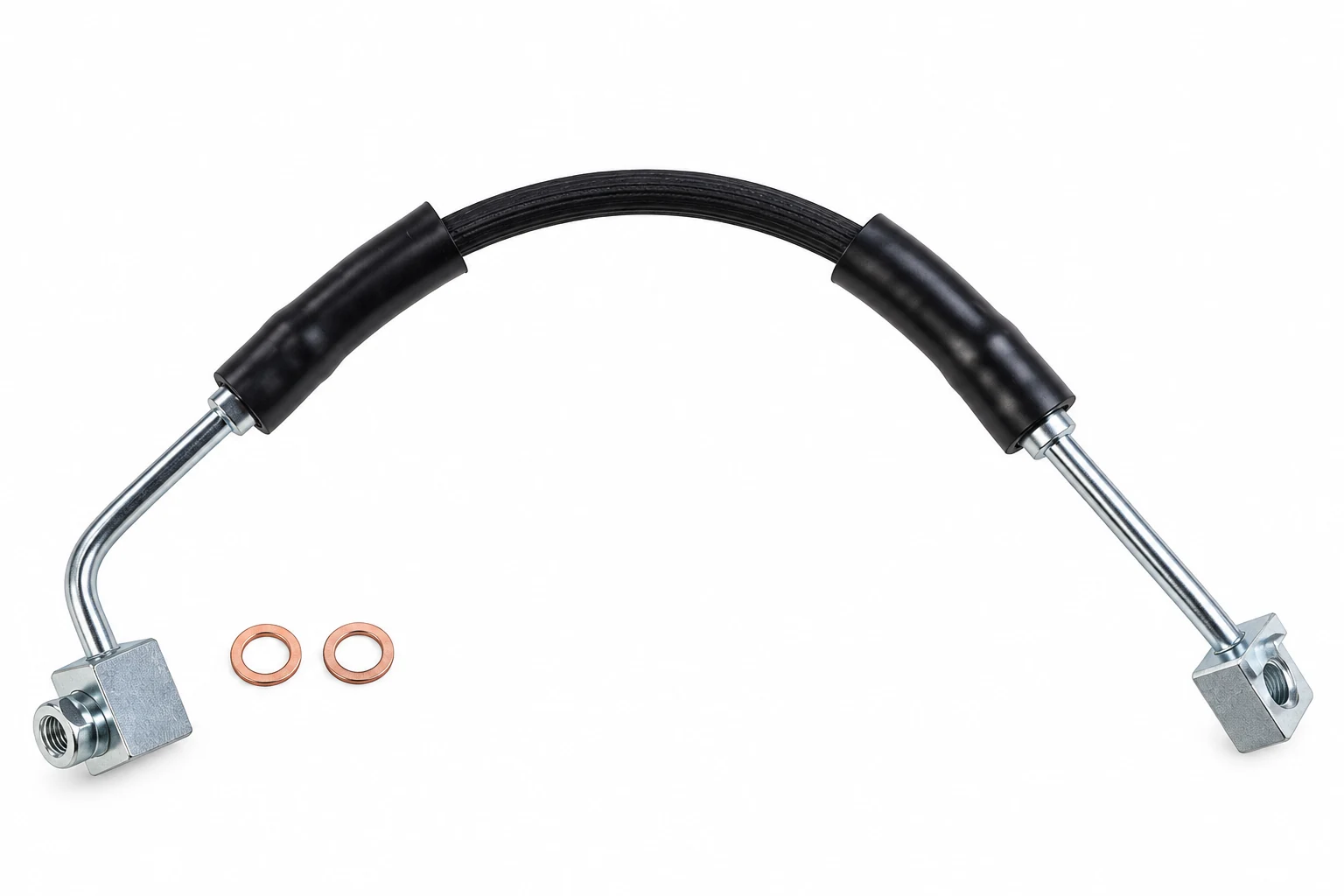
Rigid Metal Brake Line Repair in Daytona Beach
Brake lines are essentially the permanent hydraulic plumbing of the braking system.
Depending on the vehicle, rigid tubing may run:
- From the master cylinder to the ABS hydraulic unit
- From the ABS unit toward individual brake circuits
- Across the firewall
- Along the vehicle's underbody
- Along the frame or chassis
- Across a rear axle
- Into hydraulic junctions
- Up to the flexible hose connection at a wheel
These lines are formed to follow specific routes through the vehicle and are held in place by clips and brackets.
When one fails, brake-line repair can involve considerably more than replacing a preassembled part. A replacement section may need to be measured, cut, bent, fitted, flared, routed, and secured to replace the failed metal tubing.
Brake Lines Are Different From Brake Hoses
Although both carry brake fluid, a brake line and brake hose are physically and functionally different parts.
Brake Lines Are Rigid Metal Tubing
Brake lines are formed metal tubes. They run through relatively fixed areas of the vehicle where the hydraulic connection doesn't need to flex with wheel movement.
Their common problems include:
- External corrosion
- Rust-through
- Deep pitting
- Pinhole leaks
- Crushed tubing
- Kinks
- Damaged fittings
- Failed flare connections
- Improper previous line repairs
Brake Hoses Are Flexible
Brake hoses are flexible reinforced hydraulic components located where movement has to occur, particularly between the vehicle and wheel brakes.
Their common problems include cracking, bulging, chafing, twisting, and internal hose restriction.
Jimmy’s Mobile Care has a separate brake hose inspection and replacement service for those components.
This page is specifically about inspecting and repairing the rigid metal brake lines.
Rusted Brake Lines
Corrosion is one of the most important problems affecting metal brake tubing.
Brake lines routed underneath a vehicle are continually exposed to moisture and road contamination. As the protective surface deteriorates, corrosion can begin attacking the metal.
There is an important difference between minor surface rust and serious structural corrosion.
A line with heavy scaling, deep pitting, or material loss may have become significantly thinner than it originally was.
Eventually hydraulic pressure can break through the weakened metal.
The result may begin as a tiny wet spot or pinhole and quickly become a substantial brake-fluid leak when the pedal is pressed.
Pitted Brake Lines
Pitting deserves particular attention because corrosion can eat into the wall of the tubing without uniformly destroying the entire line.
A heavily pitted area may contain isolated points where very little metal remains.
That means the first visible leak may only identify the weakest point in a larger corroded section.
When we find a rusted line, we inspect beyond the hole itself.
The important question isn't merely:
Where is it leaking?
It's also:
How much surrounding metal is still suitable for service?
That determines whether a localized section can be replaced or whether the repair needs to extend farther along the vehicle.
Pinhole Brake Line Leaks
A corroded brake line can develop an extremely small opening.
With the system sitting at rest, the area may only look damp.
Under brake pressure, however, fluid can seep, drip, or spray through the opening.
A pinhole leak means the metal has already deteriorated through the wall of the tubing.
Covering the hole does not restore the structural integrity of the line.
The deteriorated metal needs to be removed from the hydraulic circuit and replaced using proper brake-line tubing and connections.
Inspecting Beyond the Visible Leak
This is one of the most important differences between brake-line repair and brake-hose replacement.
A failed flexible hose is normally replaced as a manufactured hose assembly.
A rigid brake line may run several feet through the vehicle.
When a section rusts through, we have to determine where suitable metal begins and ends.
If six inches of tubing around the leak is heavily corroded, cutting out only the exact pinhole would leave the new repair attached to compromised metal.
If corrosion extends through most of a long line, replacing a much larger section may be appropriate.
The repair is determined by the condition of the existing tubing.
Physically Damaged Brake Lines
Brake lines can also be damaged even when corrosion isn't present.
Because much of the tubing runs underneath the vehicle, damage can result from:
- Improper jacking
- Incorrect lift placement
- Road debris
- Collision damage
- Work performed on nearby components
- Contact with moving parts
- Incorrect routing
- Missing line retainers
- Severe bending or crushing
A flattened or sharply kinked metal line can restrict the hydraulic passage and weaken the tubing.
When the line has been physically damaged, we inspect the surrounding section and determine where replacement tubing should begin and end.
Brake Line Repair Often Means Fabricating a New Section
Many brake-line repairs aren't simply a matter of ordering a complete preformed line and bolting it into place.
A replacement section can often be fabricated from automotive brake tubing.
That requires determining:
- Correct tubing diameter
- Correct tubing material for automotive brake service
- Required length
- Correct fittings
- Flare type
- Connection points
- Routing
- Bend locations
- Retaining points
The new tubing then has to be formed so it safely follows the vehicle's hydraulic route.
This fabrication work is one of the defining features of brake-line repair and separates it from replacing a flexible brake hose.
Measuring a Replacement Brake Line Section
Before cutting replacement tubing, the required length and route need to be determined.
The new section must be long enough to follow an appropriate path without being stretched between fittings.
At the same time, excessive tubing shouldn't simply be coiled or left hanging underneath the vehicle to compensate for poor measurement.
The replacement section should follow the vehicle's existing routing as closely as practical while maintaining proper clearance from surrounding components.
Cutting Brake Line Tubing
Brake tubing needs a clean, controlled cut before a fitting and flare can be prepared.
A damaged or severely distorted tube end can interfere with flare formation.
After cutting, the end needs to be properly prepared so the flare can form evenly and seal against its mating surface.
This preparation matters because the hydraulic seal occurs at the formed end of the tubing—not because the threaded fitting itself somehow plugs the connection.
Brake Line Fittings
Before the new line is flared, the correct hydraulic fitting has to be installed on the tubing.
Brake-line fittings vary between applications.
They can differ in:
- Thread diameter
- Thread pitch
- Fitting length
- Seat configuration
- Tubing size
- Flare compatibility
A fitting that threads into a component isn't necessarily correct merely because it can be screwed into the hole.
The fitting, tubing, flare, and mating hydraulic seat need to be compatible.
Brake Line Flares
The end of a metal brake line is specially formed into a flare.
When the fitting is tightened, that flare seats against the mating surface inside the hydraulic connection and creates the high-pressure seal.
This is a critical part of brake-line fabrication.
A poor flare can leak even when the fitting has been tightened.
Common automotive flare configurations include double/inverted flares and ISO/bubble flares, depending on the vehicle.
We identify the required connection rather than assuming every vehicle uses the same flare.
Double and Inverted Brake Line Flares
A double or inverted flare is used on many automotive brake systems.
Creating it involves forming the tube end into the specified shape so it can seal correctly against the mating hydraulic seat.
The process requires:
- Properly cut tubing
- Correctly prepared tube end
- Fitting installed before the flare is made
- Proper tubing projection in the flaring tool
- Correct forming dies or adapters
- A centered flare
- An undamaged sealing surface
A crooked, split, thin, or improperly shaped flare isn't acceptable simply because the fitting can be tightened.
ISO and Bubble Brake Line Flares
Other vehicles use an ISO or bubble-style flare.
Its shape differs from an inverted flare and it mates with a different type of hydraulic seat.
The correct flare is determined by the vehicle's existing connection.
This is particularly important when fabricating replacement brake lines because installing the wrong flare type can create a connection that will not seal correctly under brake pressure.
Bending Replacement Brake Line
Once the tubing has been prepared, it needs to be formed to follow the vehicle.
Brake tubing can't simply be sharply folded by hand wherever a direction change is needed.
A controlled bend maintains the internal passage and avoids flattening or kinking the tube.
Depending on the required bend, an appropriate brake-line or tubing bender can be used to form the line.
The finished section needs to reach its connection points without being under tension.
Routing a Fabricated Brake Line
Correct routing protects the replacement line after it has been installed.
Brake tubing needs to remain away from:
- Exhaust components
- Driveshafts
- Axles
- Steering components
- Moving suspension parts
- Sharp body or frame edges
- Tires and wheels
- Areas where road debris can easily strike it
- Locations where the line could be crushed
A hydraulic repair isn't complete if the new tubing is simply run by the shortest possible path between two fittings.
It needs a safe route.
Brake Line Clips and Retainers
The original rigid lines are normally held to the vehicle by clips, brackets, and retainers.
These supports prevent the tubing from vibrating or rubbing against nearby components.
Unsupported metal tubing can repeatedly move as the vehicle is driven. Over time, that movement can stress the line or allow it to contact another component.
When a replacement section is installed, it needs to be appropriately supported rather than left hanging under the vehicle.
Connecting a New Section to Existing Brake Line
A section repair requires suitable connection points.
The remaining original tubing needs to be structurally sound where the repair is connected.
This is especially important on a corroded vehicle.
Making a beautiful new flare on replacement tubing does little good if the other side of the repair is attached to old metal that is already deeply pitted and ready to fail.
We inspect the existing tubing and choose connection points based on condition and accessibility.
When a Longer Brake Line Section Should Be Replaced
There are situations where a short repair section isn't the appropriate solution.
For example, if a line is:
- Heavily rusted over a long distance
- Deeply pitted in multiple areas
- Scaling throughout much of its length
- Leaking at more than one location
- Previously repaired repeatedly
- Damaged at several points
then extending the replacement to sound connection points may be necessary.
The goal isn't to use the shortest possible piece of new tubing.
The goal is to remove the compromised section of the hydraulic line.
Brake Lines at the Master Cylinder
Several rigid brake lines may connect directly to the master cylinder or nearby hydraulic components.
These lines are usually relatively short compared with underbody lines, but the fittings and bends can be tightly positioned.
If a line or fitting is damaged in this area, the repair needs to preserve the correct hydraulic connections and routing.
Because the master cylinder is the source of brake-system hydraulic pressure, any repaired connection must remain completely leak-free.
Brake Lines at the ABS Hydraulic Unit
ABS-equipped vehicles commonly have several rigid brake lines connected to the hydraulic control unit.
This area can contain multiple lines packed closely together.
When a line near the ABS unit is damaged or corroded, identifying the correct circuit and protecting the hydraulic unit's threaded ports are particularly important.
A seized fitting must be approached carefully because damaging the ABS hydraulic unit can turn a brake-line repair into a much larger repair.
Brake Lines Running Under the Vehicle
Long underbody brake lines are especially exposed to environmental conditions.
They may run from the engine compartment almost the entire length of the vehicle before reaching the rear brakes.
These are the lines where widespread corrosion can become especially important.
If a leak develops halfway along a long underbody line, we inspect accessible portions in both directions to determine whether the failure is localized or part of more extensive deterioration.
Rear Axle Brake Lines
Some vehicles use rigid metal brake lines across a solid rear axle.
A flexible hose accommodates movement between the vehicle body and axle, while rigid tubing distributes hydraulic pressure across the axle to the individual rear brakes.
This illustrates the distinction between the components clearly:
The flexible hose moves with the axle.
The rigid brake lines remain formed along the axle housing.
If the metal axle line rusts or is physically damaged, it requires brake-line repair—not brake-hose replacement.
Brake Line Unions and Connections
When a brake-line repair requires joining sections, the connection must be designed for automotive hydraulic brake service.
Properly flared tubing and appropriate brake-line fittings create the hydraulic connection.
We don't treat the brake system like household plumbing.
The components used in a repair need to be suitable for automotive brake pressure and compatible with the tubing and flare design.
Why We Don't Patch a Leaking Metal Brake Line
A rust hole cannot be safely repaired with:
- Tape
- Epoxy
- Rubber hose
- Ordinary clamps
- Sealant
- Putty
- Makeshift plumbing parts
The line has to contain substantial hydraulic pressure every time the brake pedal is applied.
If the metal wall has rusted through, the failed tubing needs to be removed from service.
The appropriate repair is to replace the compromised section using proper automotive brake tubing and hydraulic connections.
Brake Line Repair and Brake Fluid Loss
Once a metal line develops a hole, brake fluid can escape from the hydraulic system.
The amount lost depends on the size of the failure and how many times the brake pedal has been applied.
A major leak can lower or empty part of the master-cylinder reservoir.
That matters because air can then enter much farther into the hydraulic system than the immediate repair location.
Before completing the job, brake-fluid level and the hydraulic condition of the system need to be restored.
Bleeding the Brakes After Brake Line Repair
Fabricating a perfect replacement line doesn't complete the repair if air remains in the hydraulic system.
Opening a brake line allows air to enter.
After the new tubing is installed, the affected hydraulic circuit must be bled as required.
Brake bleeding removes air so pedal movement once again transfers hydraulic force through brake fluid rather than compressing trapped air.
The required procedure depends on how much of the system was opened and how much fluid was lost.
ABS Bleeding After a Major Brake Line Leak
If a brake line ruptures and the vehicle loses enough fluid for air to enter the ABS hydraulic unit, normal wheel bleeding may not always remove all trapped air.
Some vehicles require an ABS service-bleed procedure using diagnostic equipment to operate internal valves or pumps.
Whether that is necessary depends on the vehicle and how far air entered the system.
We evaluate pedal feel and the hydraulic system after the repair rather than assuming every brake-line leak requires exactly the same bleeding procedure.
Inspecting the Repair Under Hydraulic Pressure
After the replacement line is installed and the system has been bled, the repair needs to remain dry under brake pressure.
We inspect the new connections and applicable repair area for leakage.
This is especially important at newly formed flares.
A connection that is dry while the vehicle is sitting may still leak once substantial hydraulic pressure is applied through the brake pedal.
The system must hold pressure before the repair is considered complete.
How Much Does Brake Line Repair Cost?
Brake line repair cost depends heavily on how much metal tubing has failed and how difficult that section is to fabricate and install.
Factors can include:
- Vehicle year, make, and model
- Location of the failed line
- Length of replacement tubing
- Extent of corrosion
- Number of bends required
- Tubing diameter
- Flare type
- Number and type of fittings
- Accessibility
- Condition of existing fittings
- Number of replacement sections
- Routing complexity
- Brake-fluid loss
- Bleeding requirements
- ABS bleeding requirements
A six-inch physically damaged section can be a very different repair from a heavily corroded line running from the engine compartment to the rear of the vehicle.
Call Jimmy’s Mobile Care at (386) 308-2509 with your vehicle information and what you're seeing, and we can discuss your brake-line inspection and repair.
Why Inspect the Entire Failed Area Before Fabricating a Repair?
Brake-line repair begins by deciding where the new metal should start and stop.
That requires answering several questions.
Is It Actually a Rigid Brake Line?
If the failed component is flexible, it belongs to the brake-hose system and is replaced differently.
Is the Failure Rust or Physical Damage?
A crushed line may have a localized problem. A rusted line may have deterioration extending well beyond the leak.
How Far Does the Corrosion Extend?
We need structurally suitable tubing at the repair connection points.
What Size Tubing Does the Vehicle Use?
The replacement section must match the applicable hydraulic system.
Which Flare Does the Connection Require?
Double/inverted and ISO/bubble connections are not interchangeable simply because both are used on brake systems.
Can the New Line Follow the Proper Route?
The replacement tubing needs suitable clearance and support throughout its installed path.
These decisions are what turn a piece of brake tubing into a properly fabricated hydraulic brake-line repair.
Mobile Brake Line Fabrication & Repair in Daytona Beach
Jimmy’s Mobile Care brings brake line inspection, fabrication, and repair directly to your Daytona Beach location.
If your vehicle has a rusted-through line, pinhole leak, damaged section of rigid tubing, or leaking brake-line connection, we can inspect the affected hydraulic circuit and determine how much metal line needs to be replaced.
When the repair can be safely performed on-site, we can cut and form suitable replacement brake tubing, install the appropriate fittings, create the required flares, bend and route the new section, secure it to the vehicle, bleed the hydraulic system, and check the completed repair for leaks.
Schedule Brake Line Inspection & Repair in Daytona Beach
If a rigid brake line is rusted, leaking, crushed, or damaged, the repair should address the compromised metal—not simply cover the point where fluid is escaping.
Jimmy’s Mobile Care inspects the rigid tubing to determine the extent of the failure and fabricates the appropriate replacement section when on-site repair is suitable.
Call Jimmy’s Mobile Care at (386) 308-2509 to schedule car brake line inspection and repair in Daytona Beach, FL. Call today and we'll come to your location.