
Car Brake Hose Inspection & Replacement in Daytona Beach, FL
Brake hoses are the flexible hydraulic connections that carry brake fluid between the vehicle's rigid brake lines and moving brake components at the wheels. They have to contain high hydraulic pressure while flexing as the suspension moves and, at the front wheels, as the steering turns. Age, deterioration, cracking, abrasion, internal restriction, or leakage can make a brake hose unsafe or interfere with normal brake operation.
Jimmy’s Mobile Care provides car brake hose inspection and replacement in Daytona Beach, FL, at your location. We inspect flexible brake hoses for external damage and leakage and evaluate suspected internal restrictions before determining whether a hose needs replacement.
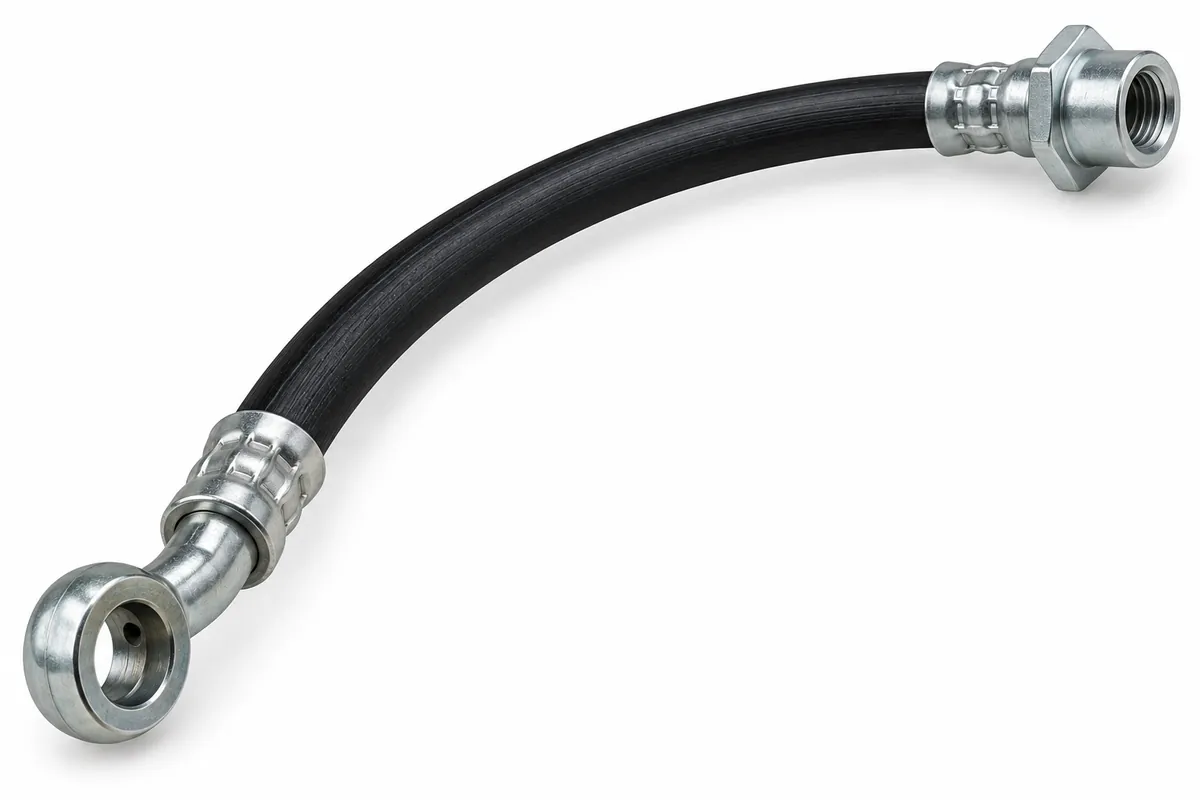
Mobile Brake Hose Inspection in Daytona Beach
A brake hose can fail externally or internally.
External problems may be visible as cracking, abrasion, swelling, damaged fittings, or brake-fluid leakage. Internal deterioration can be more difficult to identify because the outside of the hose may still appear normal.
For that reason, brake hose inspection isn't limited to looking for obvious leaks.
Depending on the symptoms, we evaluate the physical condition of the hose, its routing and connections, and whether hydraulic pressure appears to be reaching and releasing from the wheel brake correctly.
What Does a Brake Hose Do?
The hydraulic braking system has to carry pressure from the master cylinder to the brakes at each wheel.
Much of that distance can be covered by rigid brake lines, but rigid tubing cannot accommodate normal wheel and suspension movement.
That's where the flexible brake hose is used.
A typical hose connects the fixed hydraulic line on the vehicle body or chassis to a brake caliper or wheel-end brake assembly that moves with the suspension.
The hose must be able to:
- Contain hydraulic brake pressure
- Flex with suspension movement
- Accommodate steering movement where applicable
- Maintain unrestricted brake-fluid flow
- Withstand normal vibration and movement
- Remain sealed at both hydraulic connections
Damage that compromises any of these functions can affect braking.
Brake Hoses vs. Brake Lines
Brake hoses and brake lines are part of the same hydraulic system, but they are not the same component.
A brake hose is the flexible hydraulic section used where movement must occur.
A brake line is generally the rigid metal tubing that carries brake fluid along the vehicle's body, frame, or chassis.
Jimmy’s Mobile Care treats these as separate services because their failure modes, inspection procedures, and replacement methods differ.
This page covers flexible brake hoses.
Rigid hydraulic tubing, including rusted or damaged metal brake lines, is covered separately under our brake line inspection and replacement service.
Signs of a Bad Brake Hose
A damaged or restricted brake hose can produce different symptoms depending on how it has failed.
Possible signs include:
- Visible brake-fluid leakage
- Cracks or deterioration in the hose exterior
- Bulging or swelling
- Abrasion or chafing
- A brake that remains applied after releasing the pedal
- One wheel becoming unusually hot
- Vehicle pulling while braking
- Vehicle pulling after the brakes are released
- Uneven brake pad wear
- Reduced braking at one wheel
- Soft or abnormal brake pedal feel when fluid is leaking
- Falling brake-fluid level
- Brake warning light associated with hydraulic fluid loss
These symptoms do not automatically prove that the hose has failed.
A sticking caliper, hydraulic leak elsewhere in the system, or another brake problem can produce similar symptoms. We inspect and test the affected brake before recommending a hose.
Inspecting Brake Hoses for Cracks and Deterioration
Brake hoses operate close to the wheels, where they are exposed to heat, water, road debris, dirt, vibration, and repeated movement.
Over time, the outer covering can deteriorate.
We inspect accessible portions of the hose for conditions such as:
- Surface cracking
- Deep cracks
- Dry or deteriorated rubber
- Cuts
- Abrasion
- Exposed reinforcement
- Bulges
- Kinks
- Twisting
- Damage near fittings
Not every superficial mark means a hose has failed, but significant deterioration or damage can compromise the hose's ability to safely contain hydraulic pressure.
Brake Hose Abrasion and Chafing
A brake hose needs to follow the correct routing.
If it rubs against a tire, wheel, suspension component, body panel, or another part of the vehicle, repeated movement can gradually wear through its protective outer layer.
This can happen if:
- The hose is incorrectly routed
- A retaining bracket is missing or damaged
- A clip has not been installed correctly
- The wrong hose has been fitted
- Suspension or steering modifications change clearance
- The hose becomes twisted during installation
When abrasion is found, we don't only look at the damaged area. We determine why the hose contacted another component so the replacement hose isn't damaged the same way.
Bulging or Swollen Brake Hoses
A brake hose is designed to withstand substantial hydraulic pressure without expanding abnormally.
A visible bulge or swelling can indicate deterioration of the hose structure.
This is especially important because the hose contains reinforcement beneath its outer covering. Damage inside the hose may compromise its ability to resist pressure even if it has not started leaking yet.
A significantly bulging or structurally damaged brake hose should not be treated as a cosmetic problem.
Brake Fluid Leaking From a Brake Hose
Brake fluid should remain completely contained within the hydraulic system.
A leaking brake hose can reduce fluid level and eventually allow air into the system, affecting hydraulic brake operation.
We inspect for leakage around:
- The flexible portion of the hose
- Crimped hose ends
- Threaded connections
- Banjo-style connections
- Hose-to-line connections
Wetness needs to be identified correctly because brake fluid from another component can sometimes spread across nearby parts and make the hose appear to be the source.
The actual leak location should be confirmed before replacement.
Brake Hose Fittings and Connections
Brake hoses connect to the hydraulic system through fittings specifically designed for the vehicle's brake assembly.
Depending on the application, the hose may use threaded fittings, retaining clips, brackets, banjo fittings, sealing washers, or other connection methods.
We inspect the connections for:
- Brake-fluid leakage
- Corrosion
- Damaged threads
- Loose or damaged fittings
- Deteriorated sealing surfaces
- Missing or damaged retaining clips
- Physical damage around the hose end
The replacement hose needs to seal correctly at both ends and remain properly supported.
Brake Hose Banjo Bolt Connections
Many disc brake calipers use a banjo-style connection where the brake hose attaches to the caliper.
A hollow banjo bolt allows brake fluid to pass through the fitting and into the caliper.
Sealing washers are typically used at the connection to prevent hydraulic leakage.
When servicing this type of brake hose, the connection must be assembled correctly with the appropriate sealing components.
Reusing damaged sealing surfaces or incorrectly assembling the fitting can create a brake-fluid leak even when the new hose itself is good.
Internally Collapsed or Restricted Brake Hoses
One of the more deceptive brake hose failures happens inside the hose.
The internal lining can deteriorate, separate, or become restricted while the outside of the hose still appears acceptable.
Depending on the nature of the restriction, hydraulic pressure may reach the brake when the pedal is applied but may not release normally afterward.
The result can resemble a sticking or seized brake caliper.
Possible symptoms include:
- Brake drag
- One wheel becoming excessively hot
- Vehicle pulling after braking
- Rapid brake pad wear at one wheel
- Rotor overheating
- A wheel that remains difficult to rotate after the brake pedal is released
Because the hose may look normal externally, diagnosis is important.
Diagnosing a Restricted Brake Hose vs. a Sticking Caliper
A brake that remains applied is frequently blamed on the caliper, but the flexible brake hose can sometimes be responsible.
When the brake pedal is pressed, hydraulic pressure travels through the hose and applies the caliper.
If an internally damaged hose restricts fluid returning from the caliper, pressure can remain trapped at the wheel even after the pedal is released.
That can hold the brake partially applied.
When appropriate, diagnostic testing can help determine whether releasing hydraulic pressure changes the amount of brake drag.
If releasing trapped pressure allows the brake to release, the hydraulic supply—including the flexible hose—needs further evaluation.
If the brake remains mechanically seized after pressure is released, the diagnostic direction changes.
This distinction can prevent an unnecessary caliper replacement.
Can a Brake Hose Cause a Caliper to Stick?
A brake hose cannot mechanically seize the caliper piston, but an internal restriction can create symptoms that feel almost identical to a sticking caliper.
Pressure may apply the caliper normally but fail to release promptly.
The driver experiences a dragging brake, hot wheel, or pulling condition and assumes the caliper is stuck.
That is why Jimmy’s Mobile Care evaluates the hydraulic release of the brake when hose restriction is suspected rather than replacing the caliper based solely on the symptom.
Can a Bad Brake Hose Cause a Vehicle to Pull?
Yes, depending on the type of hose failure.
If a hose restricts hydraulic pressure going to one brake, that wheel may not develop the same braking force as the opposite side.
If a hose restricts hydraulic pressure returning from a brake, that wheel may remain partially applied.
Either condition can contribute to pulling, although several other brake, steering, suspension, and tire problems can also cause a vehicle to pull.
The direction of the pull alone isn't enough to diagnose a brake hose.
Can a Brake Hose Cause a Soft Brake Pedal?
A leaking or structurally compromised brake hose can affect pedal feel.
If the hose leaks brake fluid, the hydraulic system can lose pressure and eventually take in air.
A severely deteriorated hose that expands abnormally under pressure may also contribute to an abnormal pedal feel.
However, soft or spongy brake pedals have several possible causes, including air elsewhere in the hydraulic system.
We diagnose the hydraulic condition instead of assuming that pedal feel alone identifies a bad hose.
Front Brake Hose Inspection & Replacement
Front brake hoses have demanding operating conditions because they must accommodate both suspension travel and steering movement.
Every time the front wheels turn, the hose must move without:
- Stretching excessively
- Twisting
- Kinking
- Rubbing against the tire
- Contacting suspension components
- Pulling against its fittings
When replacing a front brake hose, correct routing is critical.
After installation, the hose needs sufficient movement through the steering and suspension range without contacting surrounding components.
Rear Brake Hose Inspection & Replacement
Rear brake hose arrangements vary significantly between vehicles.
Some use individual flexible hoses at each rear wheel. Others use a flexible hose between the vehicle body and rear axle, with additional hydraulic plumbing distributing pressure from there.
Independent rear suspension designs can use different hose configurations again.
We identify the vehicle's actual hydraulic layout before determining which flexible hose is responsible for the problem.
Rigid tubing attached to the axle or body remains a brake line, not a flexible brake hose, and is handled under the separate brake-line service.
Brake Hose Damage From Steering or Suspension Work
Brake hoses can sometimes be damaged during unrelated repairs if the caliper or suspension components are allowed to pull, twist, or hang from the hose.
A brake caliper should not be supported by the flexible hydraulic hose during service.
Excessive tension can damage the hose or its fittings even when the damage isn't immediately obvious.
If brake problems begin after wheel-end, suspension, bearing, axle, or brake work, hose condition and routing may need to be inspected.
Twisted Brake Hoses
A brake hose can sometimes be installed with a twist.
This is more than an appearance issue.
A twisted hose may not follow its intended path as the steering and suspension move. It can place unnecessary stress on the hose and fittings or cause the hose to contact nearby components.
When installing a replacement hose, we make sure it is correctly oriented and routed rather than simply tightening both ends wherever the hose naturally falls.
Brake Hose Replacement
Once inspection or diagnosis confirms that a flexible brake hose needs replacement, the hydraulic brake system must be opened.
The exact procedure varies by vehicle, but brake hose replacement can include:
- Confirming the hose problem. We identify external deterioration, leakage, structural damage, or evidence of an internal restriction.
- Inspecting the surrounding brake components. The caliper, pads, rotor, fittings, and related components are evaluated when the hose problem may have affected them.
- Identifying the hose routing. We note the correct path, brackets, clips, and orientation before removing the old hose.
- Disconnecting the hydraulic fittings. The hose is separated from the rigid brake line and caliper or applicable wheel-end component.
- Removing retaining clips or brackets. Supporting hardware is removed as required.
- Installing the replacement brake hose. The correct hose is routed without twisting, stretching, or contacting surrounding components.
- Restoring the hydraulic connections. Fittings and applicable sealing components are correctly installed.
- Bleeding the brake system. Air introduced when the hydraulic circuit was opened must be removed.
- Checking for leaks. Connections are inspected after hydraulic pressure has been restored.
- Checking hose routing and movement. Front hoses are checked for proper clearance through applicable steering movement, and all hoses are checked for correct positioning.
- Verifying brake operation. Pedal feel and brake operation are checked before the vehicle is returned to service.
Proper routing is just as important as making the hydraulic connection.
Why Brake Bleeding Is Required After Hose Replacement
Replacing a brake hose requires opening a hydraulic brake circuit.
Once the system is opened, air can enter.
Brake fluid transfers hydraulic force effectively because it is essentially incompressible under normal braking conditions. Air, however, compresses.
If air remains in the brake circuit, the driver can experience a soft or spongy pedal and reduced hydraulic response.
After brake hose replacement, the affected brake circuit must therefore be bled as required to remove trapped air.
Brake-fluid level is also checked and restored using the appropriate fluid for the vehicle.
Brake Hose Replacement and Brake Fluid
The replacement hose becomes part of a system containing hydraulic brake fluid.
The correct brake-fluid specification matters because vehicles may require different fluid types.
During hose replacement and bleeding, we use the appropriate brake fluid for the application.
If the existing fluid appears contaminated or another fluid-related problem is discovered, that condition can be addressed separately rather than assuming that hose replacement alone corrects it.
Does a Brake Hose Need to Be Replaced in Pairs?
Not automatically.
If one hose has been physically damaged or has a confirmed internal restriction while the hose on the opposite side remains in good condition, replacement may be limited to the failed hose.
However, the age and condition of the other hoses should still be considered.
If multiple hoses show significant age-related cracking, deterioration, or other unsafe conditions, additional replacement may be appropriate.
We base the recommendation on actual condition rather than automatically replacing every hose because one failed.
When Should Brake Hoses Be Replaced?
There is no single mileage interval that determines when every brake hose needs replacement.
Replacement may be appropriate when inspection or diagnosis identifies:
- Brake-fluid leakage
- Significant cracking
- Bulging or swelling
- Deep abrasion
- Exposed or damaged reinforcement
- Kinking
- Damaged fittings
- A confirmed internal restriction
- Incorrect or unsafe routing
- Physical damage
- Deterioration that compromises the hose
Age can justify closer inspection, but the actual condition of the hose determines the repair.
Can a Brake Hose Be Repaired?
A damaged hydraulic brake hose should not be treated like an ordinary low-pressure rubber hose.
It must safely contain brake-system pressure while repeatedly flexing with vehicle movement.
When the flexible hydraulic hose itself is leaking, structurally damaged, or internally restricted, the appropriate repair is generally replacement with the correct brake hose assembly.
Temporary patches, clamps, or improvised hose repairs are not appropriate substitutes for a proper hydraulic brake hose.
How Much Does Brake Hose Replacement Cost?
Brake hose replacement cost varies depending on the vehicle, hose location, connection design, and condition of the surrounding components.
Factors can include:
- Vehicle year, make, and model
- Front or rear hose
- Hose design and length
- Accessibility
- Condition of hydraulic fittings
- Corrosion at connections
- Caliper connection design
- Required sealing hardware
- Brake-fluid requirements
- Bleeding procedure
- Additional damage caused by a dragging brake
A straightforward front brake hose replacement can be very different from servicing a hose with heavily corroded fittings or repairing damage caused by prolonged brake drag.
Call Jimmy’s Mobile Care at (386) 308-2509 with your vehicle information and symptoms, and we can discuss the brake hose inspection and replacement your vehicle may require.
Why Inspect the Brake Hose Before Replacing It?
Several brake problems can produce symptoms similar to hose failure.
Inspection and diagnosis help answer the questions that determine the repair.
Is the Hose Leaking?
We inspect the flexible section, crimped ends, and hydraulic connections for actual brake-fluid leakage.
Is the Hose Structurally Damaged?
Cracking, bulging, abrasion, exposed reinforcement, or kinking can make replacement necessary even before a leak develops.
Is the Hose Restricted Internally?
A hose can look acceptable externally while restricting hydraulic fluid internally.
Is the Caliper Actually Sticking?
A mechanically seized caliper and a hose trapping hydraulic pressure can both create a dragging brake, but the required repairs are different.
Is the Hose Routed Correctly?
Twisting or contact with the wheel or suspension can damage an otherwise good hose.
Is the Problem Actually in a Rigid Brake Line?
If the leak or restriction is in the vehicle's metal hydraulic tubing rather than the flexible wheel hose, it belongs to the brake-line system and requires a different repair.
Determining exactly which hydraulic component has failed helps prevent unnecessary parts replacement.
Mobile Brake Hose Replacement in Daytona Beach
Jimmy’s Mobile Care brings brake hose inspection and replacement directly to your Daytona Beach location.
If you've noticed brake-fluid leakage, a cracked or damaged flexible hose, a dragging brake, an unusually hot wheel, or another symptom that could involve a restricted brake hose, we can inspect the system at your home, workplace, or another suitable location.
When inspection confirms that a flexible brake hose needs replacement and the repair can be safely completed on-site, we can replace the hose, bleed the affected hydraulic circuit, check for leaks, and verify brake operation without the traditional repair-shop visit.
Schedule Brake Hose Inspection & Replacement in Daytona Beach
A brake hose can fail visibly through cracking, swelling, abrasion, or leakage—or internally where the damage cannot be identified by appearance alone.
Jimmy’s Mobile Care inspects the flexible brake hose and directly related hydraulic components to determine whether the hose is damaged, leaking, or restricting brake-fluid movement before recommending replacement.
Call Jimmy’s Mobile Care at (386) 308-2509 to schedule car brake hose inspection and replacement in Daytona Beach, FL. Call today and we'll come to your location.